The Study · Explainer
AI agents buy through your own checkout, and disputes still land on you
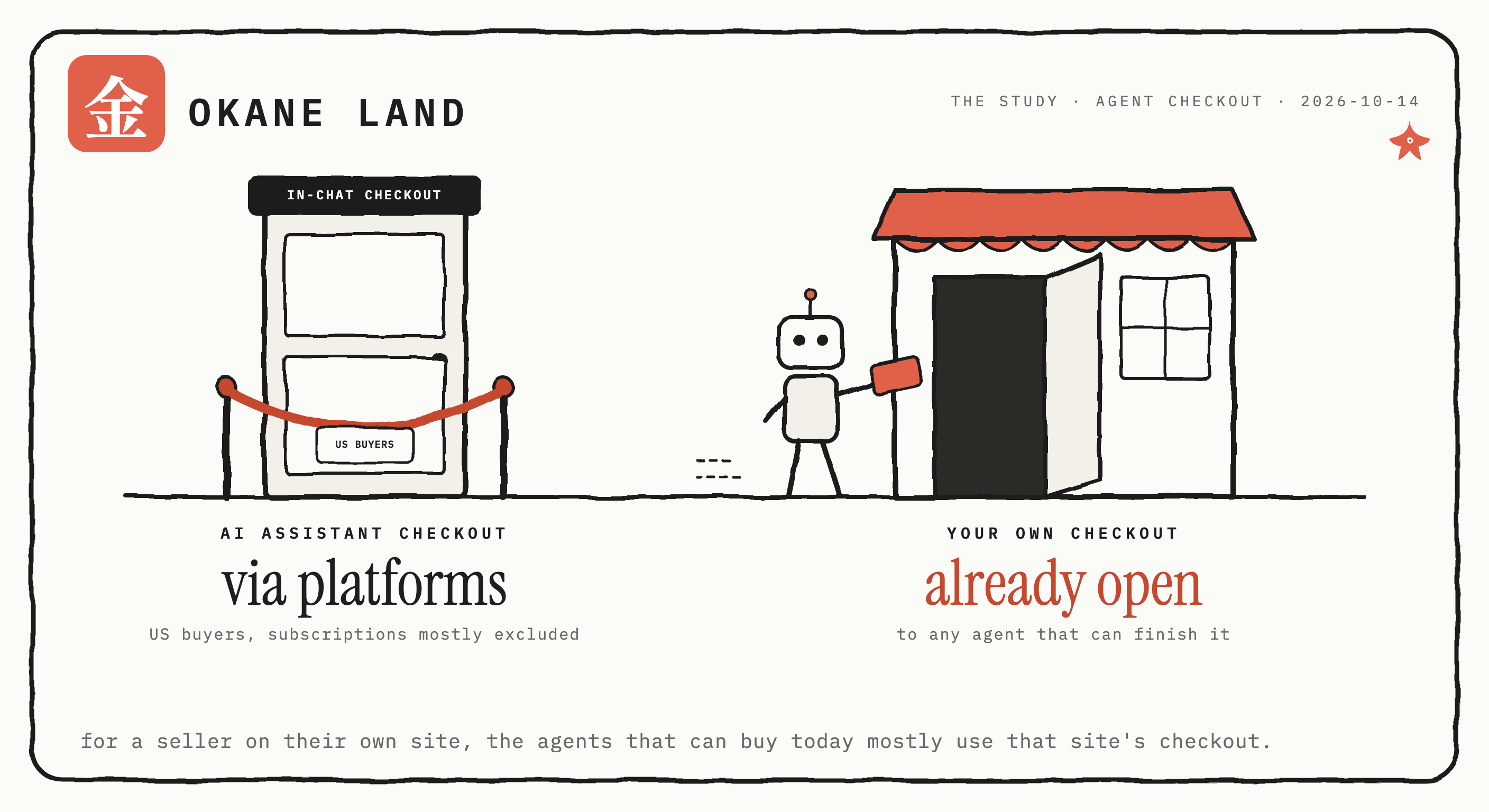
In March, OpenAI stepped back from the checkout it had built into ChatGPT six months earlier. Its announcement said the first version “did not offer the level of flexibility that we aspire to provide,” and ChatGPT now sends shoppers to finish on the merchant’s own site.
For a one-person seller on their own site, the agents that can buy from you today mostly do it the way a person does: on your own checkout page, through your own payment provider, with the usual card disputes still landing on you.
We read the merchant pages and terms of the main assistants that buy, the protocols underneath and the card networks’ rules, and checked what a small seller can switch on now.
The short version
- OpenAI’s in-chat checkout is shrinking; Google’s and Microsoft’s are growing. OpenAI’s merchant page says it is “moving away from a standalone Instant Checkout experience.” Google’s and Microsoft’s in-chat checkouts sell to US buyers and reach small sellers mainly through Shopify, Etsy, PayPal or Stripe.
- The in-chat checkouts we checked exclude subscriptions or say nothing about them. ChatGPT’s plugin rules allow commerce “only for physical goods,” Google’s checkout and Shopify’s Copilot checkout leave subscriptions out, and digital downloads appear mainly through marketplaces such as Etsy.
- If you sell from your own site, the agents mostly come to your checkout. Amazon’s Buy for Me, Meta’s Muse, OpenAI’s dots and Gemini’s Task agent buy on merchants’ own sites. Muse pays instantly at the more than 1 million businesses that accept Stripe’s Link.
- Disputes still land on you. Visa’s rules make the cardholder answerable for an agent’s actions and forbid merchants to require buyers to waive dispute rights. No network has shifted liability for agent purchases, and Stripe’s seller terms leave disputes, refunds and transaction fraud with the seller.
- AI still sends little traffic. In a Frankfurt School study of 973 online shops from August 2024 to July 2025, chatbots referred under 0.2% of visits. Ten Shopify stores tracked by an agency took 0.12% of their revenue from AI assistants this year.
- Buyers hesitate. In a YouGov poll, 14% of Americans trusted AI to place orders for them. In an NMI survey, 70% said they must be able to review or override a purchase first.
- The useful work is on your own site. A checkout an agent can finish, product pages with plain prices, search crawlers let in and dispute evidence kept. Use your platform’s in-chat channel when it covers what you sell.
Everything below is the evidence, read on October 14 from the programs’ own pages, the protocols and the card networks’ rulebooks.
Three ways an agent can pay you
“An AI agent buys from you” covers three different things, and the one open to every seller is the one that runs on your own site.
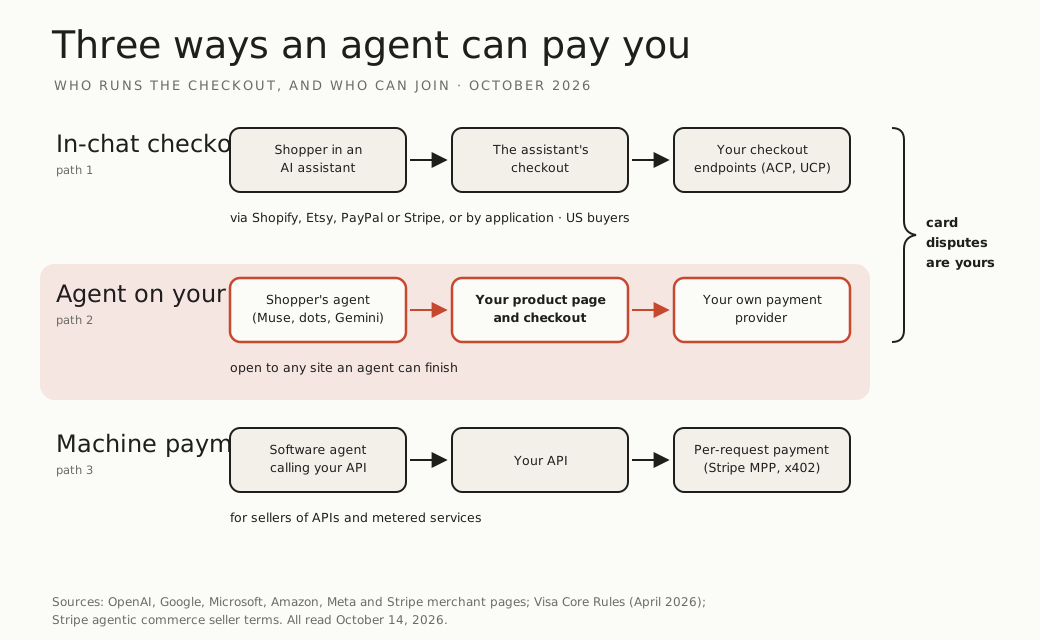
In the first, the assistant runs the checkout and calls your systems through a protocol: the Agentic Commerce Protocol (ACP, from OpenAI and Stripe) or the Universal Commerce Protocol (UCP, from Google and Shopify). In the second, the shopper’s agent opens your site and fills in your checkout the way a browser would. In the third, a software agent pays per request for an API, through the Machine Payments Protocol (from Stripe and Tempo) or the x402 standard. A seller of downloads, courses or subscriptions on their own site mostly lives in the second.
The in-chat checkouts, and who they take
| Program | Status in October 2026 | Who can sell | Fee stated | Subscriptions |
|---|---|---|---|---|
| ChatGPT, Agentic Commerce Protocol | in-chat checkout scaled back; product discovery live in the US | Shopify and Etsy catalogs; others apply and wait | none on purchases that start in ChatGPT | not through plugins |
| Google AI Mode and Gemini, Universal Commerce Protocol | live in the US | Merchant Center sellers Google approves, or sellers connected through a platform such as Shopify | none stated | excluded |
| Microsoft Copilot Checkout | rolling out since January 8, 2026, a pilot for some merchants | English-language merchants selling to US buyers, through PayPal, Shopify or Stripe | no commission or affiliate fee | not in Shopify’s Copilot checkout; no rule found for other routes |
| Perplexity Instant Buy | live in the US with PayPal | merchants on BigCommerce, Shopware and Wix, among others | none found | no rule found |
The platforms are the front door. Shopify switches eligible stores into the AI channels by default, including direct checkout in Copilot, and its Agentic plan lets brands that do not run on Shopify list products in the same channels. At Copilot Checkout’s January launch, Stripe said US users would be able to buy from Etsy businesses in the chat. Stripe said at the launch of its Agentic Commerce Suite that platforms including Squarespace, Wix, WooCommerce and BigCommerce would use it, and a seller on Stripe directly can upload a catalog and request a connection to each agent, which the agent has to accept. Each Shared Payment Token, the credential an agent passes to the seller, costs 15 cents to issue, and Stripe’s pricing page does not say who pays it.
A custom site has no shortcut. The Agentic Commerce Protocol’s own site says implementing it lists your products nowhere, because “each AI platform will manage their own process” for who participates. OpenAI takes direct feeds by application and waitlist, and Google’s checkout runs on its approval. Google says its protocol already enables direct checkout for hundreds of thousands of brands and retailers, and in early 2026 Shopify told Forrester about 30 merchants were live with native ChatGPT checkout, against The Information’s count of a dozen.
The agents that use your checkout
The agents a seller on their own site can meet today mostly buy on that site.
- Amazon Buy for Me completes purchases on the merchant’s website, and Amazon may list a merchant’s products using public information from its site. Amazon’s FAQ says merchants do not currently pay and Amazon takes no referral fee; sellers opt in with a feed or opt out by email.
- Meta’s Muse, launched in September, pays instantly wherever the seller takes Stripe’s Link, using the shopper’s saved payment method; elsewhere it uses a single-use virtual card or signs in with the shopper’s saved card. On Shopify stores it can also check out inside Muse.
- OpenAI’s dots, which began rolling out at the end of September for Pro, Business Premium and Enterprise users, can buy with a card the user saved on a merchant’s website, with the user’s approval.
- Gemini’s Task agent and Chrome’s auto browse shop on a broad range of sites, and may ask the user to take control to enter payment details. Chrome’s version is US-only and needs a paid AI Pro or Ultra plan.
None of these needs a protocol from you. What decides whether they finish is your checkout: whether it allows a guest purchase, whether it offers a saved wallet the agents use, such as Link or Google Pay, and whether a bot wall stops a signed agent before it reaches the payment form.
The protocols underneath
The protocols behind the buttons are young and still converging. ACP is open source and still in beta. UCP’s governing council is Google and Shopify, joined by Stripe in April. Google’s Agent Payments Protocol (AP2), announced in September 2025, reached version 0.2 in April and moved to the FIDO Alliance; we found no live Google product using it.
The card networks work a layer lower, with signed HTTP requests that let a merchant’s network provider recognize an agent. Mastercard’s Agent Pay builds on Web Bot Auth, and Visa’s Trusted Agent Protocol is aligned with it. Visa’s specification says merchants are not required to adopt it, and Mastercard tells merchants to switch it on at their content delivery network with no code changes. Cloudflare has counted signed agents as verified bots since July 1, with one warning for agents that act for many people: “you may trust the intermediary operator, but not necessarily every end user driving it.” For a small seller, the practical job is to check that the bot settings of your host or network provider let verified agents through.
Who pays when the agent gets it wrong
No card network has moved the risk of agent purchases onto the agent. Visa’s rulebook (the April 2026 edition, with agent rules added in October 2025) treats the registered provider of an agent payment as the cardholder for that transaction, and makes the cardholder responsible for the agent’s actions as if they had made the purchase themselves. It forbids a merchant to require a cardholder to waive the right to dispute, agent purchases included, and its dispute chapter has no separate condition for agents. The one agent change there helps sellers a little: from October 24, 2026, an agent provider’s login ID can be one of the matching details a seller shows to contest a fraud dispute under Visa’s Compelling Evidence 3.0 rules, alongside device or IP data from earlier undisputed orders.
Mastercard’s merchant guide says standard fraud detection, chargeback rights and dispute processes apply to agent purchases. Under existing rules, fraud on a properly authenticated, tokenized payment generally falls on the card issuer; what stays with a small seller is fraud on unauthenticated payments and every dispute short of fraud. Stripe’s seller terms make the seller the merchant of record, responsible for disputes and refunds and for managing transaction fraud. Worldpay puts the state of play in one line: “No liability shift exists yet.”
What the network rules have not settled is the purchase that was authorized but wrong, when the agent bought what the shopper did not mean. Two companies have started on it from the other side. Stripe’s terms for agent operators make them answerable to Stripe for purchases caused by bugs, hallucinations or misinterpretations, and American Express has announced a future protection for its cardholders when a purchase strays from the intent they approved. Neither changes what a seller faces when the chargeback arrives.
How much buying happens this way
The traffic is growing from a small base. Adobe, which measures more than a trillion visits to US retail sites, reports steep growth in visits sent by AI assistants and says those visitors converted at a 60% higher rate than other traffic in July 2026, after converting worse a year earlier; it does not publish their share of all traffic. Researchers at Frankfurt School, looking at 973 online shops, found chatbot referrals under 0.2% of traffic between August 2024 and July 2025, before most of these programs launched. Ethercycle, a Shopify agency, counted 0.10% of sessions and 0.12% of revenue from AI assistants across ten established Shopify stores from January to August 2026, $131,000 out of $109.6 million, and found direct handoffs from an agent to checkout effectively at zero. These are referral figures; nobody publishes how many purchases agents complete.
Shoppers are cautious about letting agents pay. In YouGov’s poll, about 65% of Americans said they trusted AI to compare prices and far fewer would let it put an order through. In NMI’s August survey of 1,000 US adults, 11% had used AI to complete a transaction, and seven in ten wanted the final say before any purchase went through. The forecasts run far ahead of the measurements: Morgan Stanley puts agent-driven shopping at $190 billion to $385 billion in the US by 2030, and McKinsey at up to $1 trillion of US consumer sales orchestrated by agents.
Digital products and subscriptions
The live programs were built for physical retail. OpenAI’s plugin rules bar selling subscriptions, digital content, tokens or credits through ChatGPT plugins. Google leaves subscriptions, services such as online classes, virtual items and goods that need software installed first out of its checkout; its shopping listings allow software subscriptions only when they are prepaid and renew annually. Shopify’s help pages exclude subscriptions from the direct checkouts in Copilot and in Google AI Mode and Gemini, and its agent catalog leaves out subscription services.
The protocols themselves are wider. ACP describes support for digital goods and subscriptions, OpenAI’s product feed has a flag for digital items, and Stripe’s agentic tools accept sellers of digital content and APIs. Etsy is the clearest documented case of digital items sold this way: its help center explains how to download a digital item bought through Gemini, Google AI Mode or Copilot, and still lists ChatGPT. We found no documented case of an AI agent buying a software subscription for a user. The nearest thing is metered: the Machine Payments Protocol launched in March with sellers such as Browserbase, which charges agents per browser session.
What to do this month
- Make your checkout finishable by an agent. Allow guest purchase, offer a saved wallet the agents use, such as Stripe’s Link or Google Pay, and keep account creation after payment.
- Put plain facts on product pages. Price, currency and availability in the page itself, with schema.org Product and Offer markup. Google says its AI features need no special AI files or markup beyond what search already uses.
- Let the search crawlers in. OpenAI’s OAI-SearchBot decides whether you appear in ChatGPT’s search answers; GPTBot controls training and can be set separately.
- Check your bot settings. Make sure your host or network provider passes verified, signed agents through to checkout.
- Keep dispute evidence. Order confirmations, login IDs, delivery addresses, IP addresses and device data. From October 24, 2026, an agent provider’s login ID can be one of the matching details in a Visa fraud dispute.
- Join an in-chat program only if it takes your product. Physical goods for US buyers: switch it on through your platform or payment provider, such as Shopify, Etsy, PayPal or Stripe’s Agentic Commerce Suite. Subscriptions: wait, since none of the checkouts we read lists them as supported. Downloads: so far mostly via marketplaces like Etsy. An API: look at per-request machine payments.
One email, when there's something worth sending
Get the research in your inbox.
No fixed schedule, no filler. You get an email when we've tested something, run the numbers, or found a tool worth your time.
Free. Double opt-in, unsubscribe in one click.
Got numbers of your own? Get the research →
Sources & how we researched this
- OpenAI, "Powering product discovery in ChatGPT" (March 24, 2026), read 2026-10-14: the first version of Instant Checkout did not offer the flexibility OpenAI wanted, so merchants now use their own checkout while OpenAI focuses on discovery. openai.com/index/powering-product-discovery-in-chatgpt
- ChatGPT merchants page and FAQ, read 2026-10-14: moving away from standalone Instant Checkout, purchases completed on merchant-owned websites or apps, US only, Shopify and Etsy catalogs already integrated, other feeds by application and waitlist, no fees on purchases that start in ChatGPT. chatgpt.com/merchants
- OpenAI plugin guidelines, read 2026-10-14: plugins may conduct commerce only for physical goods; subscriptions, digital content, tokens and credits are not allowed. developers.openai.com/plugins/plugin-guidelines
- Agentic Commerce Protocol site and OpenAI commerce docs, read 2026-10-14: ACP, developed by Stripe and OpenAI, is open source and in beta; implementing it does not list a business on any agent; feed fields, the digital-goods flag and checkout endpoints. agenticcommerce.dev, developers.openai.com/commerce
- OpenAI Help Center, dots privacy, security and safety FAQ, read 2026-10-14: dots can buy with a card saved on a merchant's website, with the user's approval. help.openai.com/en/articles/20001529
- Google, Universal Commerce Protocol merchant docs, Merchant Center onboarding and US Checkout Addendum, read 2026-10-14: US checkout in AI Mode and Gemini for merchants Google approves or that connect through a platform, three checkout endpoints, the Google Pay wallet, and the exclusion of subscriptions, services, virtual items and goods that need software installed. developers.google.com/merchant/ucp, support.google.com/merchants/answer/16992327
- Google, "Shopping updates for the holidays" (September 16, 2026), read 2026-10-14: UCP already enables direct checkout for hundreds of thousands of brands and retailers. blog.google/products-and-platforms/products/shopping/google-shopping-updates-holiday-shopping
- Google blog on donating the Agent Payments Protocol to the FIDO Alliance (April 28, 2026) and the AP2 site, read 2026-10-14: AP2 v0.2 and its move to FIDO; no live Google product confirmed using it. blog.google, ap2-protocol.org
- Google Gemini help, Tasks (formerly Spark), and Chrome auto browse help, read 2026-10-14: agents that shop on a broad range of sites and may ask the user to take control to enter payment details. support.google.com/gemini/answer/17094507
- Microsoft Advertising, agentic commerce and Copilot Checkout, read 2026-10-14: rolling out in the US since January 8, 2026, with the Merchant Center setting marked as a pilot; English-language merchants selling to US buyers; onboarding through PayPal, Shopify or Stripe, with Shopify merchants enrolled automatically; no commission or affiliate fee. about.ads.microsoft.com/en/solutions/technology/agentic-commerce
- Shopify Help Center, agentic storefronts, and Shopify's Agentic plan announcement (March 2026), read 2026-10-14: on by default for eligible stores; direct checkout in Copilot and in Google AI Mode and Gemini excludes subscriptions, bundles, customizable and B2B-only products; brands not on Shopify can sell through the Agentic plan. help.shopify.com/en/manual/online-sales-channels/agentic-storefronts, shopify.com/news/agentic-commerce-momentum
- Perplexity Help Center, "What is Instant Buy?", read 2026-10-14: purchases with PayPal for US users at merchants including Wayfair, Abercrombie & Fitch and thousands on BigCommerce, Shopware and Wix. perplexity.ai/help-center
- Amazon, Shop Direct merchant FAQ and Buy for Me terms, read 2026-10-14: Buy for Me completes purchases on the merchant's own website; merchants do not currently pay and Amazon takes no referral fee; opting in or out by email. amazon.com
- Meta, "Introducing Muse" (September 8, 2026), and Stripe's Link announcement, read 2026-10-14: Muse checks out instantly at more than 1 million businesses that accept Link, otherwise with a single-use virtual card. about.fb.com/news/2026/09/introducing-muse-personal-ai-agent
- Stripe, Agentic Commerce Suite launch release, docs and agentic commerce terms (Preview, last modified September 28, 2026), read 2026-10-14: setup steps; platforms including Squarespace, Wix, WooCommerce and BigCommerce named as future users; the seller as merchant of record handling disputes, refunds and transaction fraud; the agent operator answerable to Stripe for purchases caused by bugs, hallucinations or misinterpretations. stripe.com/newsroom, docs.stripe.com/agentic-commerce, stripe.com/legal/ssa-service-terms
- Stripe pricing, read 2026-10-14: $0.15 per Shared Payment Token issued, with no payer stated. stripe.com/pricing
- Stripe, "Machine Payments Protocol" (March 18, 2026), read 2026-10-14: a protocol co-authored by Stripe and Tempo for per-request payments by software agents, with Browserbase and Parallel as early sellers. stripe.com/blog/machine-payments-protocol
- Visa Core Rules and Visa Product and Service Rules, April 18, 2026 edition (agent rules last updated October 2025), read 2026-10-14: agentic transaction definitions for registered agent providers, cardholder responsibility for an agent's actions, the bar on requiring a dispute waiver, and the Compelling Evidence 3.0 update for agent provider login IDs from October 24, 2026. usa.visa.com/dam/VCOM/download/about-visa/visa-rules-public.pdf
- Visa, Trusted Agent Protocol press release, developer docs and specification (October 14, 2025), read 2026-10-14: an optional protocol, aligned with Web Bot Auth, for merchants to recognize signed agent requests. developer.visa.com
- Mastercard, Agent Pay acceptance framework and merchant developer guide, read 2026-10-14: Web Bot Auth at the CDN with no new code, and standard chargeback rights and dispute processes applying to agentic transactions. developer.mastercard.com
- American Express, agentic commerce page, read 2026-10-14: an Agent Purchase Protection described as coming in the future, for purchases that deviate from the intent the cardholder authenticated. americanexpress.com/en-us/company/agentic-commerce
- Worldpay, "Agentic commerce liability is still being written" (July 30, 2026), read 2026-10-14: no liability shift yet; fraud on authenticated tokenized transactions generally rests with the issuer; disputes short of fraud unresolved. worldpay.com/en/insights
- Cloudflare, verified bots and Web Bot Auth docs (updated October 8, 2026), read 2026-10-14: signed agents counted as verified since July 1, 2026, and the trust caveat for intermediary agents. developers.cloudflare.com/bots
- Frankfurt School of Finance & Management, press release on Kaiser and Schulze, ChatGPT referrals to e-commerce (June 22, 2026), read 2026-10-14: 973 online shops, August 2024 to July 2025, LLM referral traffic under 0.2 percent of the total. frankfurt-school.de
- Ethercycle, State of Ecommerce 2026 (updated September 20, 2026), read 2026-10-14: ten established Shopify stores; AI assistants sent 0.10 percent of sessions and 0.12 percent of revenue from January to August 2026. Agency research. ethercycle.com/pages/state-of-ecommerce-2026
- Adobe, AI traffic trends report (August 19, 2026), read 2026-10-14: AI-referred retail visitors converted at a 60 percent higher rate than other traffic in July 2026. business.adobe.com
- Forrester, "What it means that the leader in agentic commerce just pulled back" (March 7, 2026), read 2026-10-14: Shopify's count of about 30 merchants live, against The Information's dozen. forrester.com/blogs
- Etsy Help Center and Etsy news (May 5, 2026), read 2026-10-14: downloading a digital item bought through ChatGPT, Gemini, Google AI Mode or Copilot. help.etsy.com
- YouGov, "American trust in AI for retail" (poll fielded December 2025), read 2026-10-14: 14 percent trust AI to place orders on their behalf, about 65 percent to compare prices. yougov.com
- NMI consumer research (August 26, 2026), read 2026-10-14: 1,000 US adults; 11 percent have used AI to complete a transaction; 70 percent must be able to review or override before a purchase. nmi.com
- Morgan Stanley (December 8, 2025) and McKinsey (October 17, 2025) forecasts for agent-driven shopping by 2030, read 2026-10-14. morganstanley.com, mckinsey.com
- OpenAI crawler documentation, read 2026-10-14: OAI-SearchBot, ChatGPT-User and GPTBot, and what blocking each one does. developers.openai.com/api/docs/bots
- Google Search Central, AI features and your website, and Product and merchant listing structured data, read 2026-10-14. developers.google.com/search