The Ledger · Selling
Stripe or a merchant of record: the checkout decision
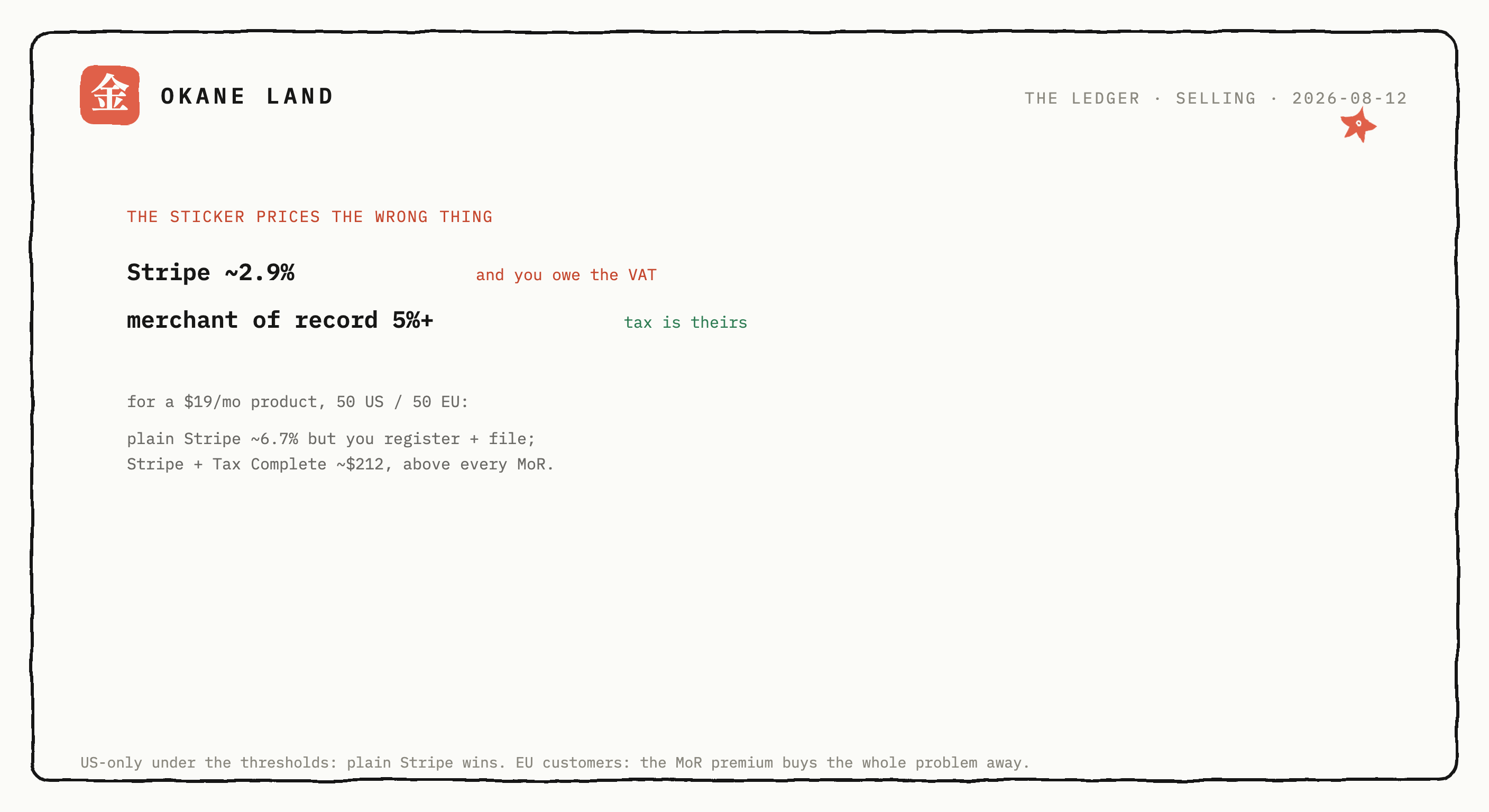
In 2024 the SaaStr founder learned that a payment processor and a merchant of record are not the same product, the hard way, through a tax bill. It is the lesson under every “Stripe or Paddle” thread and almost none of them price it: the 2.9%-versus-5% comparison everyone starts with is comparing the wrong thing. The real product is who is legally the seller, because that decides who owes the sales tax, files the returns, and inherits the liability when a tax authority comes asking.
We priced it end to end for a reference product, from each platform’s own pages read on 12 August 2026. We processed nothing; every number is a published rate, and the point is not the cheapest sticker but which total actually lands on you once the tax is counted.
The short version
- Stripe is the cheapest processor and makes you the merchant of record. At about 2.9% you keep more of each payment, and you owe the VAT, register for it, and file it. The low rate is real; so is the paperwork behind it.
- Paddle, Lemon Squeezy, Polar, and Gumroad are merchants of record. They charge 5% and up, and in exchange they are the legal seller: they collect, remit, and file the tax, and the liability is theirs.
- The decision is a trade, not a ranking. For a US-only seller under the nexus thresholds, plain Stripe is cheapest and the tax argument mostly evaporates. The moment you sell to the EU, a non-EU seller owes VAT from the first sale, and the merchant-of-record premium buys that whole problem away.
- Every rate here is dated, and the fees move. Polar repriced its tiers on 27 May 2026; treat any checkout rate as a thing to re-read before you commit, not a constant.
Processor versus merchant of record
This is the structural fact the sticker hides. A payment processor moves money and leaves you as the seller of record; Stripe’s own Tax product exists precisely to help you, the seller, monitor thresholds and calculate what you owe. A merchant of record becomes the legal seller to your customer, so the tax obligation is theirs, not yours. That single distinction is what you are actually buying at 5% instead of 2.9%: not a better checkout, a transfer of liability.
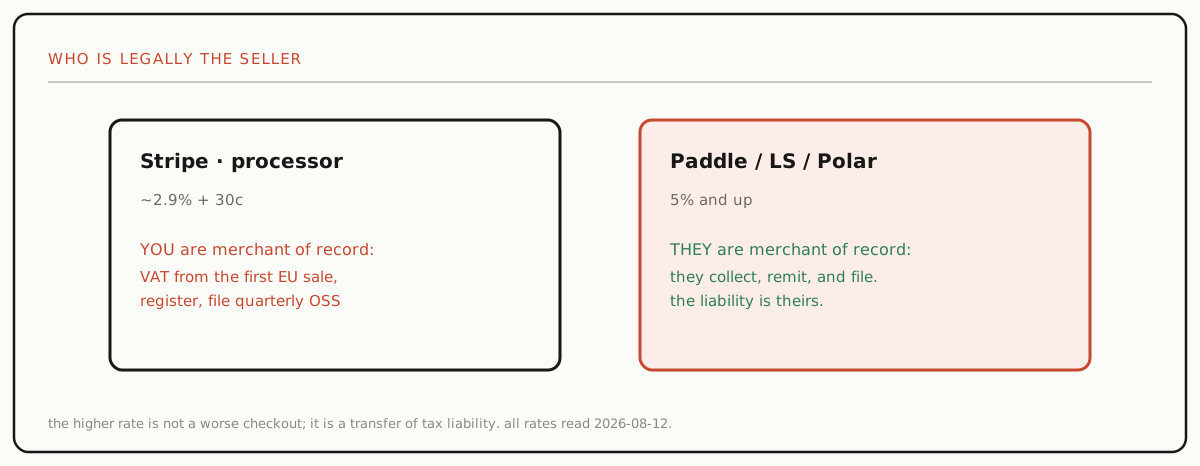
The tax you inherit as seller of record has sharp edges. For EU customers, VAT is due where the customer lives, and the EUR 10,000 small-seller threshold applies only to suppliers established inside the EU, so a US or UK solo seller owes VAT from the very first EU sale and files quarterly non-Union OSS returns. On the US side, economic-nexus thresholds like South Dakota’s $100,000 mean a small product often owes nothing yet, which is exactly why the answer depends on where your customers are.
The reference product, stated once
A fee table is meaningless without its assumptions, so here they are, printed before the numbers: a US-based sole seller, a $19/mo product priced in USD tax-exclusive, 100 subscribers split 50 US and 50 EU, all card payments, no US sales tax collected because roughly $22,800 a year sits under the nexus thresholds, and EU VAT modeled at a representative 20% though real rates run 17-27%. Monthly card volume is $1,900. Change any of these and the table moves; the method survives, the totals do not.
The fee table, six ways
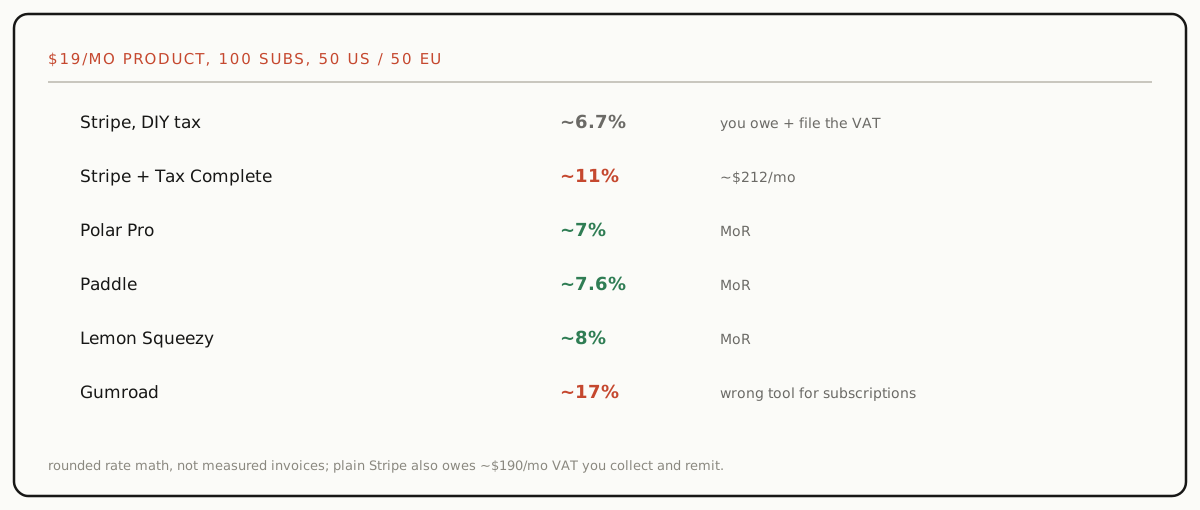
Rounded to the nearest dollar, because these are rate calculations, not measured invoices.
| Option | Who owes the tax | Roughly per month | Effective rate |
|---|---|---|---|
| Stripe, DIY tax compliance | You | ~$128 (cards + Billing + Tax Basic) | ~6.7% |
| Stripe + Tax Complete | You (filings outsourced) | ~$212 (from $90/mo add-on) | ~11% |
| Stripe Managed Payments | Stripe | cards + 3.5% | ~10% |
| Paddle | Paddle | ~$145 (5% + 50c) | ~7.6% |
| Lemon Squeezy | Lemon Squeezy | ~$150 (5% + 50c + surcharges) | ~8% |
| Polar Pro ($20/mo) | Polar | ~$132 ($20 + 3.8% + 40c) | ~7% |
| Gumroad | Gumroad | ~$325 (12.9% + 80c) | ~17% |
Read the Stripe rows carefully, because they are the trap. Plain Stripe at about 6.7% looks like the clear winner, but that row does not include the VAT itself (roughly $190 a month on the EU half at 20%, which you collect and remit) or the hours of registering and filing. Add Tax Complete to outsource the filings and Stripe lands near $212 a month, above every merchant-of-record option; and that $90 add-on is “starting at,” volume-tiered, so treat the $212 as an estimate, not a quote. The merchant-of-record platforms fold the tax and the filing into their 5%-and-up, which is why their sticker is higher and their all-in, for a seller with EU customers, is often lower.
What the table hides
Three things the totals paper over. The fee bases differ: Lemon Squeezy and Polar document that their percentage is charged on the tax-inclusive total, so a 20% VAT slightly enlarges the base the fee applies to, while Paddle and Gumroad quote against the product price. The surcharges are real: Lemon Squeezy’s own worked example shows a $2.06 fee on a $20 product sold into France, because it includes the +1.5% international card surcharge. And Gumroad’s roughly 12.9% all-in makes it the wrong tool for a recurring subscription, however convenient it is for a one-off digital sale.
Fee schedules move under you
The reason to date every rate is that they change. Polar repriced on 27 May 2026: organizations created on or after that date start at 5% + 50c, while the older 4% + 40c Early Member rate is grandfathered, with a documented catch that upgrading to any paid tier retires Early Member permanently. That is one platform in one quarter. Whatever you read here, re-open the pricing page before you wire your checkout to it, the same discipline our B2B pricing guide applies to your own numbers.
Which one, by profile
The verdict is a fork, not a favorite. If you are US-only and under the nexus thresholds, plain Stripe is cheapest and the merchant-of-record premium is buying you a problem you do not have yet. The moment you have EU customers, or you simply refuse to spend your evenings on OSS returns, a merchant of record at 5%-and-up is the genuinely cheaper option once the tax and the filing labor are counted, and Polar’s paid tier or Paddle are the closest to Stripe’s rate among them. Price it against your own customer mix and your own tolerance for tax admin, because that, not the front-page percentage, is the real decision, and it is the collect-the-money step that our pricing and unit-economics work assumes you have already solved.
One email, when there's something worth sending
Get the research in your inbox.
No fixed schedule, no filler. You get an email when we've tested something, run the numbers, or found a tool worth your time.
Free. Double opt-in, unsubscribe in one click.
How do you actually collect the money? Compare notes in the forum ↗
Sources
| Source | Link |
|---|---|
| Stripe pricing (read 2026-08-12): cards 2.9% + 30c domestic, +1.5% international, +1% currency conversion; Billing 0.7% of billing volume; Tax Basic 0.5% per transaction where registered, Tax Complete from $90/mo on a one-year contract; Stripe Managed Payments (its merchant-of-record option) adds 3.5% on top of payment fees across 75+ countries. | stripe.com ↗ |
| Paddle pricing (read 2026-08-12): 5% + 50c per checkout transaction, no monthly or migration fee, merchant of record with tax registration, filing, and remittance included; products under $10 require custom pricing. | paddle.com ↗ |
| Lemon Squeezy pricing and fees docs (read 2026-08-12): 5% + 50c per transaction, no monthly fee, merchant of record; surcharges of +1.5% international, +1.5% PayPal, and +0.5% on subscriptions, charged on the tax-inclusive total (their example shows a $2.06 fee on a $20 product sold into France, which includes the international surcharge). | lemonsqueezy.com ↗ |
| Polar fees (read 2026-08-12): merchant of record; Starter free at 5% + 50c, Pro $20/mo at 3.8% + 40c, Growth $100/mo at 3.6% + 35c, Scale $400/mo at 3.4% + 30c, +1.5% on non-US cards, fee on the tax-inclusive total; orgs created before 2026-05-27 keep a grandfathered 4% + 40c rate, but upgrading to any paid plan retires it permanently. | polar.sh ↗ |
| Gumroad pricing (read 2026-08-12): 10% + $0.50 platform fee plus card processing of 2.9% + $0.30, so roughly 12.9% + 80c all-in on a direct sale; merchant of record since 2025-01-01. | gumroad.com ↗ |
| EU VAT on cross-border B2C digital services: the EUR 10,000 threshold applies only to suppliers established in one EU member state; a non-EU seller owes VAT from the first B2C sale and files quarterly non-Union OSS returns. US example: South Dakota's economic-nexus threshold is $100,000 in-state (the reference product at about $22,800/yr sits under it). | vat-one-stop-shop.ec.europa.eu ↗ |
Show your work: if a number can't be shown, we don't print it.