The Ledger · Pricing
How to price a B2B SaaS
Roughly 72 percent of new products miss their revenue goals, by Simon-Kucher’s count, and pricing is a leading cause of the misses. Most founders spend that worry on the digits.
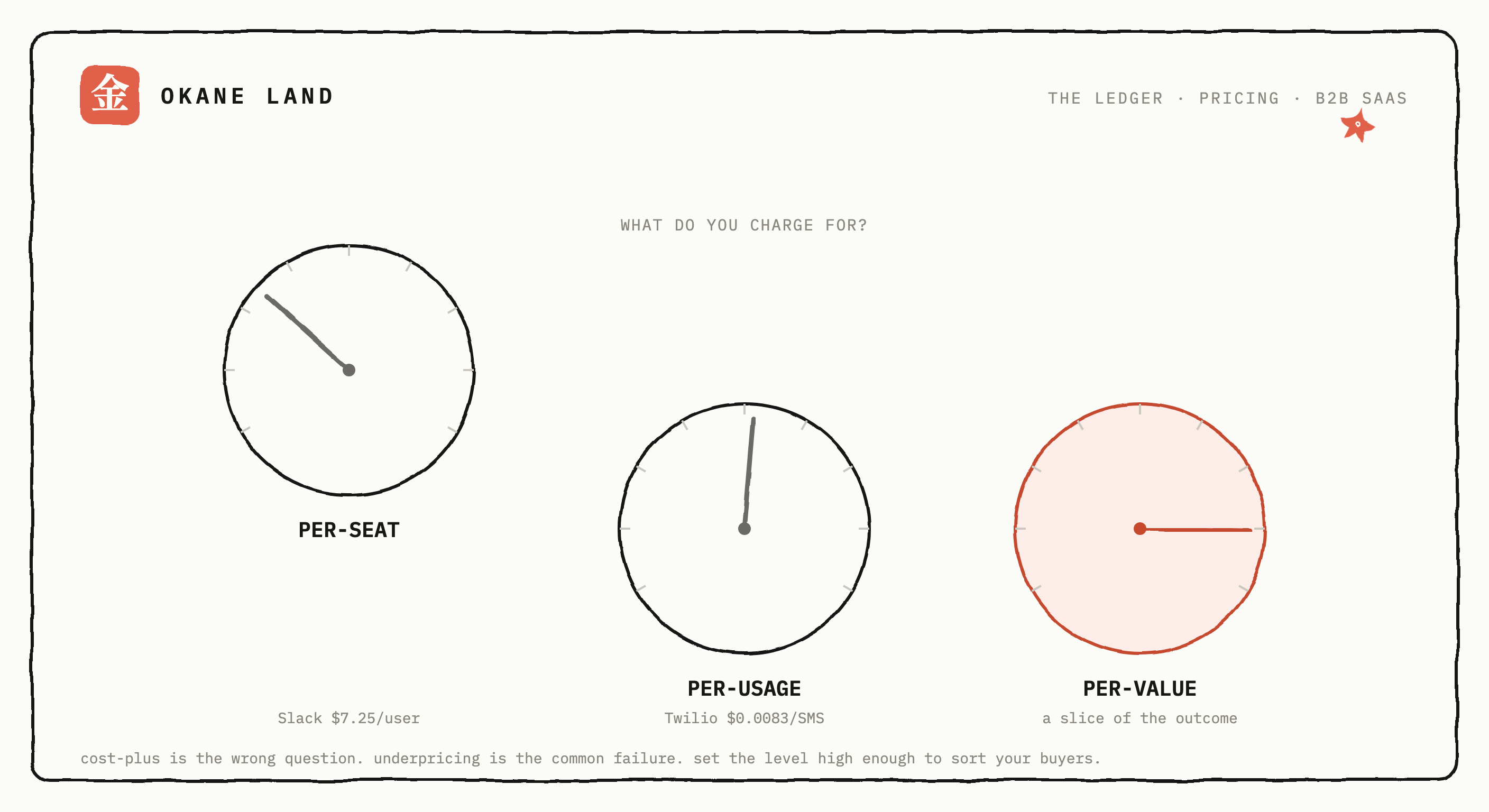
Put two real pricing pages side by side and the digits stop looking like the decision. Slack charges $7.25 a user per month. Twilio charges $0.0083 a message. Three orders of magnitude apart, and what actually shaped each business is the meter the bill is wired to. That choice comes before the number, and it is where this guide starts.
The short version
- Decide the meter before the number. What you charge for, a seat, a unit of usage, or a unit of value delivered, matters more than the digits, because it decides whether your revenue grows as the customer succeeds or works against them.
- Cost-plus is the wrong starting question for software. With near-zero marginal cost, “my costs times a markup” produces a number unrelated to what the product is worth. Price to value, not to cost.
- The common failure is charging too little, not too much. The pricing research and founder reports both point the same way: underpricing is the more frequent and more expensive mistake, and raising prices in cohorts rarely produces the churn founders fear.
- Use price to segment, not just to discount. In B2B, the number itself decides who has to approve the purchase, so a higher price can sort your market into the right buyers rather than simply leaving money on the table.
This is a decision guide built from live pricing pages and published benchmarks, not a study we ran. We did not survey founders or test willingness to pay. Every figure is attributed to its owner and dated where we read it, and the value-capture rules of thumb are strategists’ heuristics, not settled numbers.
The three pricing models (the meters), with real pages open
Every B2B price is one of three meters, or a blend. Look at each with an actual page in front of you.
Per-seat. You charge per user. Slack’s is the canonical example: Pro at $7.25 a user per month and Business+ at $15 on annual billing, verified on its pricing page 9 August 2026. HubSpot’s Sales Hub runs the same meter at higher stakes, $7, $90, and $150 a seat for Starter, Professional, and Enterprise, with one-time onboarding fees of $1,500 and $3,500 on the upper tiers. Per-seat is simple to understand and easy to forecast, and its weakness is that it can punish adoption: a customer who wants ten more people using the tool has to pay before they see the value.
Per-usage. You charge per unit consumed. Twilio is the clean case, at $0.0083 per SMS segment plus $1.15 a month per number, verified 9 August 2026. Usage pricing aligns your revenue with the customer’s own activity, which is why it tends to grow with an account rather than cap it, and its weakness is the mirror image: the bill is unpredictable, and an unpredictable bill is harder for a buyer to approve.
Per-value. You charge for the outcome, a booked meeting, a closed ticket, a dollar saved. It aligns most tightly with what the buyer actually cares about and is the hardest to meter cleanly, because you have to define and measure the value in a way both sides trust. Most mature B2B pricing is a blend: a per-seat platform fee with usage on top, or a base tier with value-based expansion.
The decision is not which meter is best in the abstract. It is which one matches how your specific buyer measures the value they get, because that is the meter that will feel fair to them as the bill grows.
Why cost-plus is the wrong question
The instinct carried over from selling physical things is to add up your costs and mark them up. For software this barely works, because the marginal cost of one more customer is close to zero. Cost-plus on a near-zero cost produces a near-zero-anchored price, which is almost always far below what the product is worth to someone it genuinely helps.
Value-based pricing asks a different question: how much better off is the customer because of this, and what share of that is fair to capture? Strategists often repeat a rule of thumb that you should price to capture some fraction of the value you create, frequently quoted in the range of ten to twenty percent, but treat that as a heuristic people repeat rather than a sourced constant, because the real answer is that the right share depends on the market and the alternative. What survives is the direction: start from the value delivered and work down, not from your costs and work up. The full arithmetic of what a software account actually costs you to serve is in our unit-economics study, and it is the floor beneath the value ceiling, not the basis for the price.
Find the number without guessing
Value-based does not mean invented. There is a cheap, established way to probe willingness to pay: the Van Westendorp Price Sensitivity Meter, a method from 1976 that asks four questions, at what price is it too expensive, too cheap, getting expensive, and a bargain, and plots the answers as curves to reveal an acceptable range. It will not hand you a single correct price, and it is a real starting instrument rather than a guess.
The B2B reality the survey misses is the buying committee. A consumer buys for themselves; a B2B customer has a champion who wants your product, a procurement function whose job is to pay less, and an economic buyer who signs. Your price has to survive all three. That is why the same number that a champion waves through can stall in procurement, and why the level you pick is partly a decision about which of those three people you want to be talking to, which the next section is about.
The trap is charging too little
The most expensive pricing mistake is usually underpricing, and two independent signals point at it.
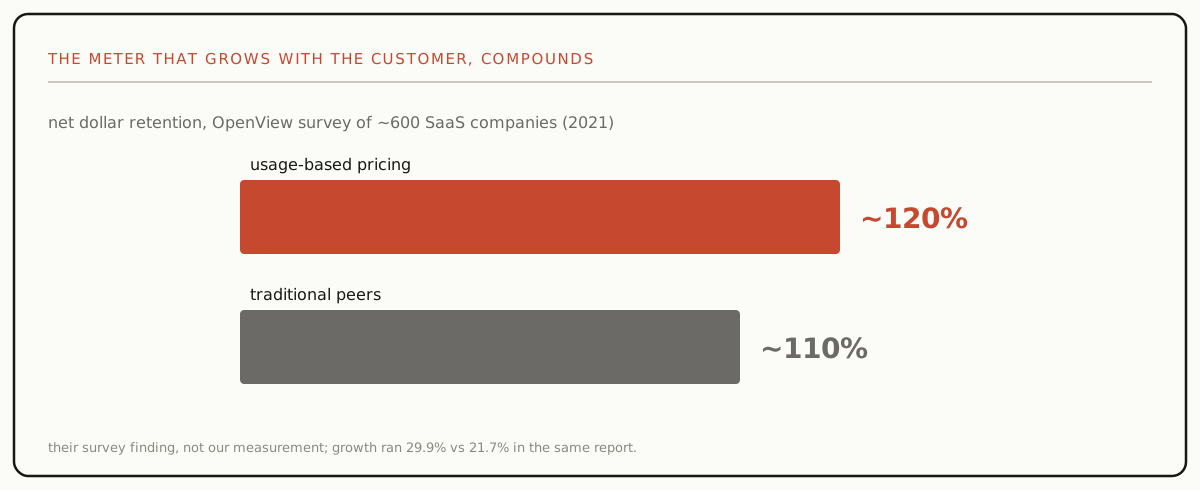
The OpenView 2021 benchmark survey of around 600 companies found that those using usage-based pricing reported net dollar retention of about 120 percent, against about 110 percent for their peers, along with faster growth. Attributed to OpenView, that is a survey finding rather than our data, and it says that a meter which grows with the customer compounds. Separately, Simon-Kucher’s pricing research, popularized in Ramanujam’s work, put the share of new products that miss their revenue goals at roughly 72 percent, with pricing a leading cause. And the recurring report from founders who raise prices is that the churn they braced for mostly did not come; the customers who valued the product kept paying, and the ones who left at a higher price were often the expensive-to-serve accounts they were better off without.
The practical move that follows is to raise prices in cohorts. Grandfather existing customers at their current rate, apply the new price to new customers, and watch what actually happens to conversion rather than what you fear will happen. The downside is bounded and the information is real, which is the same disciplined posture our pricing-psychology guide argues for.
Segment with price, do not just discount
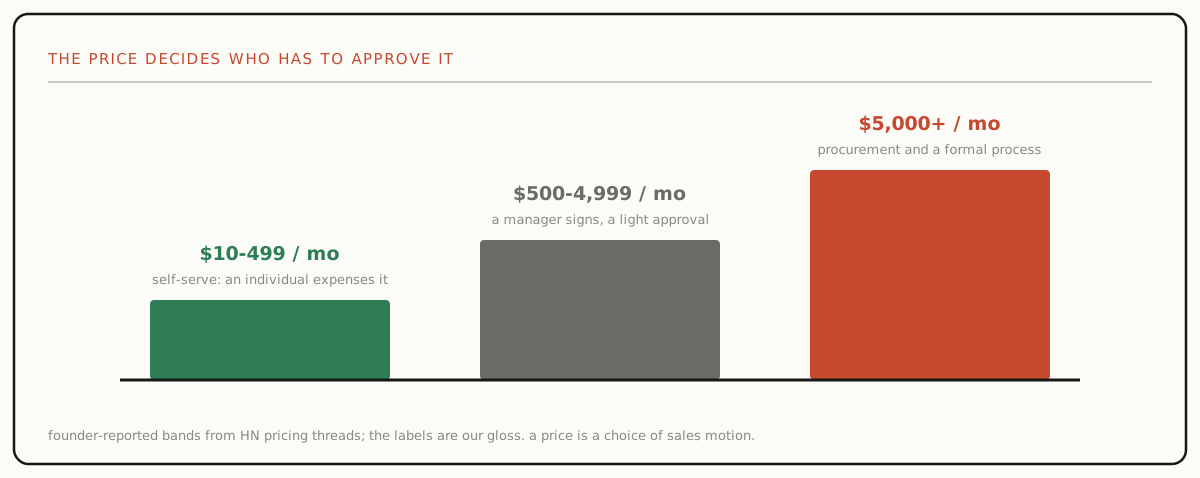
In B2B the price number is itself a filter, because it decides who is allowed to buy without asking anyone. Founders on Hacker News describe distinct bands, and while the exact figures are their own, the shape is consistent enough to plan around. Our gloss on those bands:
| Monthly price | Who can approve it |
|---|---|
| $10 to $499 | Self-serve: an individual expenses it |
| $500 to $4,999 | A manager signs, a light approval |
| $5,000 and up | Procurement and a formal process |
The lesson is that a price is not only a revenue figure, it is a choice of sales motion. Land at $49 and you are running a self-serve funnel; land at $5,000 and you have signed up for a sales process whether you wanted one or not. Picking a number just below a band boundary to stay self-serve, or just above it to justify a human touch, is a strategic act, not a rounding decision. Discounting drops a customer to a lower band and a different motion; segmenting with price means choosing the band on purpose and building the motion to match.
A worked example
Take a hypothetical AI SaaS that summarizes support tickets. The cost-plus instinct says: it costs me roughly forty cents in tokens per active user per month, so charge two dollars and feel clever. That number is anchored to your bill, not their benefit, and it leaves almost everything on the table.
Reframe to value. The buyer’s support team handles, say, 2,000 tickets a month, and your tool saves an agent a few minutes each. Now the price conversation is about a slice of a labor line the buyer already measures in real money, and a per-seat platform fee with usage-based expansion on top lets the bill grow as they route more tickets through it. Set the entry tier just inside the self-serve band so a team lead can try it without procurement, and put the enterprise tier above the $5,000 line where a formal process and a real onboarding fee are expected. Same product, a price that segments the market and grows with the account, arrived at by starting from the buyer’s value rather than your token bill.
That is the whole method in one move: meter first, value not cost, level high enough to sort your buyers, and raise it in cohorts as you learn. When the product is a service rather than a subscription, the same logic runs through our AI-work pricing guide and how to productize it; the meter changes, the discipline does not.
One email, when there's something worth sending
Get the research in your inbox.
No fixed schedule, no filler. You get an email when we've tested something, run the numbers, or found a tool worth your time.
Free. Double opt-in, unsubscribe in one click.
Setting a price and second-guessing it? Compare notes in the forum ↗
Sources
| Source | Link |
|---|---|
| Slack pricing (verified 2026-08-09): Pro $7.25/user/mo and Business+ $15/user/mo on annual billing; $8.75 and $18 on monthly. A per-seat meter. | slack.com ↗ |
| Twilio SMS pricing (verified 2026-08-09): US outbound and inbound SMS at $0.0083 per message segment, plus $1.15/mo per standard long-code number. A pure usage meter. | twilio.com ↗ |
| HubSpot Sales Hub pricing (verified 2026-08-09): Starter $7, Professional $90, Enterprise $150 per seat/mo on annual billing, with one-time onboarding fees of $1,500 (Professional) and $3,500 (Enterprise). A per-seat meter with a services floor. | hubspot.com ↗ |
| OpenView, 2021 SaaS Benchmarks (survey of ~600 companies): companies using usage-based pricing reported net dollar retention of about 120% versus about 110% for peers, and higher growth (29.9% vs 21.7%). Attributed to OpenView; a survey finding, not our measurement. | openviewpartners.com ↗ |
| Simon-Kucher pricing survey (via Madhavan Ramanujam, "Monetizing Innovation"): roughly 72% of new products launched in the prior five years failed to meet revenue goals, with pricing a leading cause. Attributed to Simon-Kucher. | simon-kucher.com ↗ |
| Van Westendorp Price Sensitivity Meter (1976): four survey questions (too expensive, too cheap, getting expensive, a bargain) plotted as cumulative curves to find an acceptable price range. An established method, not a finding. | en.wikipedia.org ↗ |
| Hacker News, "Ask HN"-style pricing threads: founders report distinct B2B price bands, roughly $10-499/mo, $500-4,999/mo, and $5,000+/mo, that change who has to approve the purchase. The band figures are founder-reported; the labels below are our gloss. | news.ycombinator.com ↗ |
Show your work: if a number can't be shown, we don't print it.