The Ledger · Pricing
Pricing your AI app: the psychology that holds up, and the tricks that fall apart

You built the app. The model behaves, the deploy is green, and one box is still empty: the price. For most vibe coders it is the scariest field on the page, and the internet is glad to help, with a firehose of pricing hacks. End every price in 7. Bolt on a countdown timer. Charm-price it at .99 and watch sales climb. Most of that is folklore, copied from one course to the next with nothing under it. A little of it is real, replicated science. This is how to tell the two apart, with the studies attached, written for pricing your own AI product.
One rule before the list. Every effect below has an edge where it stops working or turns on you. The gurus sell you the effect. The money is in knowing the edge.
The short version
The moves that hold up, in the order you will use them:
- Make the entry tier exactly $0, capped tight, and treat a 2 to 5% free-to-paid rate as normal.
- Price to match the quality you claim. A higher number is a signal. Anchor it with a visible higher tier.
- Use three plans and steer to a real middle, never a fake decoy.
- Show annual as a per-month number. Skip the coffee line.
- Use .99 only where the left digit drops, and expect a nudge.
- Quote one all-in price. Drip fees are a trust loan you repay later.
- Do not monetize on goodwill. Give a concrete reason to upgrade.
Everything below is the study behind each move, and the edge where it stops working.
Free is a different number than cheap
The most reliable finding in pricing is that $0 is not a low price. It behaves like its own category. In a field study at MIT, Shampanier, Mazar and Ariely offered Hershey’s Kisses at 1 cent next to Lindt truffles at 15 cents, and among people who bought, 73% paid up for the nicer Lindt. Then the researchers cut both prices by a single cent. The Kiss was now free, the Lindt 14 cents, the gap unchanged. The room flipped: 69% now grabbed the free Kiss. A one-cent move reversed the whole decision, because “free” reads as a reward rather than a smaller cost.
That is why every AI product you admire opens with a $0 tier. ChatGPT shows Free beside Plus at $20 and Pro at $200. Claude and GitHub Copilot run the same free-to-paid ladder. The $0 plan is the magnet, and a sliver of those users later pay.
Free is not a cheat code, though. When the free thing carries a quiet cost (a credit card up front, a long signup, handing over your data), that “free” reads as a trap and can sell worse than a small, clean price. And every free user burns real inference money. So set your entry tier to exactly $0, because the jump in signups from $1 to free is far bigger than from $3 to $1, then cap it hard with rate limits and a smaller model, and convert on usage. If your free-to-paid rate sits between about 2 and 5%, that is the normal freemium range.
A price is a quality signal, so stop racing to the bottom
Buyers cannot fully judge an AI tool before they use it, so they read the price as a clue to how good it is. And it runs deeper than belief. In a now-classic experiment, Shiv, Carmon and Ariely gave people an energy drink and a set of word puzzles. Same drink for everyone, but one group was told it cost full price and another that it was discounted. The discount group solved fewer puzzles. They did not merely believe the cheaper drink was weaker, they performed as if it were, and nobody in the study consciously connected the price to their score.
The lesson for an AI app: a too-cheap price actively signals “low quality.” Superhuman priced its email client at around $30 a month while rivals sat at $0 to $9, on purpose, so the number itself said “this is the serious one.” If you claim to be the best AI for some job, a $4 tag undercuts the claim before anyone tries it.
This is a real effect of modest size, and later work shows the experience-changing version does not fire for everyone. It leans on the buyer and the category, and it fades for people who already know your product. Treat price as a first impression, then anchor it with a visible higher tier: a Pro or Team plan priced two to three times your main one, so your main plan reads as serious but reasonable.
The third option does the selling
Put three plans in front of someone and the one you flag, or the one in the middle, does quiet work. The textbook case is The Economist’s subscription page, made famous by Dan Ariely. Three options: web only for $59, print only for $125, and print plus web for $125. The print-only option is pointless, the same price as print-and-web for less, and in Ariely’s MIT test nobody picked it. But its presence made the $125 bundle look like a steal, and 84% chose it. Take the useless decoy away, and most people drift down to the cheap $59 web plan. The bad option was the whole point.
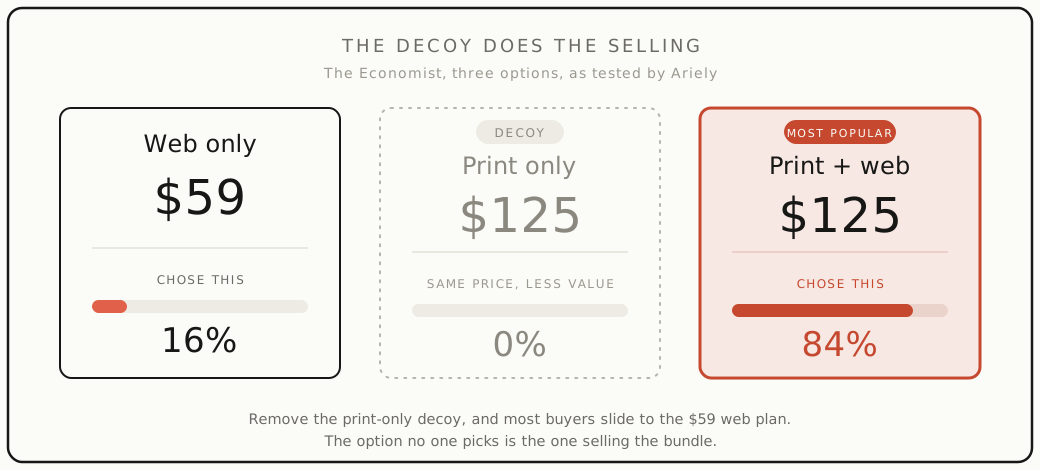
This is the “Most popular” badge on every pricing page. GitHub Copilot stamps “Best value” on its $39 Pro+ tier, parked under a $100 Max plan that makes it look sensible. Notion plants “Recommended” on its $20 Business tier. Vercel runs the clean three-step version, free Hobby, $20 Pro, then a “Contact sales” Enterprise. For your own app, build a real Starter, Pro, Team page and make the tier you actually want to sell the obvious value pick: give Pro ten times the limits of Starter for twice the price, so Pro wins on value per dollar.
The decoy effect is solid in tidy lab setups with clear numeric tradeoffs, and shakier in the wild. Several follow-up studies found it often weakens or disappears once the options are real and messy. So steer with a genuine middle tier. Do not invent a fake decoy and assume the magic carries. Which meter those tiers sit on, seats, usage, or outcomes, is the prior question, and how to price a B2B SaaS answers it.
Annual framing helps. “A coffee a day” mostly does not
There is a legitimate version of small-number framing and a tired one. The legitimate version: show your annual plan as its per-month equivalent next to the monthly price. Claude lists Pro at $17 a month billed annually beside the $20 month-to-month price, so the annual deal reads as the deal it is. John Gourville’s pennies-a-day research is the root of this: break a big yearly number into a small recurring one and people compare it to other tiny expenses instead of one large bill, so they say yes more often. Later field work on savings plans found the daily frame can sharply lift sign-ups.
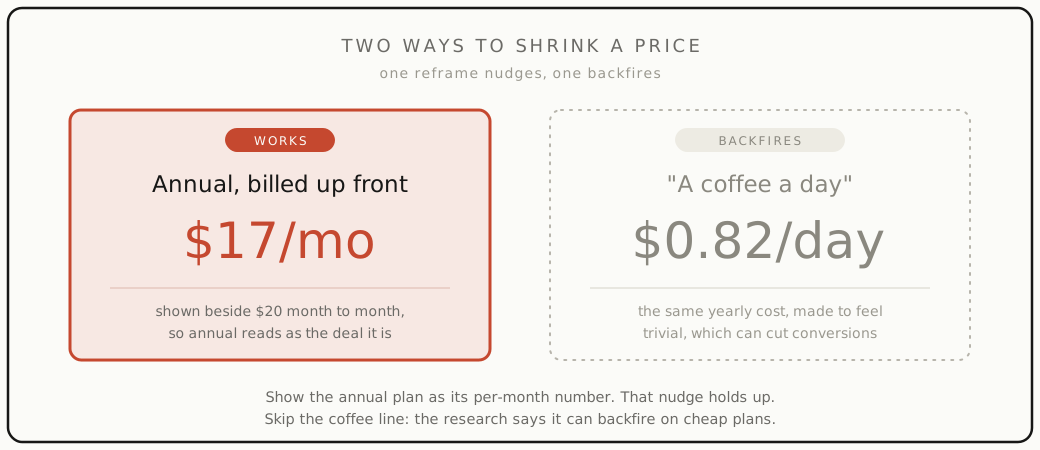
Now the tired version. “Less than a coffee a day” is the line every course teaches, and the evidence for it is weak to negative. The famous percentages people attach to Gourville’s study are a later popularization; the paper contains no such figures. The reframe also backfires for cheap items: on a low monthly price, spelling it out as pennies can make the product feel nickel-and-dimed. And a 2015 study found the coffee comparison can actually reduce donations, because telling people the amount is trivial makes the act feel trivial too. Use the clean annual-equivalent. Skip the coffee.
The .99 trick is real, and smaller than you think
Charm pricing, ending a price in 9, has the widest gap between hype and evidence of anything here. The real finding is solid: in field experiments, Anderson and Simester found a dress priced at $39 outsold the same dress at $34, while moving it to $44 changed nothing. The left digit drove the sale. It works because we read left to right and anchor on the first number, so $9.99 lands nearer to $9 than to $10. Spotify prices every tier this way: $12.99, $18.99, $21.99.
But the size of the effect is nothing like the “ends in 9 sells 24 to 60% more” you will read on course slides. A 2024 meta-analysis pooling 69 studies found the real lift is small, and shows up only when the left digit actually drops. So use it where it crosses a boundary, $19 over $20, $9 over $10, and do not bother at $47 versus $44, where the left digit barely moves. It helps most for cheap, impulse, self-serve signups, and does nothing on a careful comparison table or a premium plan sold on prestige.
Hidden fees pump the numbers, and they just got riskier
Split a price into a base plus surcharges, or reveal fees only at the end, called drip pricing, and people remember a lower total and buy more. The original research is decades old: most shoppers never add the surcharge back in, so the headline number is what sticks. StubHub later ran it as a real experiment, showing a low ticket price and dripping a roughly 15% fee in at checkout, and those shoppers spent about 21% more than the group shown the all-in price up front.
Usage-based AI apps do this all the time: a low “$20/month” headline, with metered overages and per-seat add-ons surfacing later. The research says it nudges spending up. Two reasons to not lean on it anyway. First, the lift only holds when the fees are small and expected; a big surprise fee reads as a bait-and-switch and costs you trust. Second, as of May 2025 the FTC’s rule on hidden fees requires the all-in price up front for live events and short-term lodging, and the direction of travel is clear. Quote one true number. It ages better.
”Pay what you want” mostly means “pay nothing”
It is tempting to let fans pay what they feel. The data says almost all of them feel like paying near zero. In the largest test of pay-what-you-want, Gneezy and colleagues sold photos to 113,000 theme-park visitors. Pure pay-what-you-want got far more people to buy, but the average price was 92 cents, below cost. The version that made money paired the choice with a cause, half goes to charity: fewer people bought, but the average payment jumped to $5.33. The hook is what pried money loose. When Radiohead released In Rainbows as pay-what-you-want, 62% paid nothing at all.
For your AI app: do not count on goodwill to monetize a free tier. Give people a reason to upgrade that is not just “more features,” a limit they keep hitting, a workflow they now depend on, or an identity, like “Pro funds the open-source version.” And calibrate to reality. The freemium free-to-paid benchmark is about 2 to 5%, a long way from 50%.
The tricks with no clothes
Some of the most-repeated pricing advice has no evidence under it, or the evidence points the other way:
- Countdown timers and “only 3 left.” The big conversion numbers come from app-store vendors, with no study behind them. Research on time pressure and on the downside of scarcity finds these cues can raise stress and suspicion and backfire, especially when buyers sense the scarcity is fake.
- “Always end in 7.” There is no study showing a 7-ending sells better. The idea traces to one mid-century direct marketer and spread as copy-paste lore. The measured effect is about the left digit dropping; there is no lucky number.
- “Red buttons convert 21% better.” The famous test that “proved” it had a green page with one red button. The button won by standing out. Contrast is the lever, and any color that pops pulls it.
- “Money mindset” priming. The idea that flashing money or success cues nudges people to pay is the poster child of psychology’s replication crisis. A 17-lab effort could not reproduce it.
If a pricing tip cannot point to a study, treat it as someone’s lucky habit.
This is pricing your own product. If you sell builds to clients instead, the math is different: see what to charge for AI work and how to land your first AI client.
The builders who get paid are the ones who picked a number they can defend, tested it on real buyers, and ignored the rest.
One email, when there's something worth sending
Get the research in your inbox.
No fixed schedule, no filler. You get an email when we've tested something, run the numbers, or found a tool worth your time.
Free. Double opt-in, unsubscribe in one click.
Putting a number on your app? Get the research →
Sources
| Source | Link |
|---|---|
| Shampanier, Mazar & Ariely, "Zero as a Special Price" (Marketing Science, 2007) | pubsonline.informs.org ↗ |
| Shiv, Carmon & Ariely, "Placebo Effects of Marketing Actions" (Journal of Marketing Research, 2005) | journals.sagepub.com ↗ |
| Plassmann & Weber, individual differences in marketing placebo effects (JMR, 2015) | journals.sagepub.com ↗ |
| Huber, Payne & Puto, asymmetric dominance / the decoy effect (Journal of Consumer Research, 1982) | academic.oup.com ↗ |
| Frederick, Lee & Baskin, "The Limits of Attraction" (JMR, 2014) | journals.sagepub.com ↗ |
| Yang & Lynn, more evidence challenging the attraction effect (JMR, 2014) | journals.sagepub.com ↗ |
| Anderson & Simester, "Effects of $9 Price Endings on Retail Sales" (Quantitative Marketing and Economics, 2003) | link.springer.com ↗ |
| Troll, Frankenbach, Friese & Loschelder, just-below pricing meta-analysis (Journal of Consumer Psychology, 2024) | myscp.onlinelibrary.wiley.com ↗ |
| Gourville, "Pennies-a-Day" temporal reframing (Journal of Consumer Research, 1998) | academic.oup.com ↗ |
| Bambauer-Sachse & Grewal, when the daily reframe backfires (Journal of Retailing, 2011) | sciencedirect.com ↗ |
| Savary, Goldsmith & Dhar, "Giving Against the Odds" (JMR, 2015) | papers.ssrn.com ↗ |
| Morwitz, Greenleaf & Johnson, "Divide and Prosper" partitioned pricing (JMR, 1998) | journals.sagepub.com ↗ |
| Abraham & Hamilton, partitioned pricing meta-analysis (JMR, 2018) | journals.sagepub.com ↗ |
| Gneezy, Gneezy, Nelson & Brown, pay-what-you-want field experiment (Science, 2010) | science.org ↗ |
| Biraglia, Usrey & Ulqinaku, "the downside of scarcity" (Psychology & Marketing, 2021) | onlinelibrary.wiley.com ↗ |
| Tuncer et al., scarcity cues and perceived load (Behaviour & Information Technology, 2023) | orbilu.uni.lu ↗ |
| CXL, what the famous button-colour A/B test actually showed | cxl.com ↗ |
| Scientific American, the social-priming replication crisis | scientificamerican.com ↗ |
| The Economist subscription decoy, documented | en.wikipedia.org ↗ |
| Inside Superhuman pricing (PricingSaaS) | newsletter.pricingsaas.com ↗ |
| FTC rule on unfair or deceptive fees (effective May 2025) | ftc.gov ↗ |
| Radiohead, In Rainbows pay-what-you-want numbers (Rolling Stone) | rollingstone.com ↗ |
Show your work: if a number can't be shown, we don't print it.