The Ledger · Selling
How to land your first AI client

The good news about your first AI client is that you almost certainly already know them. You just have not asked yet.
The short version
If you want the first paid build, the method in five moves:
- List everyone you already know, with their one manual pain next to each name. The friend’s business, the drowning team at your day job, the group-chat complaint. Warm beats cold, and it is measured: no channel outranks a personal recommendation for buyer trust.
- Pitch the outcome, never the model. The smallest firms mostly skip AI because what stops them is relevance rather than cost: they do not see the use. “I can draft your support replies” answers that; “I build AI solutions” confirms it.
- Send a short message that ends with a free look. The look costs you an hour, gets you the real problem, and is the start of the scoping.
- Win the argument with a working demo, never a deck. A small build running on their own workflow turns the pitch from a claim about AI into a claim about their week.
- Point at it for client two, and charge properly from the start. The Upwork floor for AI work runs $35 to $60 an hour, and agency rates sit well above it.
The rest is the evidence, and the market that makes it work.
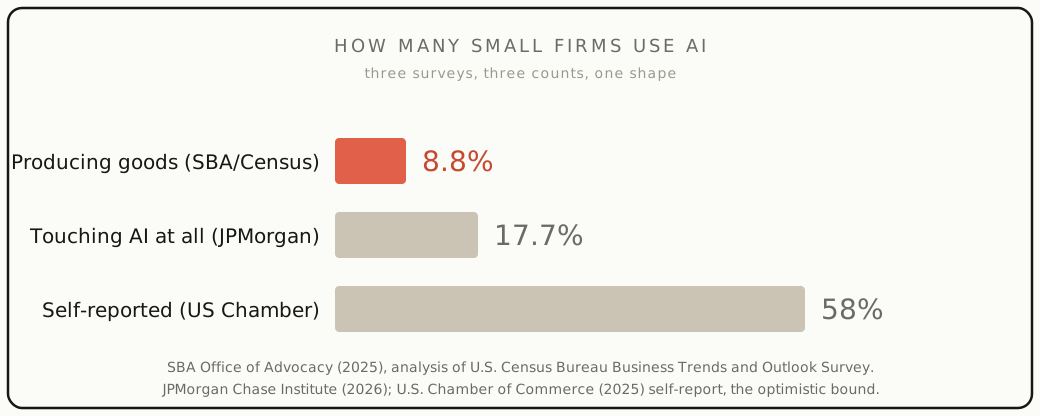
Start with the market, because it is on your side. Most small businesses still have not put AI to work. By mid-2025 only 8.8% of US small firms were using AI to produce their goods or services, per the Census data the SBA analyzed. Count more loosely and it climbs, to about 17.7% touching AI at all by the end of 2025 in JPMorgan Chase and Census figures, and as high as a self-reported 58% in the US Chamber’s survey. The measures disagree because they count different things, but they agree on the shape: a large slice of small businesses runs a manual, expensive process a model could help with, and has not fixed it. That gap is the job.
Start where you already are
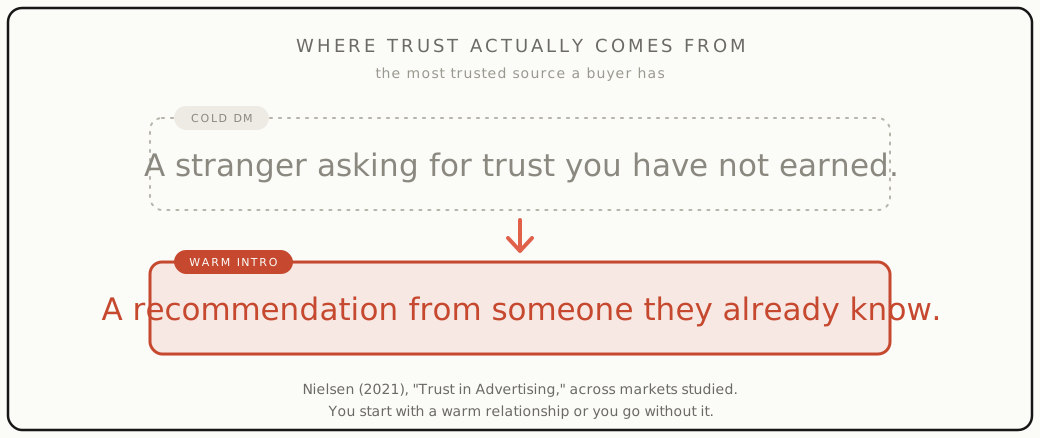
Your first client is almost never a stranger from the internet. It is the small business a friend runs, the team at your day job drowning in a manual task, the person in a group chat complaining about something AI happens to be good at. The hard part of a first sale is trust, and trust does not come from a cold DM. Across markets, the single most trusted source of information a buyer has is a recommendation from someone they already know, per Nielsen. You cannot cold-email your way to that. You start with it or you go without it.
Make a short list of every person or business you have a real connection to. Next to each, write the one repetitive, annoying, expensive thing they do that a model could help with. That list is your pipeline, and it is more qualified than any cold outreach you could run.
Sell the result
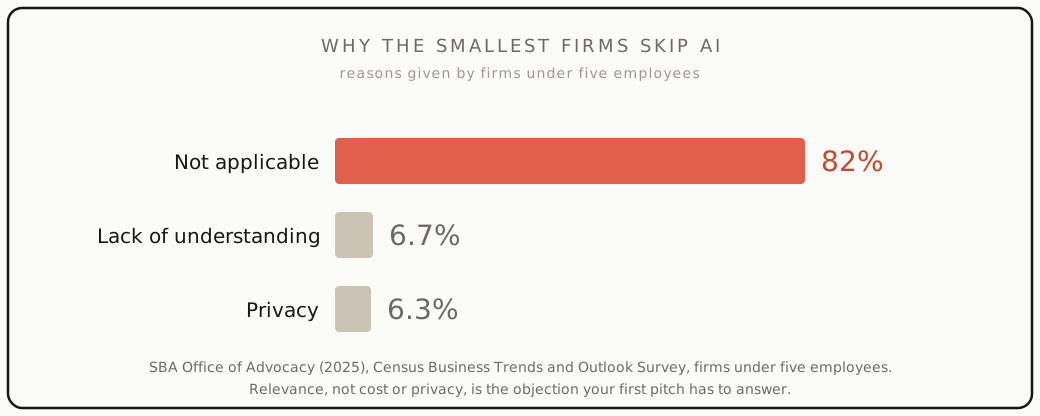
Nobody wants to buy AI. They want the thing on the other side of it: fewer hours on data entry, faster replies to customers, a first draft instead of a blank page. The adoption data shows how deep this runs. When the SBA asked the smallest firms why they were not adopting AI, nearly 82% of those under five employees gave the same reason: they do not believe AI “is applicable to their business.” Not cost. Not privacy, which 6.3% cited. Not a lack of understanding, at 6.7%. Relevance. They cannot see what it would do for them.
So “I build AI solutions” lands as noise, and worse, it confirms their objection. “I can turn the support emails you answer by hand into draft replies your team just approves” answers it. Lead with their problem in their words, and keep the tech invisible. The model is how you do the job. It is not the job.
The first message
Keep it short, specific, and free of hype. Something like:
Hey, I noticed your team spends a lot of time on [the manual thing]. I have been building tools that handle exactly that, and I think I could cut it down a lot. Want me to take a look and show you what is possible? No charge for the look.
That last line does the heavy lifting. A free, low-risk first look gets you in the door, lets you see the real problem, and gives you something concrete to price. The look is scoping, and it is the fastest path from “maybe” to a paid build.
Proof beats pitch
You do not need testimonials yet. You need one thing that visibly works. Build a small, real version of the thing for one person on your list, even at a low price or as a favor, and get it running. Remember the 82%. The objection you are up against is “this is not for us,” and a slide deck cannot beat that. A working demo of their own workflow, with their own data, can, because it stops being a claim about AI and becomes a claim about their Tuesday.
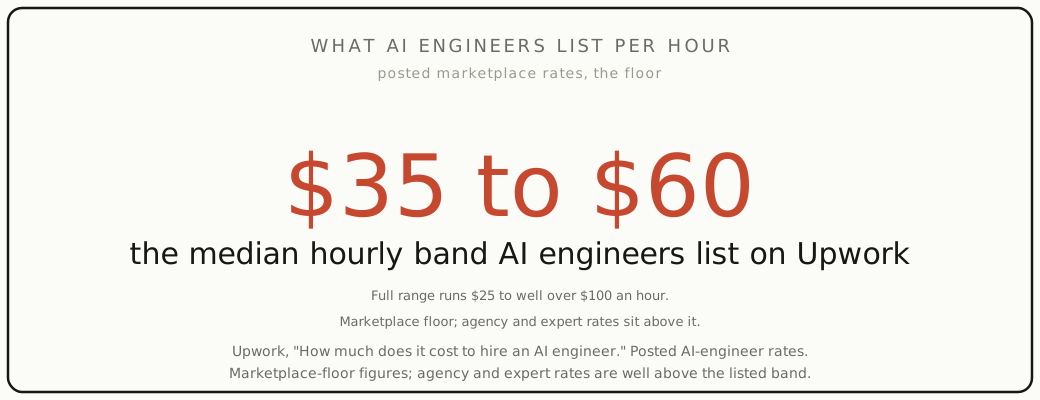
Then the second client is easier, because now you can say “I did this for them” and point at something real. What to charge along the way is its own solved question; for reference, AI engineers list a median around $35 to $60 an hour on Upwork, and that is the marketplace floor, with agency and expert rates well above it. That is the whole loop: a warm lead, a real result, a number you can show. Repeat it three times and you are choosing between the ones who found you. Selling a product instead of a service is the same trust problem without the warm intro, and getting your first 10 users is that playbook.
One email, when there's something worth sending
Get the research in your inbox.
No fixed schedule, no filler. You get an email when we've tested something, run the numbers, or found a tool worth your time.
Free. Double opt-in, unsubscribe in one click.
Chasing your first client? Get the research →
Sources
| Source | Link |
|---|---|
| SBA Office of Advocacy (2025), "AI in Business: Small Firms Closing In" (analysis of U.S. Census Bureau Business Trends and Outlook Survey). 8.8% of small firms use AI to produce goods or services; ~82% of the smallest non-adopters say AI is "not applicable to their business." | advocacy.sba.gov ↗ |
| JPMorgan Chase Institute (2026), "Understanding AI Use by Small Businesses." 17.7% of 4.6M small businesses adopted AI by the end of 2025, up from 5.2% in early 2023. | jpmorganchase.com ↗ |
| U.S. Chamber of Commerce (2025), "Empowering Small Business" (survey of 3,870 firms under 250 employees). 58% self-report generative-AI use in 2025, up from 23% in 2023. Trade-association self-report; the optimistic bound. | uschamber.com ↗ |
| Upwork, "How much does it cost to hire an AI engineer." Posted AI-engineer rates: a median band of roughly $35 to $60 an hour, ranging from $25 to well over $100. Marketplace-floor figures. | upwork.com ↗ |
| Nielsen (2021), "Trust in Advertising." Recommendations from people you know rank as the most-trusted source of information across markets. | nielsen.com ↗ |
Show your work: if a number can't be shown, we don't print it.