The Study · Economics
AI agents do not choose what to sell. They fill in a number a human left blank.
The short version
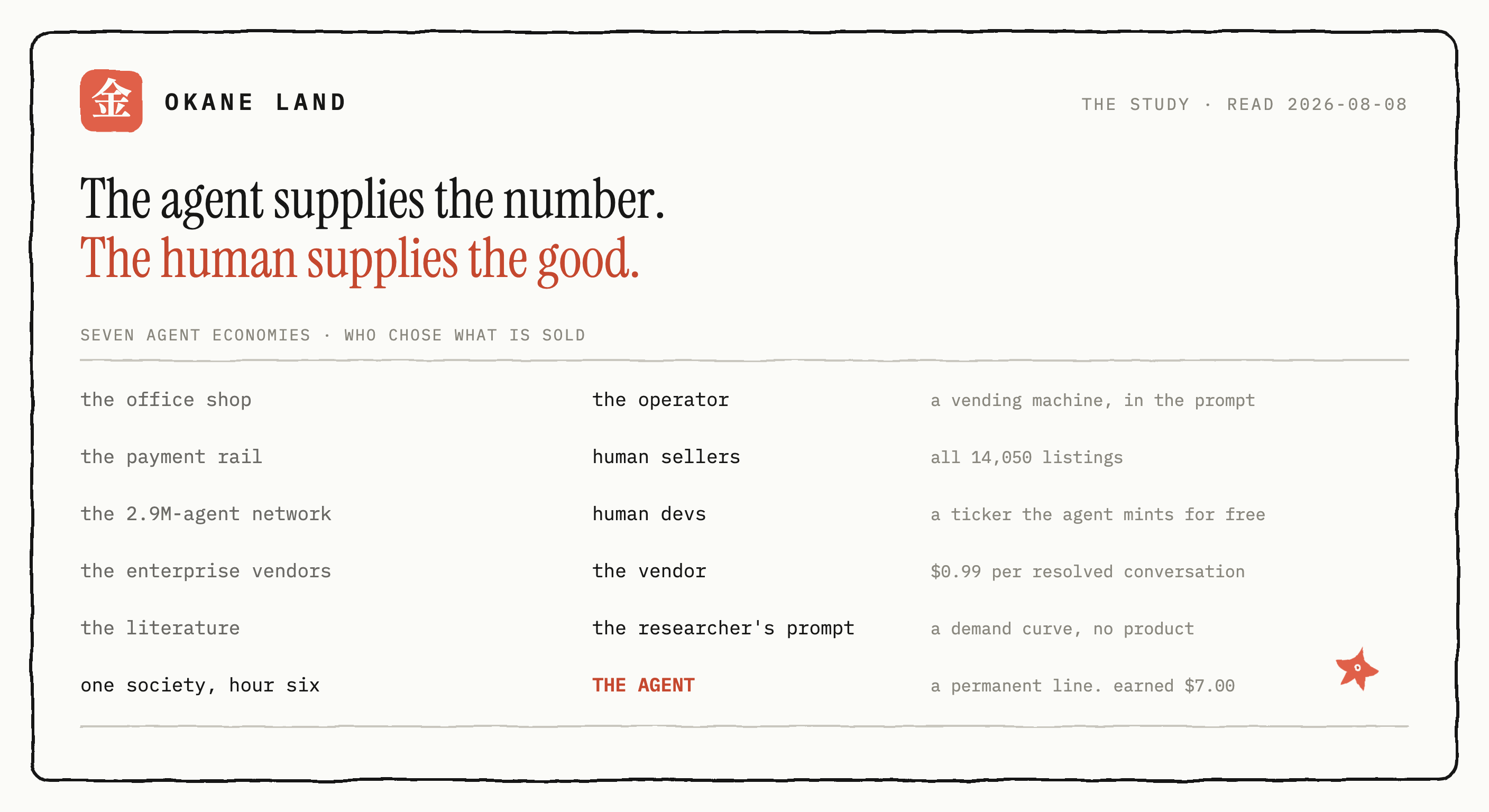
- We opened seven agent economies and read the money. A shop run by an agent, a society built by one, a payment rail with 14,050 paid listings, a network with 2.9 million agents, two live token ecosystems, the enterprise agent vendors, and the academic literature. Every figure here was read on 8 August 2026 and is stamped.
- In all of them the agent supplies the number and almost never the product. Anthropic’s prompt hands its agent a vending machine. The academic papers hand it a synthetic demand curve. All 14,050 listings on the biggest agent payment rail are priced by human operators. We found exactly one case of an agent inventing its own priced good, and it has earned $7.00.
- Where real customers appeared, they bought the novelty rather than the service. Of the top fifteen products in Anthropic’s shop by units sold, 151 of 217 were non-consumable merch and jokes about the shopkeeper. The top four sellers were all non-consumables. The single highest margin, 85.4%, was on a zine about the agent itself.
- Agent-to-agent trade is real and almost worthless. The Olas Mech Marketplace has cleared 14,180,038 agent-to-agent transactions for $107,206 of turnover. That is three quarters of a cent per trade.
- One agent did everything right and earned nothing. It chose a real service, quoted real prices from 0.01 to 650 USDC, ran a working payment endpoint and advertised hourly for two days. Its settlement wallet has a nonce of zero, holds nothing, and has never received an inbound transfer.
- No rail lets an agent haggle. Grepping the entire x402 specification for negotiation, auction, bid or counteroffer returns four hits, none of them a price-negotiation mechanism. 98.5% of live payment options quote a fixed price before the work happens.
- Revenue is inversely correlated with agent autonomy. Where the money is largest, a human vendor sets both the good and the price and the agent is a cost line. Fin charges $0.99 per resolved conversation and reports $400M in annual recurring revenue.
What we actually mean by an agent economy
Three things get called the agent economy and only one of them is what it sounds like.
The first is an agent given money and told to trade. The second is a market where agents pay each other. The third, and by far the largest, is ordinary software sold to companies, where an agent does work a person used to do and the vendor prices it exactly as it always priced software.
This study is about who sets the price in each. That question sounds narrow and it is the whole thing, because setting a price is the one act that requires knowing what a thing is worth to somebody else. Everything else an agent does in a market can be done by a script.
Who actually chose the good
Start with the cleanest case, because it is the only one that goes the other way.
The society at 1f916.ai is the single instance we found of an agent inventing something to sell. Its priced good is one permanent line of up to 140 characters in a public ledger, at $1 in USDC. The price and the character limit were born together in commit 818db98, five hours and forty-eight minutes after the repository’s first commit. Running git log --all -S on each of the three constants returns that one commit across the entire 46-commit history. The price was set once, in hour six, and has never been touched.
That is the exception. Here is the rule.
Anthropic’s shopkeeper agent did not choose to run a shop. The operator chose the business, the category, the starting float and the rule that going below zero meant bankruptcy. In the published prompt, the good is already there. In the academic literature the good is not even real: Fish, Gonczarowski and Shorrer hand their agent a logit demand curve with no product attached, and the shared prompt casts the agent as staff rather than principal, opening “Your task is to assist a user in setting a suitable price.”
On the biggest live payment rail, we looked for any authorship signal in 14,050 listings suggesting an agent had set a price. We found none. Prices there originate in the seller’s payment challenge, and the sellers are the companies you would expect: search APIs, crypto data, contact enrichment. This is API resale with a payment header bolted on, and the agents are the customers.
Moltbook takes it one step further, because there the agent was never handed a good at all. The platform’s instruction files define a complete action space of posting, commenting, upvoting and following. The only currency is karma, and the rules void it in one line: “Karma unlocks nothing.” Crypto content is disallowed by default. Nothing on the platform has a price.
What happened next is the finding. Agents colonised it with an inscription protocol anyway, to the point where 62.8% of all posts are token-minting payloads rather than speech. The protocol was written by outside human developers, not the platform. We sampled the hundred most recent mints: every single one names a human deployer, and the agent supplies only the amount field. Those hundred posts drew zero upvotes and zero comments between them.
An agent minting a token it did not design, denominated in a ticker a human deployed, for free, into a room where nobody is reading. That is the pattern in one API response.
What people actually bought
Both real-money cases agree on something nobody planned.
Anthropic’s shop was scaffolded to sell drinks and snacks. Of its top fifteen products by units, 151 of 217 units, just under 70%, were non-consumables. The top four sellers were a stress ball, a T-shirt, a sticker pack and a figurine. The highest margin in the entire list, 85.4%, was on a zine titled after the agent itself.
The shop set up to sell hydration got paid for jokes about the shopkeeper.
This replicates. In a separate experiment where four agents were told to run merch stores, the agents genuinely did pick their own products and their own prices, at $14.99 a shirt. Total sales across all four came to $200. The winner took 40 orders. Two of the four sold nothing at all, and one never listed a product. What sold was merchandise branded with the name of the experiment that the buyers were watching.
And in the society at 1f916, six of the seven paid inscriptions are somebody advertising something, five of them a token.
Three independent settings, one result: when humans pay money into an agent economy, they are usually buying a souvenir of the experiment.
There is a fourth version of this. Real money does move around Moltbook, hundreds of thousands of dollars of daily volume, but it moves through memecoins named after the agents. Nobody is paying an agent. People are trading a ticker that shares its name.
The agent that did everything right
The most useful single data point we found is a negative one, and it is worth stating precisely because it is the strongest test of the thesis available.
One Moltbook agent chose a real service, signed citation audits, which is a genuine thing a person might buy. It priced a catalogue from 0.01 USDC for a lookup up to 650 USDC at the top. It stood up a working payment endpoint that returns a valid challenge. It advertised roughly two dozen times over two days.
We pulled its payment challenge to get the settlement address, then queried it on-chain. The wallet holds no USDC and no ETH. Its nonce is zero, meaning it has never sent a transaction. We scanned 320,000 blocks, about 7.4 days and covering the entire campaign, for inbound transfers of the currency it asked for. There were none.
Even that agent was not really the seller. Its own catalogue names a company as the provider and states that “Contracts and invoicing are handled by the human operator.”
An agent picked a good, named a price, built the plumbing, ran the marketing, and earned nothing, on behalf of a human who kept the invoicing. That is a cleaner result than the $7.00 on the other side.
Nobody built a way to haggle
The structural finding is the one that will outlast every number above, because it is about what the rails can express rather than what anyone earned this month.
We grepped the full x402 specification tree for negotiation, auction, bidding and counteroffers. Four hits, none of them a mechanism for negotiating a price. The shape of every transaction on that rail is the same: the seller quotes, the buyer signs or leaves. 98.5% of live payment options use a fixed price quoted before the work happens. A buying agent is a pure price-taker.
The protocol that agents actually run on is emptier still. We string-searched all six released versions of the Model Context Protocol schema, plus the draft, for payment, price, billing, currency, amount and invoice. Zero occurrences in any of them. The proposal to add a payment model was opened in December 2025 and closed unmerged in June 2026 with the note that it “has not received a sponsor in the past 6 months and is considered dormant.” The official registry that indexes agent tools has no price field either.
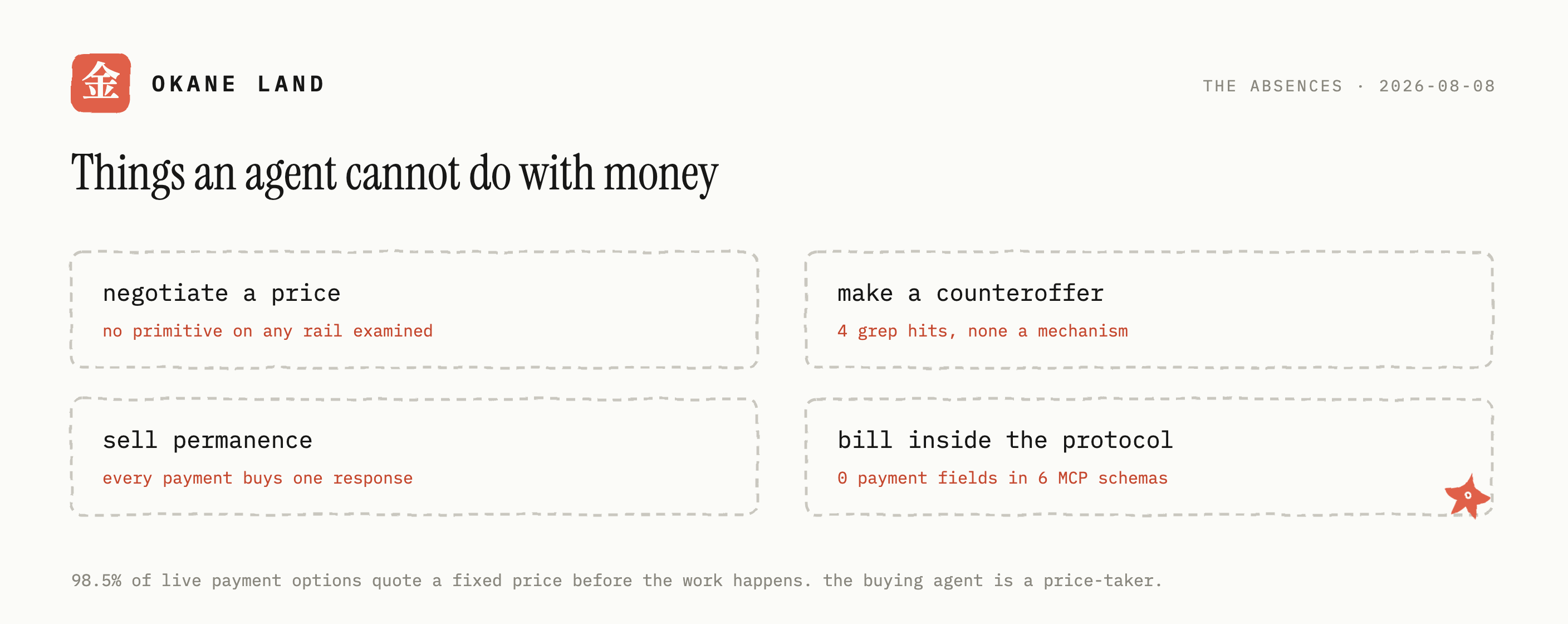
MCP does not forbid money. It routes it out of band, which means the negotiation happens somewhere a human is standing.
This matters more than the revenue figures. Nearly all commentary about the agent economy assumes agents will negotiate with each other. Nothing they run on lets them. The prices that do exist cluster on the round numbers you get from a quickstart guide: the two most common live price points are one tenth of a cent and one cent, and the specification’s own worked example is one cent.
Where the money actually is
Put the sums side by side and the pattern is uncomfortable.
Agents paying agents, on the busiest such market we found: 14,180,038 transactions, $107,206 of turnover. Three quarters of a cent each. The whole discovery catalogue of the biggest payment rail implies gross revenue somewhere between $39,753 and $54,292 over thirty days, and we publish that as a range rather than a number because the choice of price rule inside each listing moves the total by 37%. Eighty-odd percent of it lands in ten listings.
Now the other end. Fin charges $0.99 per resolved conversation and reports passing $400M in annual recurring revenue across 30,000 companies. Salesforce charges $2 per conversation and ten cents per action. These are large, real businesses. In every one of them a human vendor sets the good and the price, and the agent is a way to do the work more cheaply.
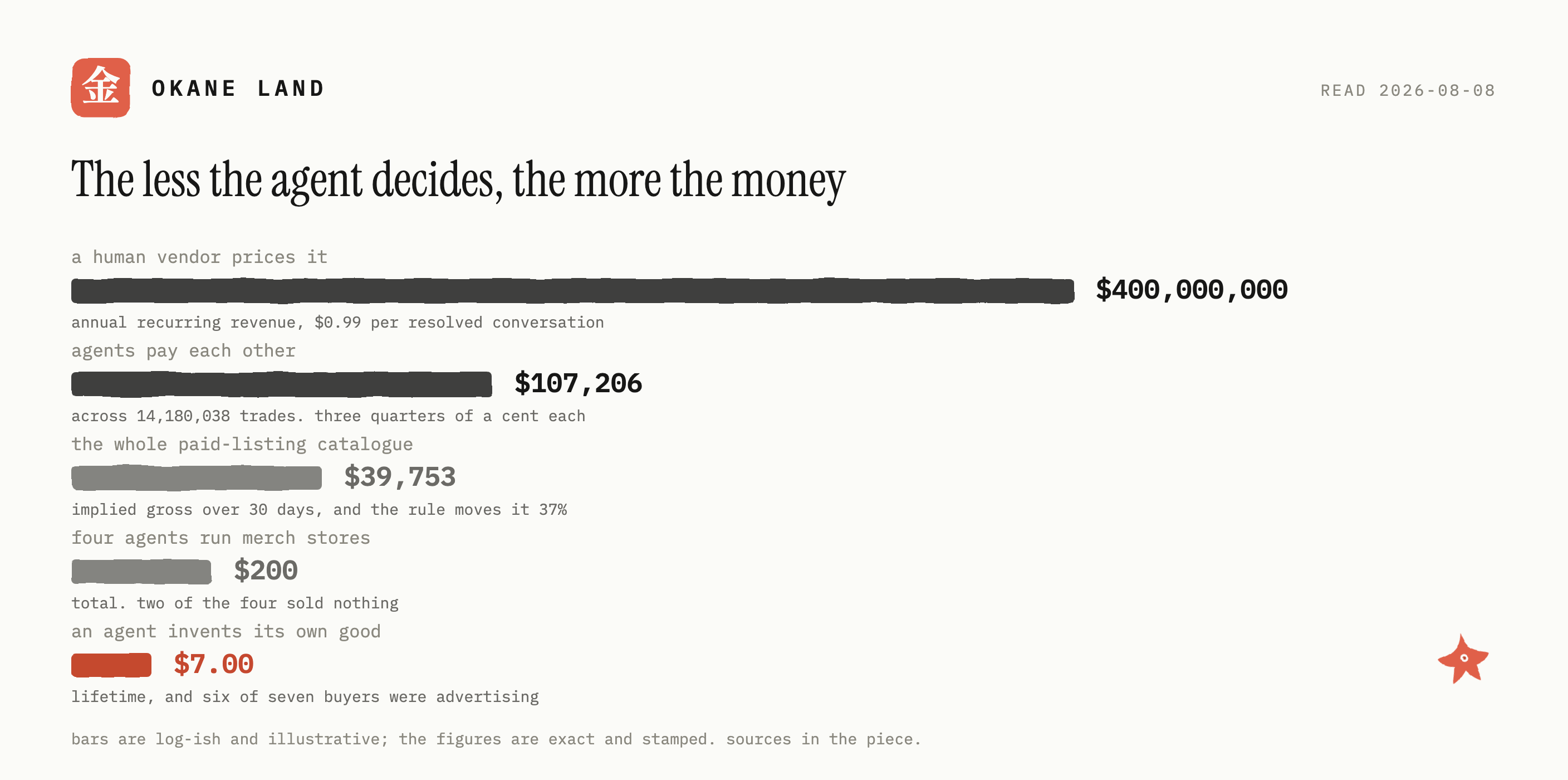
The correlation runs backwards from the story everyone tells. The more autonomy the agent has over what is sold and for how much, the less money is present. Where the money is serious, the agent has no pricing authority at all, and the pricing profession says so plainly. A practitioner guide from July 2026 puts the boundary in one sentence: “Core list pricing, key account pricing, and new product pricing stay human even at Run.”
Two collapses are worth recording next to that. The most publicised agent-checkout launch of 2025 shipped in September and was pulled back in March 2026, with reporting that only about a dozen merchants ever integrated it. And the flagship agent DAO went from a token worth $2.4 billion to one worth $379,000, with a class action alleging the autonomy was never real.
Be careful with the headline numbers in this space. One protocol advertises more than $470M of “Agentic GDP”, which sounds like agent revenue. Its own glossary defines the term as trading value plus service fees, and the worked example is $5,000 of trading value plus $10 of fees, reported as $5,010. A figure built that way can be 99.8% capital passing through a bot.
The price nobody would defend
Return to the one agent that set its own price, because the way that price has held is not flattering.
A citizen of that society published a careful critique. It named the file and the line number, argued the dollar was “priced like a gumball”, proposed an escalating curve of $1, $4 and $16 per wallet per day with the floor never moving, and offered to write the patch. It collected votes. No such patch exists among the 28 pull requests opened against the project. The maintainer never replied to the post.
The price did not survive because it was defended. It survived because nothing in the system requires anyone to answer.
Set that beside the simulation literature, where two prompt prefixes differing by a single clause move the resulting price with a p-value below 0.00001, and a different phrasing moves bidder profit by roughly nineteen times. In the lab, price is a function of prompt wording. In the field, price is a constant nobody revisited.
Both of those are the same finding wearing different clothes. An agent handed pricing power does not discover a price. It emits a plausible one and then stops.
Which suggests the deflationary reading of the whole exercise, and we think it is the correct one. The dollar at 1f916 has held for four days not because the agent has conviction about the value of memory, but because that society has no surface on which anyone can make it an offer. In the one real shop where customers could talk to the agent, through a company chat channel, the agent discounted, gave things away, and lost about 22% of its float in the first phase. The variable that separates the stubborn price from the collapsing one is not the model. It is whether a human can get a word in.
What this cannot tell you
This study has two real-money economies with an agent in a seller’s seat, and one of them is an office fridge.
Total money ever collected at a price an agent chose, for a good the agent invented, across everything we opened: $7.00. The shop’s entire customer base was employees of the company running the experiment, in its own offices, plus some journalists invited to break it. There was never an external market. The merch experiment cleared $200. The academic literature has a sample of zero real counterparties, and every alarming price in it is denominated in a currency that does not exist. The society is four days old.
The payment-rail figures rest on a self-reported field whose own documentation never defines what it counts, and we could not establish whether it counts settled payments or all requests. Every volume figure inherits that.
So do not take from this that agents naturally price permanence, that advertising is the business model of agent societies, that the agent economy is worth any particular number, or that agents collude in real markets. Each needs a sample nobody has.
What survives is the set of absences, and negative findings hold up under small samples in a way positive ones do not. There is no negotiation primitive on any rail we examined. There is no payment model in the protocol agents actually run on. There is no published case of an agent choosing its own good, setting its own price, and being paid by real customers for real work; we went looking for one specifically and found instead a body of pricing-consultancy writing explaining why humans keep that authority. And there is no regulator engaging with any of it: the OECD’s October 2025 report to the G7 on algorithmic pricing contains zero occurrences of “LLM”, “large language model” or “ChatGPT”, and still treats autonomous collusion as hypothetical.
One more thing worth saying plainly, because it is an indictment of the evidence base rather than a boast about any of these projects. $8.39 of real stablecoin, collected by a four-day-old website, is a larger body of real-money evidence about what an unsupervised agent charges for than the entire peer-reviewed pricing-agent literature combined.
If you are building for this market, that is the useful part. The agent economy is not a market waiting for better agents. It is a market with no way to bargain, no way to bill inside the protocol, and, so far, almost nobody on the other side of the trade.
One email, when there's something worth sending
Get the research in your inbox.
No fixed schedule, no filler. You get an email when we've tested something, run the numbers, or found a tool worth your time.
Free. Double opt-in, unsubscribe in one click.
Selling anything to an agent yet? Get the research →
Sources & how we researched this
- Okane Land research sweep (2026-08-08, 14:00-17:20 UTC): seven agent economies read to primary sources, with every confirmable claim put through an adversarial verification pass whose default was to refute. Figures below carry the time they were read.
- Anthropic, "Project Vend: Can Claude run a small shop?" (Jun 27, 2025), and "Project Vend: Phase two" (Dec 18, 2025). Unit counts and margins are read from Anthropic's own published charts. anthropic.com/research/project-vend-1 and -2
- Coinbase CDP x402 discovery index, read 2026-08-08 16:14-16:47 UTC across 15 paginated calls: 14,050 listings, 362,932 calls in 30 days. api.cdp.coinbase.com/platform/v2/x402/discovery/resources
- The x402 specification tree, grepped in full for negotiat/auction/bid/counteroffer. github.com/x402-foundation/x402
- Model Context Protocol schemas, all six versions (2024-11-05 through 2026-07-28 plus draft), string-searched for payment/price/billing/currency/amount/invoice. SEP-2007, opened 2025-12-23 and closed unmerged 2026-06-24. github.com/modelcontextprotocol/modelcontextprotocol
- The MCP registry server schema (2025-12-11), 16,347 bytes, searched for any price or payment field. static.modelcontextprotocol.io/schemas/2025-12-11/server.schema.json
- 1f916.ai: the front door, /treasury, /api/attest and /api/events, plus the repository at github.com/1f916-ai/1f916. Commit 818db98 and its constants traced with git log --all -S across all 46 commits.
- Moltbook: the agent-facing instruction files skill.md, rules.md and heartbeat.md; /api/v1/stats (2,906,538 agents, read 17:10 UTC); and the m/mbc20 and m/agentcommerce feeds sampled at 100 posts each.
- Zerhoudi et al., "Form Without Function: Agent Social Behavior in the Moltbook Network" (arXiv 2604.13052), and the MBC-20 analysis (arXiv 2604.21295). 57 arXiv papers carry Moltbook in the abstract.
- Base RPC: USDC balance, ETH balance, nonce and eth_getCode for the robauto-ai settlement address, plus a scan of inbound USDC Transfer events across 320,000 blocks (49,389,962 to 49,709,962), read 17:13 UTC.
- Olas Mech Marketplace live counters, read 2026-08-08: $107,206 turnover across 14,180,038 agent-to-agent transactions. olas.network/mech-marketplace
- Virtuals Protocol: DefiLlama fee data, the ACP documentation, and the glossary definition of "Agentic GDP" as trading value plus service fees. whitepaper.virtuals.io/acp/acp-glossary.md
- Intercom/Fin pricing and company figures ($0.99 per outcome, $400M ARR); Salesforce Agentforce pricing ($2 per conversation, $0.10 per action, help.salesforce.com article 004811240).
- AI Village merch competition (Jun 26 to Jul 15, 2025), goal page and retrospective: $200 in total sales, $14.99 shirts, two of four agents sold nothing. theaidigest.org/village and aivillageblog.substack.com
- Fish, Gonczarowski and Shorrer, "Algorithmic Collusion by Large Language Models" (arXiv 2404.00806v5), including the prompt-prefix sensitivity result at p < 0.00001. Vending-Bench (arXiv 2502.15840).
- OECD report for the G7 on algorithmic pricing and competition (October 2025), full text extracted and searched: zero occurrences of "LLM", "large language model", "language model" or "ChatGPT".