The Ledger · Selling
App Store or web checkout: the math at 15%
In April, Apple briefly pulled Cal AI from the App Store. The calorie-counting app, which had grown to $50 million in annual recurring revenue before MyFitnessPal bought it, had moved its checkout onto Stripe inside the app and left Apple’s own purchase button off the screen, among other violations Apple cited. US apps have been allowed to send buyers to their own checkout since April 30, 2025, and Apple takes nothing on those sales; according to TechCrunch’s reporting, most apps still have to offer Apple’s purchase alongside the link.
For a small app that link is worth less than it looks, because the rate small developers pay Apple is already the low one, and sending a buyer from the paywall to a web page usually costs some of them.
We read the current terms from Apple, Google and the courts, priced the web route, and set it against the published tests of web sales against in-app sales.
The short version
- A small developer pays Apple 15%. The Small Business Program charges 15% to newcomers and to developers under $1 million in the prior year’s proceeds. Larger developers pay 30% until a subscriber has stayed a year, then 15%.
- A US link to your own checkout costs nothing at Apple, for now. In December the Ninth Circuit opened the door to a fee on those sales, to be set by the trial court. In August Apple proposed 15%, 10% for renewals and 5% for Small Business Program apps. Nothing has been approved.
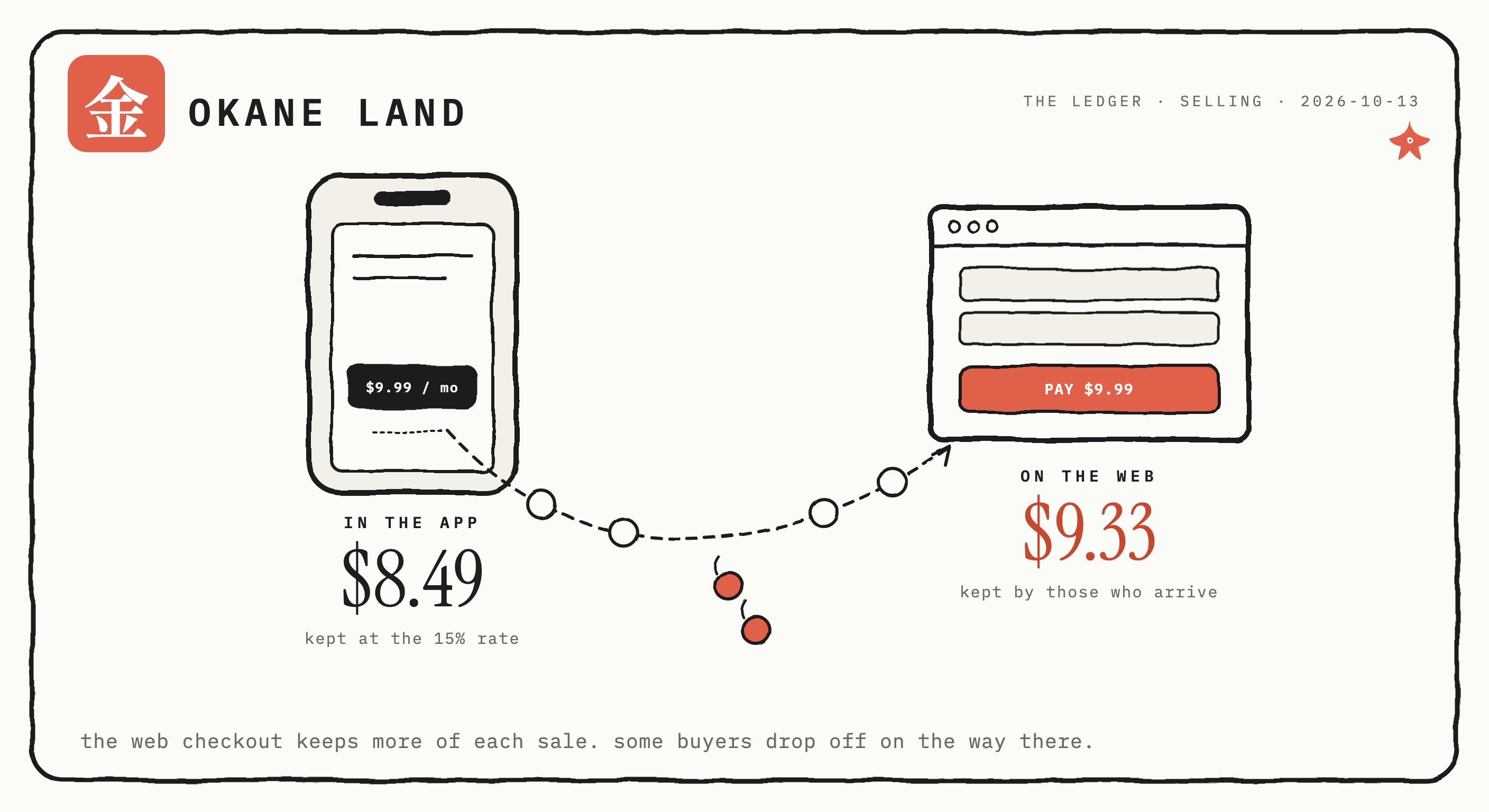
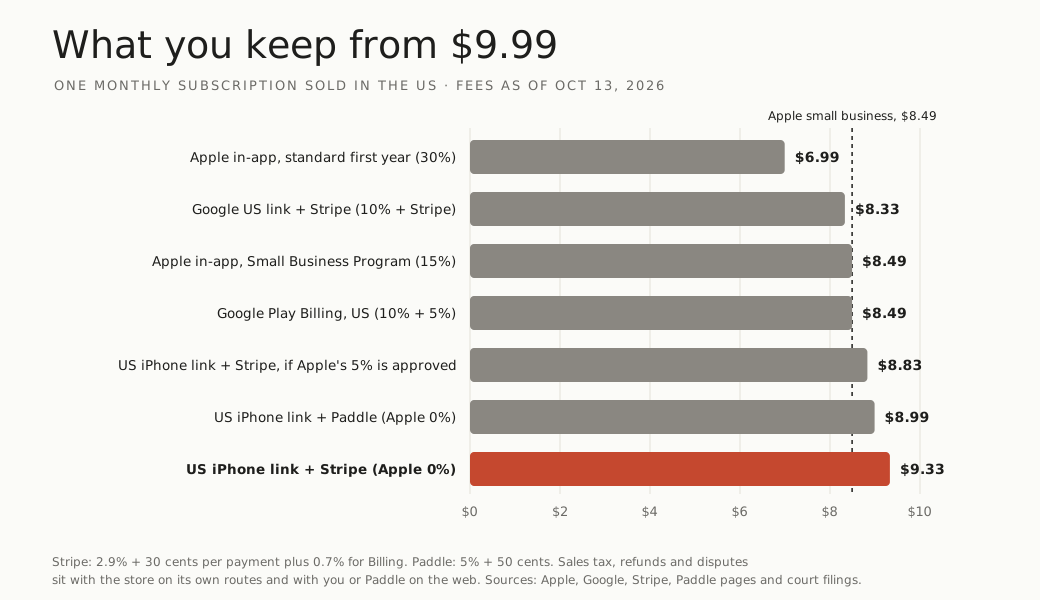
- The saving is 84 cents on a $9.99 plan. Stripe’s card and billing fees come to about 66 cents, so a small developer keeps $9.33 on the web against $8.49 in the app, and takes on the sales tax, refunds and disputes Apple handles for its cut.
- That covers losing about 9% of buyers, and at 15% the published results came out flat or behind. RevenueCat’s test on its Dipsea app, recalculated at the small-business rate, “would have made 86¢ per IAP dollar” after adding a web button. Adapty reported a small-business app that rolled its test back when revenue per paywall viewer fell 9%. At 30% the results split.
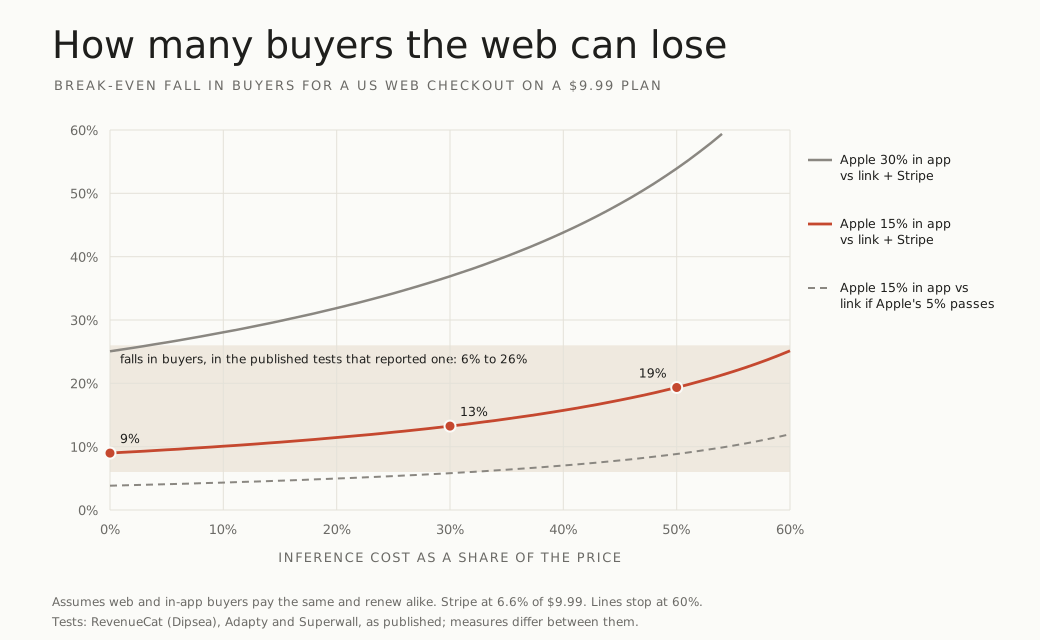
- The more an AI app spends on inference, the more buyers it can afford to lose. With inference at 30% of the price, the break-even fall in buyers is 13%; at half the price, 19%.
- On Android the link saves nothing. Play Billing costs a US subscription 15% in all, and since October 1 Google charges 10% on subscriptions bought through a link. A link plus Stripe keeps $8.33 against $8.49.
- In the EU a small developer’s link-out costs more than the app. Since October 1 Apple takes 10% on link-out sales from small developers and 15% in the app. Add card fees and the app comes out ahead, and on the web you file the VAT yourself.
Everything below is the evidence, with the fee math stated once so you can redo it with your own price.
What the stores charge now
| Route | Who | Rate | In force |
|---|---|---|---|
| Apple in-app purchase | standard | 30% in a subscriber’s first year, then 15% | long-standing |
| Apple in-app purchase | Small Business Program | 15% | long-standing |
| Apple, US web link | most apps | 0% until a court approves a fee | since April 30, 2025 |
| Apple’s proposed US link-out fee | standard, renewals, small business | 15%, 10%, 5% | proposed August 13, 2026 |
| Google Play Billing, US, EEA and UK | subscriptions | 10% plus a 5% billing fee | since June 30, 2026 |
| Google, US link or your own billing | subscriptions | 10% | charged from October 1, 2026 |
| Apple in-app purchase, EU | standard, small business | 26%, 15% | since October 1, 2026 |
| Apple link-out, EU | standard, small business | 15%, 10% | since October 1, 2026 |
The Small Business Program changes the math the most. It covers developers with up to $1 million in proceeds in the prior calendar year, counted together with any associated accounts, and developers new to the App Store. Pass $1 million and the standard rate applies for the rest of that year. The lower rate starts 15 days after the end of the fiscal month in which Apple approves you, so it is worth enrolling before the first sale. Outside the program, a subscription drops to 15% once the subscriber has a year of paid service; free trials do not count toward the year.
The US zero is a court order, and it may not last. In April 2025 a federal judge held Apple in contempt and barred any commission on purchases made outside the app. The Ninth Circuit kept the contempt finding in December 2025 but called the permanent ban too punitive: Apple may charge a fee based on its necessary costs, with some compensation for its intellectual property, and until the trial court approves one, it may charge nothing. Apple filed its proposal on August 13, and as of the October 9, 2026 status report the parties were still negotiating the scope of Apple’s document production, with Epic’s 60-day response clock not yet started. The Supreme Court has also agreed to hear a narrower question in the case, with Epic’s brief due November 13, 2026.
What the web route costs
On a $9.99 monthly plan, Stripe takes 2.9% plus 30 cents for the card (59 cents) and 0.7% for Billing (7 cents): 66 cents, or 6.6%. International cards add 1.5%, currency conversion 1%, Stripe Tax 0.5% per transaction (or 50 cents through its API), and a dispute costs $15, plus another $15 if you contest it and lose. A merchant of record such as Paddle lists 5% plus 50 cents, which is 10% of a $9.99 price, quotes custom rates below $10, and takes the tax filing off your hands; our checkout guide prices that trade in full.
The in-app route includes work the web route hands back. Apple’s Paid Applications Agreement and developer pages say it collects the price as your agent, collects and remits sales tax and VAT in the US, the EU and the UK, runs refunds, retries failed renewals for up to 60 days and pays out within 45 days of the month’s close. On the web, each of those becomes your job or a vendor’s line item. Tools such as RevenueCat cost the same on both routes: free up to $2,500 of monthly revenue, then 1% of all of it.
The break-even
A web route earns more per sale and closes fewer sales. To find how many buyers it can lose, divide the saving per sale by what a web sale keeps: at the 15% rate, 84 cents divided by $9.33 is 9%. If each subscriber also costs you inference, subtract that from what the web sale keeps before dividing. On a $9.99 plan, with buyers on both routes paying the same and renewing alike:
| In the app | On the web | Web route can lose up to |
|---|---|---|
| Apple, 15% | iPhone link, Stripe | 9% of buyers |
| Apple, 15% | iPhone link, Paddle | 5.6% |
| Apple, 30%, first year | iPhone link, Stripe | 25% |
| Apple, 30%, first year | iPhone link, Paddle | 22% |
| Apple, 15% | iPhone link, Stripe, Apple’s proposed 5% | 3.8% |
| Google Play Billing, 15% | Google’s 10% plus Stripe | none: the link costs more |
The two lines that matter for most small apps are the first and the fifth. Today a small developer’s web checkout can afford to lose about one buyer in eleven. If the court approves anything like Apple’s proposal, the margin shrinks to about one in twenty-six.
What the tests found
RevenueCat ran the most detailed public test on Dipsea, an audio app it bought to run experiments like this, in May 2025: about 3,100 new US iPhone users in each of the three groups it compared, over roughly three weeks. Paying conversion was 6.30% with in-app purchase only, 5.90% with a web button added and 5.30% with the web only. At a 30% Apple fee, proceeds per customer came to $2.09, $1.94 and $1.96. Recalculated at the 15% rate, the web-button group would have made 86 cents and the web-only group 77 cents for every in-app dollar. In the web-button group, the web annual plan cost $47.99 against $69.99 for the in-app one, which moved revenue as well as conversion.
Superwall’s early data, published the same month without a sample size, showed initial conversions down 11.9%, net proceeds up 19.85% at a 30% fee and down 1.3% at 15%. Adapty’s one-year review of three customer apps, updated in September, found the same split. A 30%-tier app lost 26% of its purchase rate and still earned 53% more per paywall viewer after redesigning the web offer, a result Adapty itself calls directional. A 15%-tier app earned 9% less per viewer and rolled the test back.
Most of these numbers come from companies that sell web-checkout or paywall tools, so the losses they report run against their own pitch. Across the 115,000 apps in RevenueCat’s 2026 report, web purchases made up 3.2% of revenue worldwide and 4.9% in North America. The big savings so far belong to large apps paying 30%: Match Group’s 2026 guidance assumes about $110 million of savings from alternative payments, up from the $90 million it first expected, and the company has noted “some impact to gross revenue” in tests at Tinder and Hinge.
Why AI apps get more room
The store fee comes off the price, and an AI app’s profit is the price minus what its users cost in inference. That makes the fee a bigger share of what is left. Take a $9.99 plan whose subscriber burns $3 a month in model calls. In the app at 15%, the developer keeps $5.49 after inference; on the web, $6.33, about 15% more. The break-even fall in buyers rises to 13%, against 9% for an app with no inference bill.
AI apps also carry a heavier refund load on the web. Their buyers ask for money back more often: RevenueCat puts the median refund rate for AI apps at 4.2% against 3.5% for other apps, and on the web every refund and dispute is yours to handle, at $15 or more a dispute on Stripe. Separately, Apple now gives Small Business Program members with fewer than two million first-time downloads its own Foundation Models on its servers “with no cloud API cost”, another reason to enroll.
The big AI apps have taken both paths. ChatGPT Plus costs $19.99 in the iPhone app and $20 on the web, and OpenAI’s help pages recommend subscribing on chatgpt.com to people who use ChatGPT across several devices. Anthropic prices part of the fee into the app: Claude Max 5x costs $124.99 in the iPhone app and $100 on the web, and the Pro annual plan $214.99 against $200. Google charges the same for Gemini in both places. The money involved is growing fast: Sensor Tower counts more than $5 billion in in-app spending on generative AI apps in 2025, nearly three times the year before.
Google Play: a smaller gap
Google rebuilt its fees this year. In the US, the EEA and the UK since June 30, a subscription pays a 10% service fee plus a 5% billing fee when it goes through Google Play Billing, and 10% with no billing fee through your own billing or an external link. Australia and Japan followed on September 30, Korea moves on December 31, 2026 and the rest of the world in September 2027. In the US, developers must report and pay the 10% on link-out subscriptions bought within 24 hours of the click from October 1. Epic objected to such fees in October 2025 and then settled with Google in March 2026; the court has not ruled on the fees, and since July it has required monthly compliance reports.
The arithmetic leaves little to gain. A link plus Stripe costs 16.6% of a $9.99 plan against 15% through Play Billing, and with Play Billing Google also collects US sales tax in the states that levy it. On Android, Play Billing is the cheaper route unless your payment processor costs well under 5%.
Outside the US
Apple moved the EU to a single set of terms on October 1. In-app purchase costs 26%, or 15% for small developers and subscriptions after a year. Your own payment inside the app costs 20% or 10%. A link-out costs 15% or 10%, applies to sales within seven days of the tap, includes later renewals and locks you into the choice for 12 months. Japan and Brazil charge 21% plus a 5% processing fee in the app, or 10% plus 5% for small developers, and 15% or 10% on link-outs.
For a small developer those link-out rates sit too close to the in-app rate to leave room once US-style card fees are added, and the web route also hands you the VAT filing. These comparisons use Stripe’s US domestic rates. Larger developers paying 26% in a subscriber’s first year in the EU have about 4 points to work with on a Stripe checkout, less once international card fees apply.
What to do
- Enroll in the Small Business Program first. It halves Apple’s first-year cut for anyone under $1 million, and the rate only starts after approval.
- Price the web route with everything in it. Card fees, billing, tax handling or a merchant of record, refunds and disputes, on your actual price. Low prices lose more to Stripe’s 30-cent fixed fee.
- Do the division. Divide what the web saves per sale by what a web sale keeps after inference, and compare the result with the share of buyers you expect to lose.
- If you test, test properly. Split new users at random and judge on revenue per paywall viewer through at least one renewal; first-purchase conversion alone misleads in both directions.
- Consider pricing the fee in. Anthropic charges more inside the app than on the web for its Max plans, which recovers part of the store’s cut from the buyers who choose the app.
- Build the web button so you can turn it off. The US fee may change after the trial court rules or the Supreme Court decides.
- On Android, stay on Play Billing. Since Google’s 10% applies to link-out sales too, the web route costs more there.
One email, when there's something worth sending
Get the research in your inbox.
No fixed schedule, no filler. You get an email when we've tested something, run the numbers, or found a tool worth your time.
Free. Double opt-in, unsubscribe in one click.
Priced something with this? Get the research →
Sources
| Source | Link |
|---|---|
| Apple, App Store Small Business Program (read 2026-10-13): 15% commission on paid apps and in-app purchases for developers with up to $1 million in proceeds in the prior calendar year and for new developers; the standard rate applies for the rest of a year once $1 million is passed; the reduced rate starts 15 days after the fiscal month of approval; members with fewer than two million first-time downloads can use Apple Foundation Models on Private Cloud Compute with no cloud API cost. | developer.apple.com ↗ |
| Apple, auto-renewable subscriptions and the Paid Applications Agreement, Schedule 2 (read 2026-10-13): 70% of the price in a subscriber's first year and 85% after one year of paid service; Apple collects prices as agent, collects and remits sales tax and VAT in listed regions including the US, EU and UK, handles refunds, and pays within 45 days of the fiscal month's close. | developer.apple.com ↗ |
| Apple, App Review Guidelines 3.1.1(a) and 3.1.3 (read 2026-10-13): link entitlements are not required for buttons, external links or other calls to action in United States storefront apps. | developer.apple.com ↗ |
| US Court of Appeals for the Ninth Circuit, Epic Games v. Apple, No. 25-2935 (December 11, 2025): contempt finding affirmed; the permanent bar on any commission reversed; no commission on linked-out purchases until the district court approves a fee. | cdn.ca9.uscourts.gov ↗ |
| Apple's remand proffer, Epic Games v. Apple, N.D. Cal. 4:20-cv-05640, Dkt. 1708 (August 13, 2026): proposed US link-out commissions of 15% for standard apps, 10% for partner programs and subscription renewals, and 5% for Small Business Program apps; plus the docket through the October 9, 2026 status report and the Supreme Court docket in No. 25-1311. | courtlistener.com ↗ |
| Apple, alternative payment options and DPLA Attachment 14 for the EU (read 2026-10-13): from October 1, 2026, 26% or 15% on in-app purchases, 20% or 10% on alternative in-app payments, 15% or 10% on link-outs, a 7-day attribution window with renewals included, and a 12-month commitment. | developer.apple.com ↗ |
| Apple, app distribution in Japan and in Brazil (read 2026-10-13): in-app purchase at 21% plus a 5% payment processing fee, or 10% plus 5% for small developers and renewals after a year; link-outs at 15% or 10%. | developer.apple.com ↗ |
| TechCrunch, "Apple's Cal AI crackdown signals it's still policing the App Store" (April 21, 2026): Cal AI's brief removal for an embedded Stripe checkout that removed in-app purchase, among other violations Apple cited; in most cases apps must still offer Apple's in-app purchase alongside an external link. | techcrunch.com ↗ |
| Google Play, lower service fees and the new fee structure (read 2026-10-13): in the US, EEA and UK from June 30, 2026, subscriptions at 10% plus a 5% billing fee when Google Play Billing is used; Australia and Japan from September 30, 2026, Korea from December 31, 2026 and the rest of the world from September 30, 2027. | support.google.com ↗ |
| Google Play, US external content links and alternative billing (read 2026-10-13): 10% on subscriptions bought through a link within 24 hours of following it, with fees reported and paid from October 1, 2026; no billing fee on these routes. | support.google.com ↗ |
| Epic Games v. Google, N.D. Cal. 3:20-cv-05671: Epic's October 30, 2025 position that fees on link-out purchases would violate the injunction (Dkt. 754), the March 4, 2026 settlement, the July 14, 2026 withdrawal of the joint motion to modify the injunction (Dkt. 824) and the July 24, 2026 order for monthly compliance reports (Dkt. 831). | courtlistener.com ↗ |
| Google Play, tax and merchant-of-record pages (read 2026-10-13): Google collects US sales tax on Play Billing purchases in the states that levy it; under alternative billing or links the developer handles tax. | support.google.com ↗ |
| Stripe pricing (read 2026-10-13): 2.9% plus 30 cents per domestic card payment, 1.5% more for international cards, 1% for currency conversion, Billing at 0.7%, Tax at 0.5% per transaction (no-code) or 50 cents (API), $15 per dispute plus $15 to contest it (refunded if you win), and Managed Payments at 3.5% on top. | stripe.com ↗ |
| Paddle pricing (read 2026-10-13): 5% plus 50 cents per transaction as merchant of record, with custom pricing offered for products under $10. | paddle.com ↗ |
| RevenueCat pricing (read 2026-10-13): free up to $2,500 in monthly tracked revenue, then 1% of tracked revenue, web included. | revenuecat.com ↗ |
| RevenueCat, "IAP vs web purchases: conversion test" (May 2025): Dipsea, an app RevenueCat acquired as a testing ground, about 3,100 new US iOS users per group; paying conversion 6.30%, 5.90% and 5.30%; proceeds per customer at Apple's 30%, and RevenueCat's recalculation at 15%. Vendor source. | revenuecat.com ↗ |
| Superwall, "Initial data is in: app-to-web conversion rates after the App Store ruling" (May 7, 2025): initial conversions down 11.9%; net proceeds up 19.85% at a 30% fee and down 1.30% at 15%. Vendor source, sample not disclosed. | superwall.com ↗ |
| Adapty, "App-to-web paywalls on iOS: one year of data" (May 6, 2026, updated September 28, 2026): three customer apps, including a 30%-tier app with conversion down 26% and revenue per viewer up 53%, and a 15%-tier app with revenue per viewer down 9% that rolled its test back. Vendor source. | adapty.io ↗ |
| RevenueCat, State of Subscription Apps 2026 (115,000+ apps, 2025 data): web purchases at 3.2% of total revenue globally and 4.9% in North America; median North American monthly price of $9.99; AI apps' median refund rate of 4.2% against 3.5%. Vendor source. | revenuecat.com ↗ |
| Match Group shareholder letters: Q3 2025 (November 4, 2025), expecting about $90 million of 2026 savings from alternative payments and noting "some impact to gross revenue" in tests at Tinder and Hinge; Q4 2025 (February 3, 2026), guidance assuming about $110 million of 2026 Adjusted EBITDA savings from alternative payments. | sec.gov ↗ |
| App Store listings and pricing pages for ChatGPT, Claude and Gemini (read 2026-10-13): ChatGPT Plus at $19.99 in the iPhone app and $20 on the web; Claude Max 5x at $124.99 in the app and $100 on the web, Pro annual at $214.99 and $200; Gemini at the same prices in both. | apps.apple.com ↗ |
| Anthropic support, "What is the Max plan?" (read 2026-10-13): Max 5x at $100 and Max 20x at $200 a month, prices for web subscriptions only. | support.claude.com ↗ |
| OpenAI Help Center, "How do I avoid being charged twice if I subscribe to ChatGPT on iOS, Android, and the web?" (read 2026-10-13): subscribing on chatgpt.com as the recommended option for people who use ChatGPT across multiple devices. | help.openai.com ↗ |
| Sensor Tower, State of Mobile 2026 (January 21, 2026): in-app revenue of generative AI apps nearly tripled in 2025 to more than $5 billion. | sensortower.com ↗ |
Show your work: if a number can't be shown, we don't print it.