The Proof · AI tool
Rank Prompt on the free plan: it scored our AI visibility at zero, and by hand we found citations on two of eight questions
- Who it's for
- A solo builder who wants to know whether AI assistants cite their site, and is willing to write the questions themselves. The free report answers a different question, whether AI names your brand when asked for recommendations in your category, and a new site scores zero on that by construction. The useful mode, running your own prompts across four engines, costs a credit each and starts at $39 a month.
- Real cost
- $0. A Google sign-in, no card, ten welcome credits. The auto-generated first report spent nine of them in about four minutes; the tenth bought one custom question on four engines. Starter is $470 a year, billed annually, for 150 credits a month. The seven-day trial needs a card, converts on its own, and refunds are discretionary inside 24 hours.
Before we opened an account we asked Perplexity and Google AI Mode eight questions our readers ask, and wrote down every source they cited. Then we let Rank Prompt run its free report on the same site. It said zero percent, on nine questions it wrote itself. Both results are correct, and the gap between them is the whole product: an AI visibility tool measures the questions it chooses, and the free plan chooses questions a small site cannot win.
What's good
- The site read is accurate. From the bare domain it correctly described the six sections, the editorial standard, the pen name and the newsletter, and built its prompt categories from that.
- When we spent the last credit on one of our own questions, it found what we had found by hand: our Perplexity-limits study cited by Claude and Perplexity Sonar, plus the Reddit thread that links to it. The citations tab labels your own pages "Your Site."
- Every answer is stored in full with its sources, so you can read what ChatGPT, Claude, Perplexity and AI Mode said, question by question, rather than trusting a score.
- The free action plan is specific to the site rather than boilerplate: methodology blocks on reviews, a plain-language summary on the homepage, internal links from reviews to research, an Indie Hackers outreach idea.
- The create-report form tells you exactly which model stands behind each engine name, which most trackers hide.
Where it breaks
- The free report writes brand-recommendation questions, "what publications would you recommend for hands-on AI tool reviews," and a new independent site scores zero on those by construction. Our hand-measured baseline on reader questions found citations on two of eight, on both engines we could check.
- "ChatGPT" in the report is GPT-5.6 Luna and "Claude" is Claude Haiku 4.5, the cheapest models on each API. The models people use in the apps, and every Gemini, Grok and Sonnet, are premium and locked on the free plan.
- Ten credits, gone in one report. Running your own questions, the mode that produces useful numbers, is one credit per prompt across the bundled engines, and the free plan leaves you one to spend.
- The competitors list mixes real peers such as Indie Hackers and One Useful Thing with article headlines parsed as businesses, including one called "AI Is Enabling More Entrepreneurship."
- The trial takes a card and converts to a paid plan on its own, refunds are at the company's discretion within 24 hours of a charge, and the privacy policy says nothing about what happens to the prompts and AI answers it collects for you.
How we tested
An AI visibility tool sells a number. The only way to test the number is to know the answer first. So before the account existed we measured our own site by hand.
We wrote eight questions our readers ask, each one with a page on this site that could answer it, and typed them fresh into Perplexity, signed out, and Google AI Mode, signed in. For every answer we read the engine’s own source list and wrote down every domain. That is the ground truth in the kit: 8 questions, 2 engines, 16 answers, every cited domain named. ChatGPT was meant to be the third engine and never rendered a search answer signed out on two tries, so it is not in the baseline.
Then we gave Rank Prompt the bare domain and let it do what it does. The gates were fixed with the fixture: a live report at $0 with no card, what the report contains and how its questions are chosen, precision and recall against the baseline where the credits allowed, whether the competitors it names are plausible peers, whether its action plan repeats the schema myths we have already researched and dropped, where the trial wall sits, the price and refund terms, and what the policies say about your data.
The door
Sign-in is a Google account. Onboarding is a chat with an assistant: who are you, what is your website, then “reading your site now.” Its read of okaneland.com was accurate to a degree we did not expect. It listed the six sections by name, quoted the editorial standard, identified the author as a pen name, described the newsletter, and proposed ten categories. Nine minutes after the homepage, we were looking at nine questions it had written.
That is where the test really begins, because the questions decide the number.
The nine questions it wrote
Every one of the nine is a request for a recommendation. “What are the most recommended independent publications for hands-on AI tool reviews and cost comparisons?” “Which independent publications offer practical vibe coding guides for building products with AI?” “Can you recommend research publications that examine the real costs, workflows, and business results of AI for solo founders?”
These are the questions a brand-tracking product has to ask, because its headline metric is whether an assistant names your brand. They are also questions no assistant answers with a nine-month-old independent site. It ran them on ChatGPT, Claude and Google’s AI Mode, 27 answers in about four minutes, and reported the result with a label: Emerging. Visibility 0 percent. Citations 0 percent. “AI named Okaneland in 0 of 9 questions on at least one platform. 0 of 218 sources it cited were your site.”
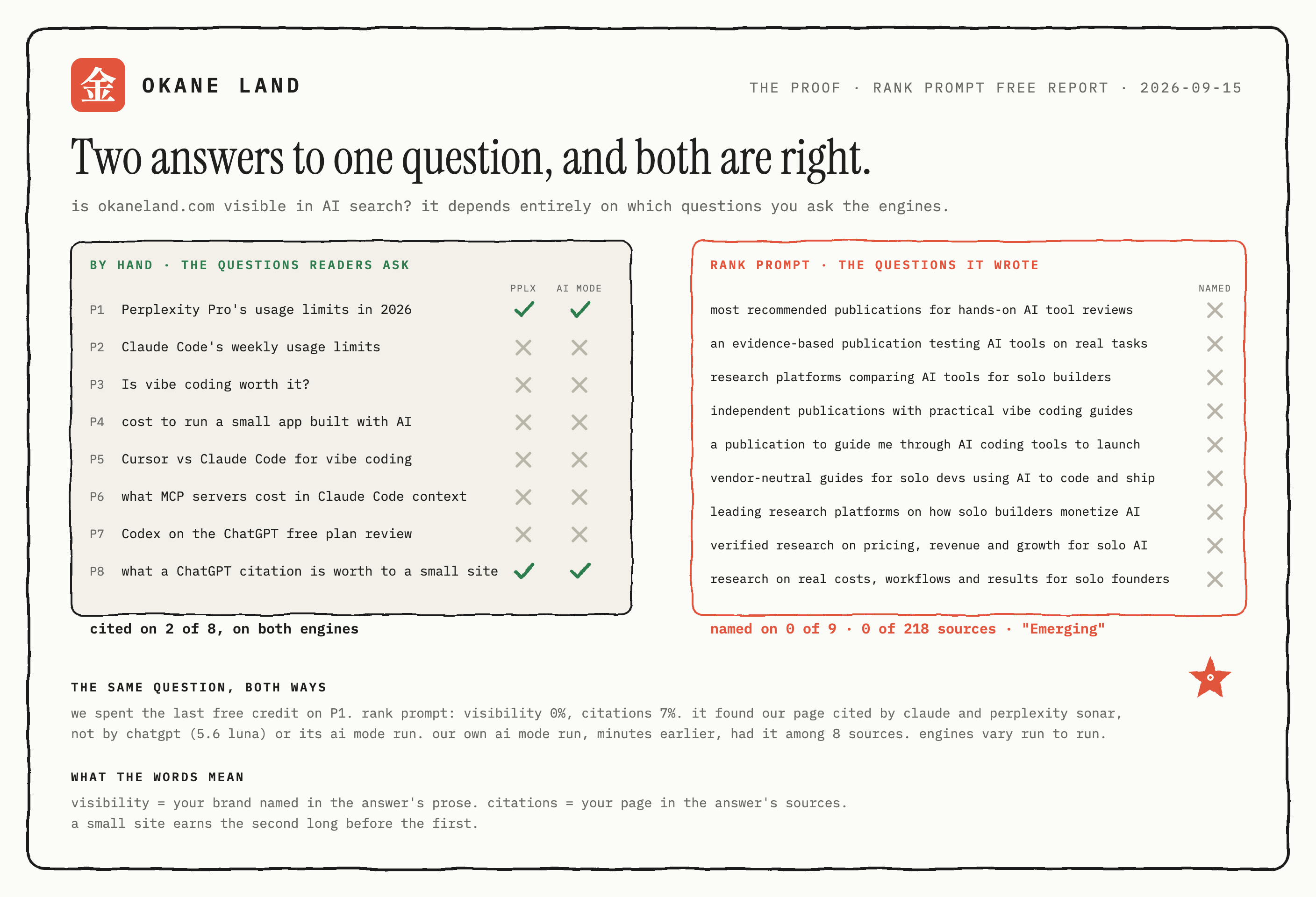
Set that beside the baseline. On the questions readers ask, both engines cited okaneland.com for two of eight: the Perplexity Pro limits study, and the study on what a ChatGPT citation is worth, where Perplexity listed our page first. On the other six, neither engine cited us and the tool would have been right to say so. Two measurements of the same site on the same afternoon, zero and two of eight, and neither is wrong. They are answers to different questions.
The words matter here. In Rank Prompt’s vocabulary, visibility is your brand named in the prose of an answer, and citations are your pages in the answer’s sources. A small site earns the second long before the first. The free report’s questions are built to measure the first.
The same question, both ways
The free account arrives with ten credits. The first report spends nine. We spent the tenth on one of our own questions, the Perplexity limits one, across the four engines the standard bundle covers.
The result page said visibility 0 percent, citations 7 percent, and the citations tab explained it: two of 29 citations across the four answers were our study, labelled “Your Site,” with the Reddit thread that links to it cited twice more. Claude and Perplexity Sonar had both cited the page. ChatGPT had cited only Perplexity’s own help center. AI Mode’s five sources included the Reddit thread and not our page, while our own AI Mode run minutes earlier had our page among eight sources. Engines vary between runs, which is a reason to track over time and a reason to distrust any single reading, including ours.
So on the one question we could afford, the tool found what we found. That is the product working. It is also the product you cannot use on the free plan, because the credit that bought it was the last one.
What stands behind the engine names
The create-report form is the most useful page in the app, because it says what “ChatGPT” means. The standard bundle, one credit per prompt, is ChatGPT 5.6 Luna, Perplexity Sonar, AI Mode and Claude Haiku 4.5. The premium tier, an extra credit each and locked on the free plan, is ChatGPT 5.6 Terra, Grok 4.20, Gemini 3.7 Flash and Claude Sonnet 5.
Read that as a buyer. A report that says you are invisible on ChatGPT has asked the cheapest model on OpenAI’s API, which is not the model a person gets in the ChatGPT app. It is a reasonable engineering choice at a credit a prompt. It is not the same thing as your visibility in ChatGPT, and the report page does not say so.
Competitors, sources and the plan
The competitors tab lists 129 “businesses” named across the 27 answers. The top of the list is real: Indie Hackers, One Useful Thing, The Gradient, There’s An AI For That, Artificial Analysis, TechRadar Pro. It also contains an entry called “AI Is Enabling More Entrepreneurship,” which is a headline the parser mistook for a company. The citations tab is cleaner, 208 unique sources with paths, and it is the part of the report we would read first, because it shows that small sites do get cited for these questions: a Substack vibe-coding guide, a one-person blog post on solo-founder AI stacks, a personal site’s tool roundup.
The free action plan, nine tasks written from the site, is better than the genre. It wants a methodology block on every review, a plain-language summary on the homepage, the Study and Ledger sections linked as a cluster, an Indie Hackers contribution, and internal links from reviews to research. It hedges its schema advice with “only where the page content supports it.” It does slip once: “Add ItemList and Review schema” to the reviews index, and ItemList is on the list of recommendations we have researched and dropped. No FAQ schema, no question-shaped headings, no keyword stuffing.
Where it breaks
The free report asks the wrong question for a small site. It is built to say whether AI recommends your brand, and for a new independent publication the answer is no on every engine and will be for a long time. The number is true and useless. The useful number is whether your pages get cited for the questions people ask, and the free plan gives you one credit to find out.
The model behind the name. Visibility on “ChatGPT” is visibility on GPT-5.6 Luna. The app’s model and every premium engine sit behind the trial.
The parser. Article titles become competitors. Check the list before you put it in front of a client.
The trial and the refund. Seven days, card required, converts to paid on its own. The terms offer a refund “within 24 hours of being charged… at our discretion” and none for forgotten cancellations. Monthly credits do not roll over.
The policy gap. The privacy policy, last updated in March, covers your email and usage data and says nothing about the prompts and AI answers the product collects for your brand, or whether they train anything.
Real cost
Free is $0 forever and buys one auto-generated report plus one question of your own. Starter is $470 a year, billed annually, which the pricing page presents as $39.17 a month, for 150 credits a month, six engines and up to ten brands. At one credit per bundled prompt, 150 credits is our eight questions on four engines about four times a month, or once a week with a few premium engines added. Pro is $855 a year for 500 credits. The trial is seven days with 50 credits and a card.
The verdict
Situational, and the situation is a paid one. The machinery is sound: it reads a site well, stores every answer with its sources, labels your own pages, and on the one question we could afford it agreed with our hands. The free report is where the trouble is. Its questions produce a zero for any site that is not yet a brand, and the label it puts on that zero, Emerging, is the beginning of a sales conversation rather than a measurement of anything a solo builder can act on.
If you want the number this tool can produce, write your own questions first, the ones your readers type, and count the credits before you start. If you want to know whether your pages are being cited this week, the method in our kit costs nothing: type the question, open the sources, write down the domains. We did it for eight questions in twenty minutes, and it is the baseline every visibility tool should be measured against before you pay for one.
One email, when there's something worth sending
Get the research in your inbox.
No fixed schedule, no filler. You get an email when we've tested something, run the numbers, or found a tool worth your time.
Free. Double opt-in, unsubscribe in one click.
Checking your own AI visibility? Get the research →
Sources
Every outside quote in this review was re-fetched from its source before we used it.
| Source | Link |
|---|---|
| The test kit: the frozen fixture and gates, the hand-measured ground truth with every domain each engine cited for the eight questions, and the run log (2026-09-15). | okaneland.com ↗ |
| Rank Prompt pricing: Free "$0 forever" with the first full report; Starter $39.17 a month billed annually ($470 a year) for 150 credits; the 7-day trial needs a card (read 2026-09-15). | rankprompt.com ↗ |
| Rank Prompt platform page: prompts are auto-generated from your brand, competitors and keywords; visibility is a proprietary 0 to 100 score across six engines (read 2026-09-15). | rankprompt.com ↗ |
| Rank Prompt terms of service, last updated March 12, 2026: refunds "within 24 hours of being charged... at our discretion," trial auto-converts, monthly credits do not roll over. | rankprompt.com ↗ |
| Rank Prompt privacy policy, last updated March 12, 2026: covers account and usage data; no statement on tracked prompts, AI answers or model training. | rankprompt.com ↗ |
| Okane Land, what a ChatGPT citation is worth: the study behind one of the two questions where our site was cited by hand (2026-07). | okaneland.com ↗ |
| Okane Land, Perplexity Pro limits: the study cited on both engines by hand and by the paid-style custom run (2026-06). | okaneland.com ↗ |