The Study · Explainer
AEO and GEO: one real study, a pile of mythology, and a traffic cliff

In 2024, a team led out of IIT Delhi and Princeton ran the first controlled experiment on getting content cited by AI search engines. They tested nine ways to rewrite a page. The one tactic the entire SEO industry was built on, stuffing a page with the keywords people search for, scored about 10% worse than doing nothing at all. Adding citations, real statistics, and direct quotes lifted a page’s visibility in AI answers by up to 40%. That paper, “GEO: Generative Engine Optimization,” is the closest thing this field has to a foundation. Almost everything sold on top of it is mythology.
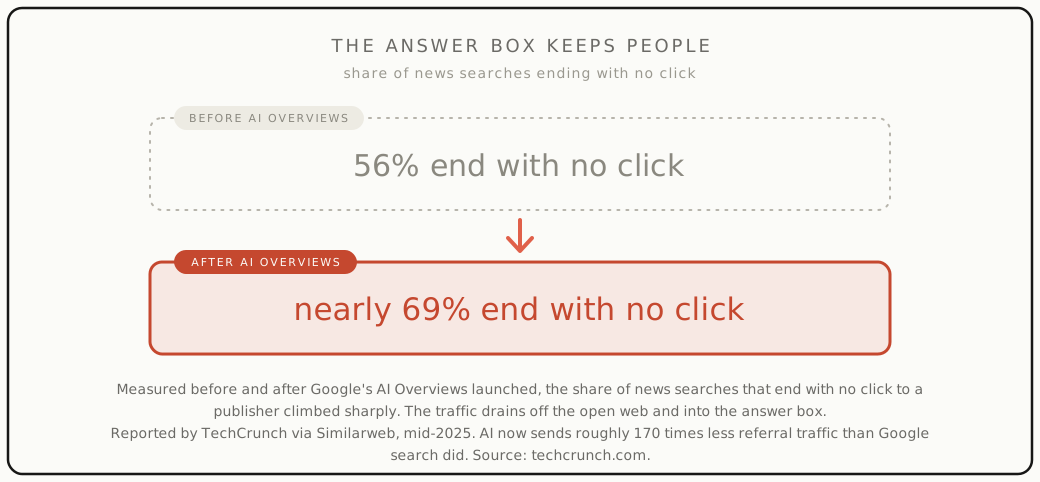
The reason this matters is not academic. When Google puts an AI summary at the top of the results, people stop clicking. Pew Research tracked 68,879 real Google searches and found users clicked a normal result link 8% of the time when an AI summary was present, versus 15% when it was not, and clicked a link inside the summary itself just 1% of the time. Since AI Overviews launched, the share of news searches that end with no click to a publisher rose from 56% to nearly 69%. The traffic is draining off the open web and into the answer box.
So the question every founder and marketer is now asking is fair: if AI is going to summarize me instead of sending me visitors, how do I at least get cited in the summary? The answer has a name, two names actually, AEO and GEO, and an industry selling tools around them. This is what the research supports, what it does not, and where the money is going. It is the same method as our look at whether AI coding really makes you faster: follow the funding, and trust the people measuring the gap over the people selling the close.
The short version
If you are shipping to earn and want to be found by AI search, the evidence backs a short list and contradicts a long one.
- It is still SEO. Google’s own 2026 documentation says optimizing for AI search “is optimizing for the search experience, and thus still SEO,” because the AI features run on the same ranking systems. The page still has to be indexed and good. There is no separate AI funnel to game.
- Credibility beats tricks. The one controlled study found that citing your sources, adding real numbers, and quoting experts measurably raised AI visibility. Keyword stuffing and a more “authoritative” tone did nothing. Write things that are true and well-supported.
- Get mentioned where AI reads. AI answers lean heavily on Reddit, Wikipedia, YouTube, and earned media; buying a GEO tool moves none of that. Being talked about on third-party sites tracks with AI visibility far more than backlinks do.
- Ignore the file-and-schema mythology. An llms.txt file is not read by any major engine. Special schema markup does not move AI citations in controlled tests. Both are sold hard and backed by nothing.
- Do not confuse cited with chosen. Most AI citations do not even name the brand, AI search engines get their source attributions wrong more than half the time, and getting cited is a long way from getting recommended. The target is noisy. Build for the reader who clicks through, because clicks are scarce and trust is the only durable asset.
Everything below is the evidence, including the parts that argue with the bullets.
What AEO and GEO actually are
Two terms, very different pedigrees. GEO, generative engine optimization, comes from research. It was introduced in a 2023 paper by Pranjal Aggarwal, Vishvak Murahari and colleagues, first posted to arXiv in November 2023 and published at KDD 2024, one of the top peer-reviewed venues in the field. It has a definition, a benchmark, and an experiment behind it.
AEO, answer engine optimization, comes from marketing. There is no founding paper and no clean origin. The term is usually traced to SEO consultant Jason Barnard, whose own site dates the coinage to 2017 in one place and 2018 in another, with his earliest concrete public use being a 2018 BrightonSEO talk. Even the people selling AEO cannot agree what it is: as of early 2026 there is no consensus definition separating AEO from GEO, LLMO, AIO, and “AI SEO,” and the labels get used interchangeably.
The cleanest definition comes from the company that owns the index. Google’s position, in its 2026 Search Central documentation, is that “optimizing for generative AI search is optimizing for the search experience, and thus still SEO,” because its AI features are “rooted in our core Search ranking and quality systems.” The most authoritative voice in the room says the new discipline is the old discipline. Hold onto that. Most of what follows is the gap between that plain statement and what the tools are selling.
The one real experiment
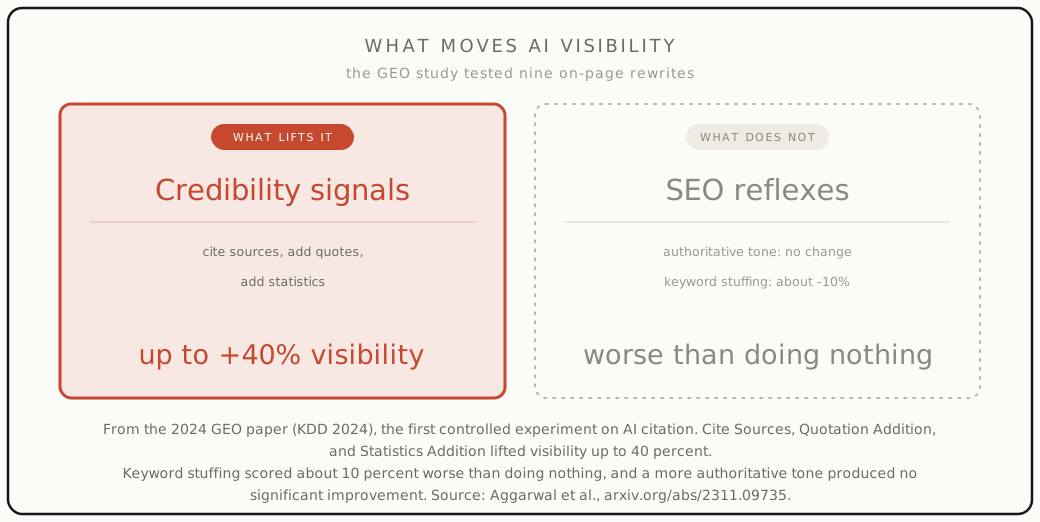
Give the GEO paper its due, because it is the only controlled result here. The researchers built GEO-bench, 10,000 queries across 25 domains, each paired with the top five Google results, and tested whether rewriting a source could make a generative engine feature it more. Three tactics worked: Cite Sources, Quotation Addition, and Statistics Addition lifted visibility by 30 to 40% on the paper’s main metric. The effect carried over to a live engine, Perplexity, at up to 37%. The lesson is narrow and real: generative engines reward content that looks credible, with sourced claims, real numbers, and named quotes.
The more useful finding is what failed. Keyword stuffing, the bluntest classic SEO move, performed about 10% worse than not optimizing at all. Rewriting in a more persuasive, “authoritative” tone produced no significant improvement; the models were already robust to it. The paper’s own conclusion is that traditional SEO strategies will not transfer to generative engines. So the foundational study says two things at once: a few credibility tactics help, and the reflexes most SEO blogs still sell actively hurt.
It is worth knowing the limits, because the next wave of research does. The GEO experiment measured how visible a single source is inside a fixed set of results. It did not test which of two competing pages wins the citation. That distinction matters, and the 2026 work went after it.
What the independent research adds
The sharpest correction comes from a controlled study, “What Gets Cited,” that ran 252,000 trials across six models. Its finding: the biggest drivers of being cited are topical relevance and retrieval position; on-page tweaks trail far behind. Formatting changes, the section-and-structure edits GEO tools push, had no measurable effect; the models “parse content regardless of visual organization.” Credibility and completeness cues helped, but only as secondary factors once a page was already relevant and retrieved. A separate Carnegie Mellon study, AutoGEO, automatically learned what generative engines prefer and landed back on “source citation” with credible attribution as a consistently favored feature, which independently corroborates the GEO paper’s one durable tactic.
Then there is the assumption under every “rank in AI” pitch: that AI cites the pages already ranking in Google. It mostly does not. An academic measurement from Ruhr University Bochum and the Max Planck Institute found AI Overview links have less than 50% overlap with Google’s organic top 10, and stay below 60% even against the top 100; on average 53% of the domains an AI Overview consults are not in the organic top 10 at all. An independent analysis by Originality.AI, across 29,000 health-and-money queries, found 52% of AI Overview citations come from outside the top 100 results. The AI is reading a broader, stranger set of pages than the ranking everyone optimizes for.
The engines cite badly
Here is the part the tools never mention: getting cited by an AI is a low-quality signal, because the citations themselves are unreliable. A Stanford study at EMNLP 2023 found that across four generative search engines, only 51.5% of generated sentences were fully supported by their own citations. It got worse at scale. Columbia’s Tow Center tested eight AI search engines on 1,600 queries and found they gave incorrect source attributions more than 60% of the time, ranging from Perplexity at 37% to Grok-3 at 94%. In an earlier test, ChatGPT Search was wrong on 153 of 200 source questions while almost never admitting uncertainty.
We saw the same thing first-hand. When we bought Perplexity Max and drove every tool in it, the advanced research modes were strong, but everyday search still leaned on SEO content mills, and one Deep Research report cited a politics magazine for a claim about AI billing. The fix in that review is the fix here: the Academic mode that restricts sources to real research is the antidote, which tells you the default is the problem.
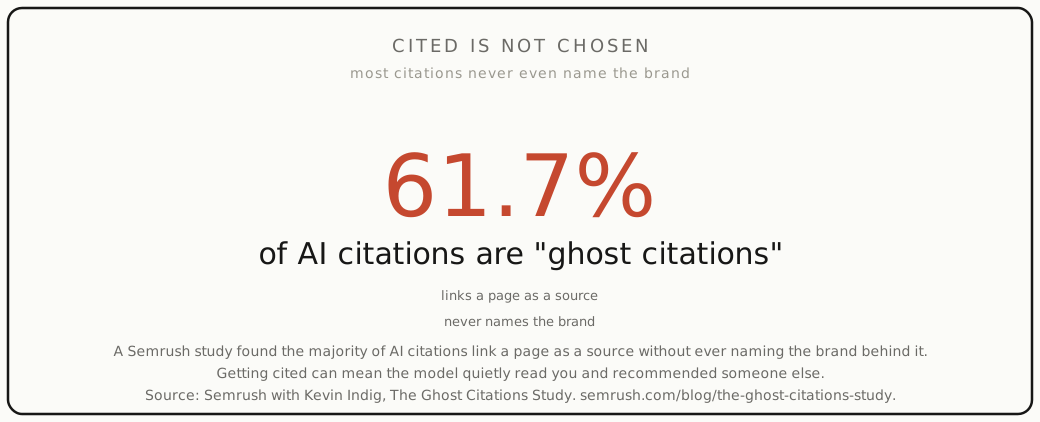
And being cited is not being chosen. A Semrush study found 61.7% of AI citations are “ghost citations” that link a page as a source without ever naming the brand. So “we got cited” can mean the model quietly read you and recommended someone else.
Who actually gets cited
If a GEO tool could buy you into AI answers, you would expect the citations to cluster around its customers. They do the opposite. Across the platforms, AI answers lean on community and earned sources. In Profound’s analysis of 680 million citations, Wikipedia made up almost half of ChatGPT’s top citations and Reddit nearly half of Perplexity’s. Peec AI’s look at 30 million cited sources ranked Reddit first, YouTube second, LinkedIn third. A 5W analysis found Wikipedia and Reddit alone drive more than 25% of US ChatGPT citations, while the Wall Street Journal, New York Times, and Bloomberg do not appear in the top 20. Muck Rack, across 25 million AI-cited links, found earned media accounts for about 84% and paid content 0.3%.
The rest is a very long tail. Evertune, across 200 million prompts, found even the single most-cited domain on a platform rarely exceeds 5% of citations, with the other 95% spread across thousands of sites. There is no shortcut into that distribution. The one thing that reliably moves it is being genuinely talked about: a clean natural experiment found that when Google’s AI Overviews started surfacing a subreddit, that community’s activity rose about 12%, concentrated in real opinion and experience rather than facts.
The myths the tools sell
With the evidence in hand, the popular tactics sort cleanly into what holds up and what does not.
- “Add an llms.txt file.” Busted. Google’s Gary Illyes said flatly that Google does not support llms.txt and is not planning to. John Mueller said no AI service uses it, and server logs show the bots do not even request the file, comparing it to the discredited keywords meta tag. An SE Ranking study of about 300,000 domains found no correlation with AI citations. We publish an llms.txt ourselves because it is cheap and harmless, but nobody should sell it as a citation tactic, because no engine reads it yet.
- “Add special schema markup.” Busted. Google’s documentation states plainly there is no special schema.org structured data you need to add. Ahrefs tracked 1,885 pages that added schema and found no meaningful uplift on any platform, with citations actually dipping slightly in Google’s AI Overviews. The “schema pages get cited more” claim is correlation: those sites also do everything else right.
- “Carry over your keyword tactics.” Busted by the founding study itself: keyword stuffing scored below baseline.
- “Format and structure for the AI.” Busted by the controlled citation study: formatting-only edits had no measurable effect.
- “GEO is a brand-new discipline.” Overblown. Google calls it still SEO, and the field cannot agree on its own definitions.
- “A tool can buy you in.” Overblown. There is no fixed ranking to game, ChatGPT cites only about 15% of the pages it even retrieves, and the citation distribution is a long tail dominated by earned sources.
The two tactics that survive contact with the evidence are unglamorous: be credible, and be mentioned.
What actually moves the needle
So here is the short list the research supports, stated plainly.
Make the content genuinely credible. The one controlled experiment says citations, statistics, and named quotes raise AI visibility, and the Carnegie Mellon work agrees. That lever is substance, and no formatting trick supplies it.
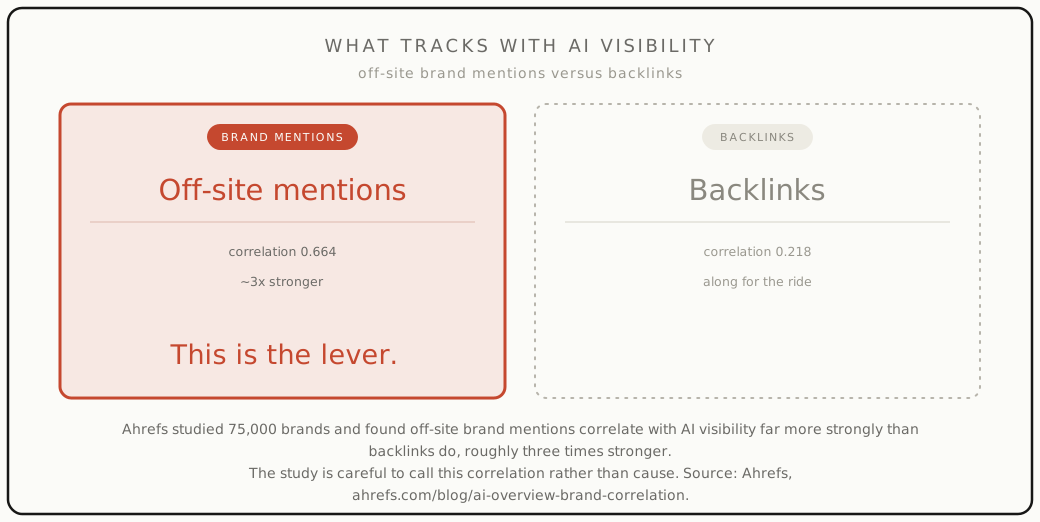
Earn mentions on the sites AI trusts. Ahrefs studied 75,000 brands and found off-site brand mentions track with AI visibility at 0.664 versus 0.218 for backlinks, roughly three times stronger, though the study is careful to call it correlation rather than cause. Combined with the earned-media and Reddit findings above, the pattern is consistent: third-party validation is the lever; your own page is along for the ride.
Match the engine and the moment. Freshness helps, but unevenly: about half of Perplexity’s citations are from the current year while ChatGPT skews older, so there is no universal recency rule.
And do the boring thing Google keeps repeating. Its single strongest recommendation is that unique, useful content will matter more than any other suggestion, and the only hard requirement to appear in an AI Overview is that the page is indexed and snippet-eligible. It is also why tools like Surfer SEO, which now score both classic SEO and AI-search visibility, are useful as scorecards but cannot sell you a separate AI funnel. There is not one.
The bottom line
Stand back and the hype cycle resolves. GEO is one solid, narrow research finding, that credibility beats tricks, wrapped in an industry that needed a new thing to sell after AI ate the click. AEO is the same instinct without even a paper behind it. The genuinely big story is that the click is disappearing and the answer box keeps people from leaving, with AI sending roughly 170 times less referral traffic than Google search did as of mid-2025.
The builders who come out ahead will be the ones who are actually worth citing, on the sites where AI reads, who stopped treating a citation as a sale, and no GEO tool or llms.txt file buys that. It is the same thing that worked before the machines started summarizing, with less room than ever to fake it.
One email, when there's something worth sending
Get the research in your inbox.
No fixed schedule, no filler. You get an email when we've tested something, run the numbers, or found a tool worth your time.
Free. Double opt-in, unsubscribe in one click.
Optimizing for AI search yourself? Get the research →
Sources & how we researched this
- Aggarwal, Murahari, Rajpurohit, Kalyan, Narasimhan & Deshpande (2024), GEO: Generative Engine Optimization. KDD 2024. arxiv.org/abs/2311.09735
- Vishwakarma, Kumar & Jamidar (2026), What Gets Cited: Competitive GEO in AI Answer Engines. SIGIR 2026. arxiv.org/abs/2605.25517
- Wu, Zhong, Kim & Xiong (2025), What Generative Search Engines Like and How to Optimize Web Content Cooperatively (AutoGEO). arxiv.org/abs/2510.11438
- Kirsten, Grosse Perdekamp, Wu, Upadhyay, Gummadi & Zafar (2025), Characterizing Web Search in the Age of Generative AI. arxiv.org/abs/2510.11560
- Liu, Zhang & Liang (2023), Evaluating Verifiability in Generative Search Engines. Findings of EMNLP 2023. arxiv.org/abs/2304.09848
- Zhang, Cui & Zhang (2026), The Impact of AI Search on the Online Content Ecosystem: Evidence from Google and Reddit. arxiv.org/abs/2605.16428
- Pew Research Center (2025), Google users are less likely to click on links when an AI summary appears in the results. pewresearch.org
- Google Search Central (2026), Optimizing your website for generative AI features on Google Search. developers.google.com/search/docs/fundamentals/ai-optimization-guide
- Google Search Central, AI features and your website. developers.google.com/search/docs/appearance/ai-features
- Barnard, Answer Engine Optimization (entity definition), with the coinage dated 2017 in one place and 2018 in another, plus the April 2018 BrightonSEO talk. jasonbarnard.com/entity/answer-engine-optimization
- Wikipedia (2026), Generative engine optimization (no consensus definition across AEO, GEO, LLMO and AIO). en.wikipedia.org/wiki/Generative_engine_optimization
- Jazwinska & Chandrasekar (2025), AI Search Has a Citation Problem. Columbia Journalism Review / Tow Center. cjr.org
- Jazwinska & Chandrasekar (2024), How ChatGPT Search Misrepresents Publisher Content. Columbia Journalism Review / Tow Center. cjr.org
- Originality.AI (2025), Google Ranking and AI Citations Study. originality.ai/blog/google-ranking-ai-citations-study
- Search Engine Land (2025), Google says normal SEO works for ranking in AI Overviews and llms.txt will not be used. searchengineland.com
- Search Engine Journal (2025), Google Says LLMs.txt Comparable To Keywords Meta Tag (John Mueller). searchenginejournal.com
- SE Ranking (2025), LLMs.txt: Why Brands Rely On It and Why It Does Not Work (about 300K domains). seranking.com/blog/llms-txt
- Ahrefs (2026), We Tracked 1,885 Pages Adding Schema. AI Citations Barely Moved. ahrefs.com/blog/schema-ai-citations
- Ahrefs (2025), An Analysis of AI Overview Brand Visibility Factors (75K brands). ahrefs.com/blog/ai-overview-brand-correlation
- Ahrefs (2026), Update: 38% of AI Overview Citations Pull From The Top 10. ahrefs.com/blog/ai-overview-citations-top-10
- Semrush, How Google AI Mode Compares to Traditional Search and Other LLMs. semrush.com/blog/ai-mode-comparison-study
- Semrush with Kevin Indig, The Ghost Citations Study. semrush.com/blog/the-ghost-citations-study
- Semrush, AI Overviews Study (Jan to Nov 2025). semrush.com/blog/semrush-ai-overviews-study
- Profound (Lafferty), AI Platform Citation Patterns (680M citations). tryprofound.com/blog/ai-platform-citation-patterns
- Peec AI (Rudzki, 2026), Top domains cited by AI search: analysis of 30M sources. peec.ai/blog
- 5W Public Relations (2026), Citation Source Audit Q1 2026: Wikipedia and Reddit drive over 25% of US ChatGPT citations. prnewswire.com
- Evertune (2026), AI Search Statistics for Generative Engine Optimization (200M prompts). evertune.ai
- Muck Rack (2026), What Is AI Reading? (25M+ AI-cited links). muckrack.com/blog/what-is-ai-reading-may-2026
- Seer Interactive (2025), AI Brand Visibility and Content Recency (5,000+ URLs). seerinteractive.com
- AirOps (2026), The Influence of Retrieval, Fan-out, and Google SERPs on ChatGPT Citations. airops.com
- Similarweb, via TechCrunch (2025), AI referrals up 357% year over year in June, reaching 1.13B; and ChatGPT referrals to news sites. techcrunch.com
- SparkToro and Datos (2024), Zero-Click Search Study. sparktoro.com
- Alphabet (2025 to 2026), Q1 and Q2 2025 earnings and June 2026 investor presentation (AI Overviews user figures). blog.google