The Primer · Marketing & Ads
How to make your product citable: an AEO walkthrough
Vendor-neutral
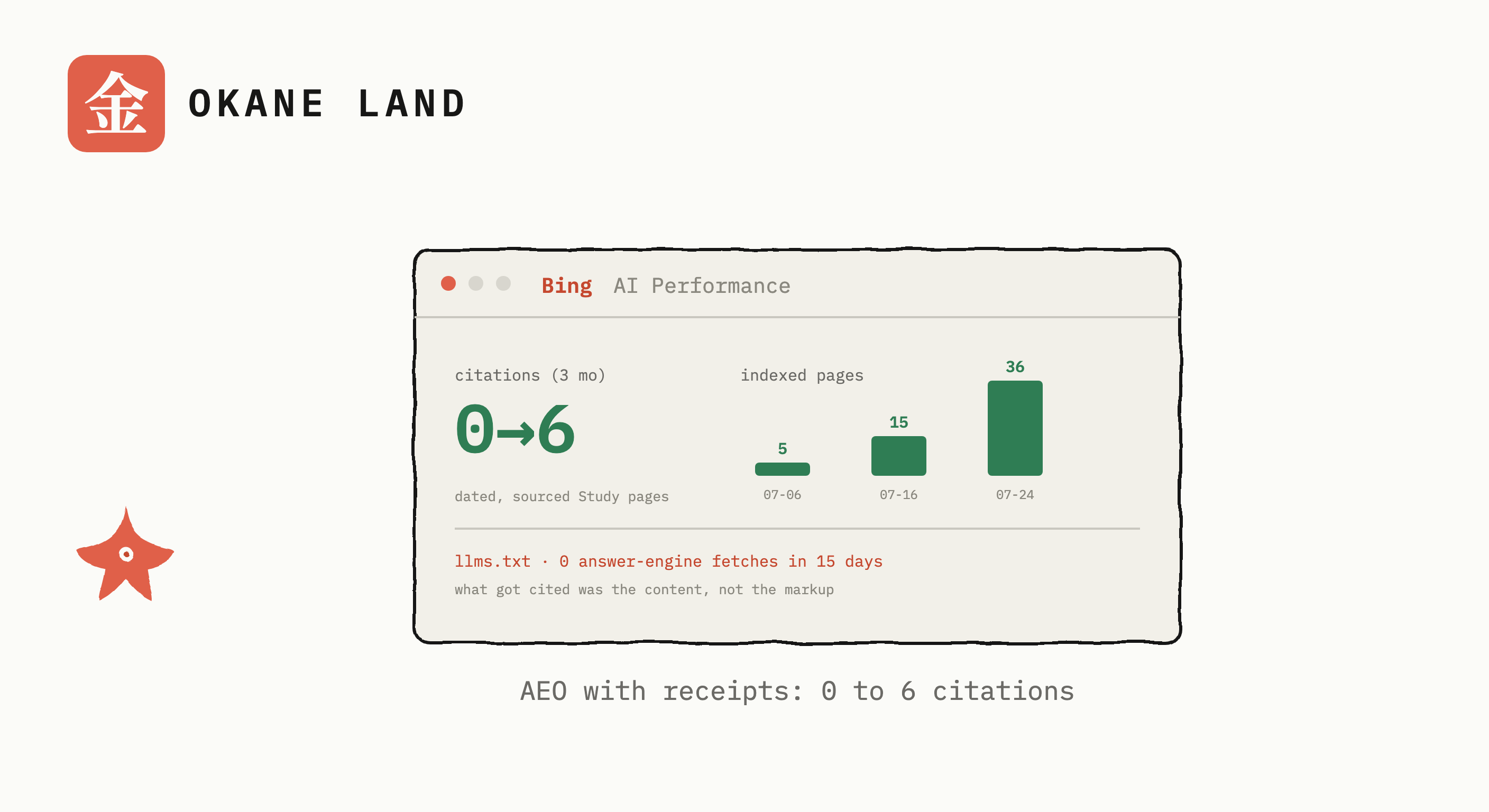
The get-cited-by-ChatGPT genre is thick with unverifiable stats. We can only publish the walkthrough we can show our work for: our own agent-facing plumbing, tied to the files on disk, our Bing citation report going from zero to six, a fifteen-day server-log test of whether answer engines even read an llms.txt, and the tactics our own research made us drop. Every step carries either a before-and-after or a named source.
The search results for “how to get cited by ChatGPT” are full of confident numbers with no receipt behind them. We cannot out-confident them, and we would not want to; the one thing this site can do that the playbooks mostly do not is show its work. We instrumented our own AI citability end to end, kept the logs, and read the one dashboard that measures it. So this is not a list of tactics that worked for someone. It is a walkthrough where every step is tied to a file on disk or a named source, including the steps that did nothing.
Here is the whole answer up front, and it is deliberately small. A small site can be cited: ours logged its first citations, going from zero to six, after we fixed indexation rather than after we added markup. The plumbing everyone recommends is cheap hygiene, and on our evidence it is not the lever. And the one file the AEO genre sells hardest, llms.txt, was requested by answer-engine crawlers exactly zero times in fifteen days of our logs. The receipts follow.
The dashboard that makes this measurable
You cannot manage what you cannot see, and until recently AI citations were invisible. Microsoft’s AI Performance report in Bing Webmaster Tools, launched in Public Preview on 10 February 2026, changed that: it reports how often your pages are cited across Microsoft Copilot, AI-generated summaries in Bing, and select partner integrations Microsoft does not name. Its metrics are Total Citations, Average Cited Pages, and Grounding queries, which Microsoft states plainly is a sample, not a full count. Two caveats travel with every number from it: it covers Microsoft surfaces, not ChatGPT or Claude, and it is a preview dashboard whose numbers Microsoft can restate.
Where we started, and what actually moved
Our own diagnosis, months ago, was that at zero citations the gap was not markup, it was indexation: five indexed pages against a same-owner sister site’s forty-seven, and on that sister site two pages accounted for 89% of its 241 citations. Citations are hit-driven, which means the prerequisite is being a specific, indexed page an engine can quote, not a clever tag.
So we fixed indexation first, and then read the report. The citation log has exactly one entry, and we quote it rather than dress it up:
2026-07-24 · indexed: 36 · citations(3mo): 6 · Cited pages both Study explainers: /study/ai-productivity-roi-at-work/ (4), /study/is-vibe-coding-worth-it/ (2). Grounding-queries breakdown still No data available. Impressions 132 over 3mo.
One reading, small numbers, and the causality is genuinely tangled: index recovery, URL submissions, and new Study publishes all overlapped, so we will not tell you a single action produced the six. What we will tell you is the shape. The cited pages are two Study explainers, dense with dated specifics and named sources. They are not the plumbing pages, and they are not the price-index data page, which has zero citations. That is the single most useful thing in this piece: what got cited was the specific, sourced content, exactly as the research in our citation-value study predicts, and not the markup layer.

The plumbing, receipt by receipt
We shipped the whole agent-facing kit, and you can read each file: /llms.txt and /llms-full.txt generated from the live content; per-article clean markdown served to agents that send Accept: text/markdown, via nginx content negotiation, for the five original sections (The Signal, added later, is not wired into it, so that is a real gap in our own setup, not a boast); and a robots.txt that names about twenty crawlers with Allow: / and carries no content Disallow rules, its single Disallow being Cloudflare’s own edge path. Ship this because it is cheap and harmless and makes your content legible to agents that do fetch markdown. Do not ship it believing it is what gets you cited, because our own citations landed on HTML Study pages, not on any of it.
The llms.txt adjudication
This is the section the genre will not write, so we ran the test. Google’s John Mueller said, in a dated April 2025 comment, that no AI service is known to use llms.txt and that server logs show bots do not even request the file. We have the server logs, so we checked ours over fifteen days.
The result nuances Mueller in one direction and confirms him in the load-bearing one. It nuances him because some crawlers do request the file: over the window, about 54 fetches of the two llms files happened, and training-and-index crawlers accounted for a handful (GPTBot 2 of its 702 requests, Googlebot 5). It confirms him where it counts: the answer-engine bots requested it zero times. Bingbot made 1,006 requests to the site and fetched llms zero times; ChatGPT-User 477 and zero; PerplexityBot 283 and zero. The rest of the 54 were SEO tools and browsers. Because /llms.txt serves uncached from origin, those zeros are real and not a caching artifact. Read this as adjudication, not advice: publish the file if you like, but on our logs the engines that answer questions are not reading it, so nobody should sell it to you as a citation tactic.

The tactics we researched and dropped
Part of a candid walkthrough is the recommendations we chased and rejected, with the reason. Before shipping we researched and dropped a stack of SEO-flavored AEO advice: FAQPage schema, ItemList and CollectionPage markup, SoftwareApplication structured data, rewriting H2s into question shapes, treating HSTS as a ranking signal, and swapping Article subtypes. Each was dropped because the primaries did not support it, and our AEO study already published the llms.txt and schema busts in full, with the sources that killed them, so we cross-link rather than re-argue them here. The standard is the differentiator: we did not drop them because a competitor’s playbook is bad, we dropped them because the evidence for each was missing.
The checklist, in order
What to copy, ordered by what our own evidence supports, strongest first:
- Be indexed. Submit your sitemap, use IndexNow or URL submission, and confirm your page count is recovering in Webmaster Tools. This is the prerequisite our diagnosis kept landing on; nothing downstream matters if the engine cannot find the page.
- Be the specific, dated, sourced page. Both pages that got cited are exactly that. Write the thing an engine can quote a precise claim from, with a date and a named source, the recipe our citation-value study draws from the research.
- Instrument before you optimize. Read the Bing AI Performance report so you are measuring citations, not guessing at them.
- Ship the plumbing as hygiene, not as the lever. llms.txt, markdown variants, a permissive robots.txt: cheap, harmless, legible to agents, and not what our citations came from.
That is the walkthrough, and its whole value is that it is small and checkable. Six citations on thirty-six pages, from one reading of a preview dashboard, is not a victory lap; it is a receipt, and it says the boring thing works and the sold thing does not. Re-read your own report before you trust any of it, because a public-preview number is exactly the kind of figure that gets restated, and the only citation data worth acting on is the one in your own account.
One email, when there's something worth sending
Get the research in your inbox.
No fixed schedule, no filler. You get an email when we've tested something, run the numbers, or found a tool worth your time.
Free. Double opt-in, unsubscribe in one click.
What did your citation report show? Compare notes in the forum ↗
Sources
| Source | Link |
|---|---|
| Okane Land Bing Webmaster Tools citation log (.bwt-citation-log.md, repo root), single entry: 2026-07-24, indexed 36, citations(3mo) 6 from 0, cited pages /study/ai-productivity-roi-at-work/ (4) and /study/is-vibe-coding-worth-it/ (2), grounding-queries No data available (sampled), impressions 132. A single reading of a public-preview dashboard, not a trend. | okaneland.com ↗ |
| Microsoft Bing Webmaster Blog, Introducing AI Performance in Bing Webmaster Tools (2026-02-10, Public Preview): the report aggregates citations across Microsoft Copilot, AI-generated summaries in Bing, and select partner integrations Microsoft does not enumerate; metrics include Total Citations, Average Cited Pages, and a sampled Grounding-queries figure. | blogs.bing.com ↗ |
| First-party plumbing (repo, verified 2026-08-09): llms.txt.ts and llms-full.txt.ts generate /llms.txt and /llms-full.txt; index.md.ts and [...path]/index.md.ts serve clean markdown to agents sending Accept: text/markdown for the five original sections (The Signal is not included); robots.txt names ~20 crawlers with Allow: / and no content Disallow rules (its single Disallow is Cloudflare's /cdn-cgi/ path). | okaneland.com ↗ |
| Okane Land VPS nginx access logs, 2026-07-29 to 2026-08-12 (~15 days): about 54 requests for /llms.txt and /llms-full.txt combined; answer-engine crawlers requested them zero times (bingbot 1,006 site requests / 0, ChatGPT-User 477 / 0, PerplexityBot 283 / 0), GPTBot 2 of 702 and Googlebot 5, the rest SEO tools and browsers; /llms.txt serves uncached so the zeros are real. | okaneland.com ↗ |
| Published research this expands: /study/aeo-and-geo-what-the-research-says (the llms.txt and schema busts, with primaries) and /study/what-a-chatgpt-citation-is-worth (the four-bullet action layer this walkthrough is the hands-on version of). | okaneland.com ↗ |
| John Mueller (Google), via Search Engine Journal (2025-04-17): a dated Reddit comment that no AI service is known to use llms.txt and that server logs show bots do not even request the file, the claim our own logs now test. | searchenginejournal.com ↗ |