The Study · Economics
Does building in public actually pay?

In June 2025, Wix paid eighty million dollars in cash for a six-month-old company built by one person. Maor Shlomo had bootstrapped Base44 alone, raised no outside money, spent nothing on ads, and grown it entirely by documenting the build in public on LinkedIn and X. Nine months after the acquisition it was doing one hundred million dollars in ARR, and about a hundred and fifty million by May 2026. It is the cleanest evidence you will find that building in public pays. It is also not the lesson. Building in public multiplied a product that deserved it, and that order is the entire trick.
In the same twelve months, another founder built in public just as loudly, got a $15 million Series A partly on the strength of that attention, and then admitted in March 2026 that the $7 million ARR he had told the press was, in his own words, “a lie.” His real number was closer to $5.2 million. Same tactic, and it produced a fabricated headline instead of a clean exit.
When one tactic produces an $80 million exit, a fabricated revenue figure, and a long tail of accounts that never make a dollar, the tactic is not the thing doing the work. Building in public is a multiplier, and a multiplier needs something real to multiply.
The short version
If you are deciding where your hours go, the evidence supports this much:
- The tactic decides nothing on its own. One playbook, one year: an $80M cash exit, a confessed-fake $7M ARR that was really $5.2M, and $348,000 of revenue after a $1M+ ad blitz.
- Followers buy at a fraction of a percent. Photo AI launched to roughly 350,000 followers and converted around 0.06% to customers in week one, per an analyst estimate.
- The median public build earns $500 a month. Across 326 disclosed indie projects, that is the base rate under the highlight reel.
- Email is the only funnel stage that pays. Purchase conversion runs 4 to 8% from a list against well under half a percent from organic social, and every durable case captured one.
- Four gates before you commit: retention above the 40% very-disappointed bar, posts that end in email capture, formats the platforms score (a reply is worth 13.5 likes on X), and real numbers only.
Everything below is the evidence, the survivors and the silence both.
One real win, two traps
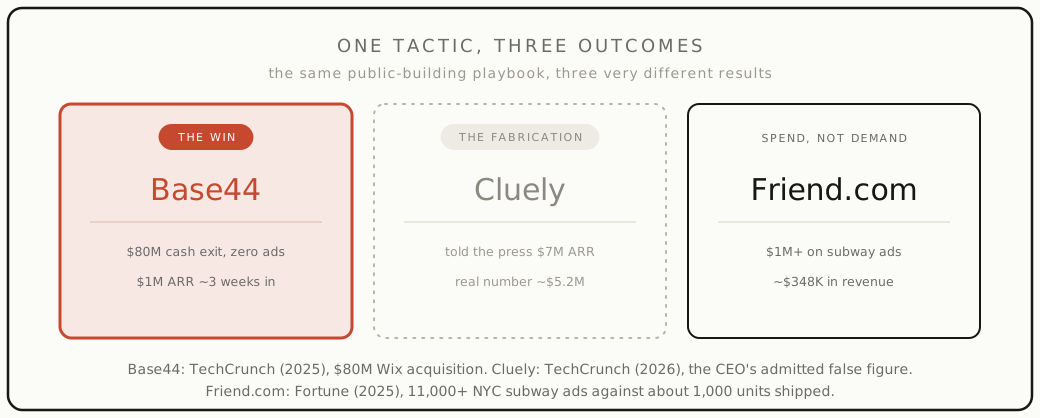
Start with the three outcomes side by side, because they set the whole frame.
Base44 is the win, and it is real. An acquirer paid cash, and the numbers kept climbing on someone else’s books afterward. Shlomo hit a million in ARR about three weeks after launch, reached roughly 250,000 users before spending a cent on marketing, and the public build was the entire growth engine. The audience worked because there was a product under it that people kept using.
Trap one is the fabricated number. Cluely’s Roy Lee ran the same playbook, loud and constant, and a16z partner Bryan Kim led its Series A on the explicit thesis that for consumer AI “momentum is the moat.” But momentum measured in impressions is not revenue, and the gap between the two created a pressure that Lee eventually resolved by inflating the revenue to match the attention. Building in public did not cause the lie. It raised the stakes on the number until the number bent.
Trap two is mistaking spend for demand. Friend.com poured more than a million dollars into 11,000-plus New York subway ads, one of the most visible marketing blitzes an AI hardware startup has run. By the founder’s own account it had shipped around a thousand units, roughly $348,000 of revenue, before the company pivoted the pendant toward a free web chatbot. Visibility is not traction, and paid reach carries its own brutal economics. A packed feed and a packed subway car can both be bought, and neither one is a customer.
Three founders, one tactic, three outcomes. The variable is what you are multiplying.
What actually gets paid
Look only at the cases that held up under scrutiny, and a pattern repeats: the public build fed an owned channel, and the product retained.
Base44 is the ceiling. The floor of the “it worked” stories is more instructive. Marc Lou, an indie maker who has built in public for years, self-reported a personal $1,032,000 for 2025 across products like ShipFast and CodeFast, and he is candid that growth came from customers sharing screenshots of his stuff, an audience compounding on a product people used. That figure is his own, unaudited, and worth reading as a founder’s claim rather than a filed number, but the shape of it fits: public building plus a product that delivered.
Senja, a testimonials tool, reached about a million in ARR by late 2025, and its founders say something the highlight reels leave out: building in public seeded their early adopters, but the repeatable revenue came from SEO and product-led growth. The audience was the ignition; the engine was the product.
Then there is the rare fully transparent case. Buffer has published a live metrics dashboard for years, salaries since 2013 and revenue since 2020, and as of this writing it shows about $25.6 million in ARR. That is what verifiable building in public looks like: an audited-style number anyone can load, the opposite of an axis-free Stripe screenshot posted for a dopamine hit. The community has learned to tell them apart, and the second kind is why so many public numbers deserve a squint.
The wins are real. They are also outliers, and in every durable one the same two things were true: the product retained, and the public building terminated in something the founder owned.
The funnel math nobody tweets
Here is the arithmetic that never makes it into the “how I grew my audience” thread.
Raw followers convert at a fraction of a percent. Pieter Levels, one of the most followed builders alive, launched Photo AI to an audience of roughly 350,000 and did about $5,400 in first-week MRR. Worked back to customers, that is around 0.06 percent of the following, and I will flag that the conversion figure is an Indie Hackers analyst’s estimate rather than a number Levels reported. Even generously, a huge follower count turns into a small number of buyers. Followers are the widest, shallowest part of the funnel.
The median builder is not Pieter Levels. Across 326 indie projects disclosed on Hacker News, the median revenue was five hundred dollars a month. Read the zeroes again: five hundred, with nearly half the parseable projects sitting in the $500-to-$1,000 band. The timeline you scroll is a survivorship highlight reel stacked on top of that median, and the median is where you land by default. It is the base rate a one-person AI business has to clear. The vibe-coding version of that highlight reel, itemized against its denominator, is its own piece.
Owned beats rented by an order of magnitude. Email converts to purchase in the low single digits, commonly cited around 4 to 8 percent, while organic social sits well under half a percent. Free-to-paid conversion on a newsletter runs around 0.6 percent at the median and up toward 5 percent for strong independent operators like Casey Newton. Those benchmark ranges come partly from tooling vendors, so read them as directional, but the direction is not in dispute: a name and an email address are worth many multiples of a follow. The reason the durable cases all captured an email list is that the list is the only part of the funnel that pays at a rate you can build on.
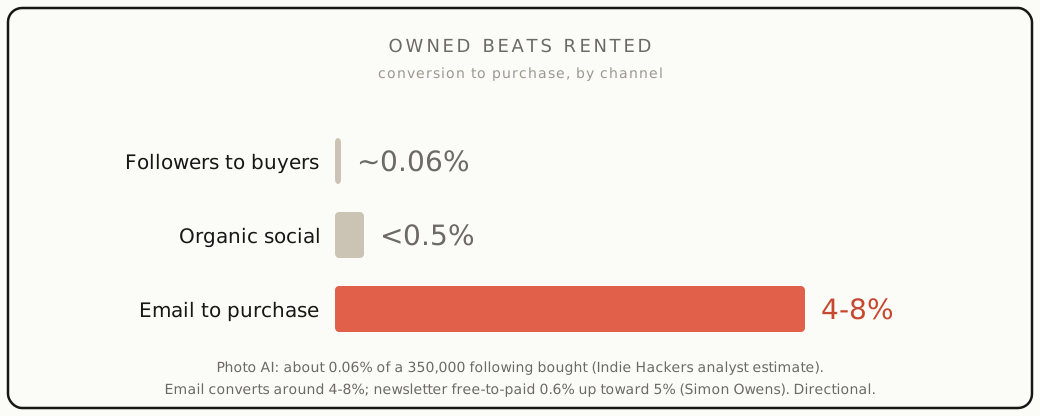
So the real value of an audience is that it de-risks a launch and seeds an owned asset. Treat it as a compounding list-builder, and the math starts to make sense.
The platform mechanics you are actually playing
If you are going to build in public, at least play the game the platforms actually score.
X tells you its scoring, because it open-sourced the ranker. The published weights put a reply at 13.5 times the value of a like, and a reply the original author then engages with at 75 times, against a like’s 0.5. Link posts are penalized, and Musk has said out loud to put the link in a reply rather than the main post. Read that as instruction: the platform pays for conversation and taxes the outbound link. The weights are from the 2023 snapshot and may not match current production exactly, but the design intent is unambiguous.
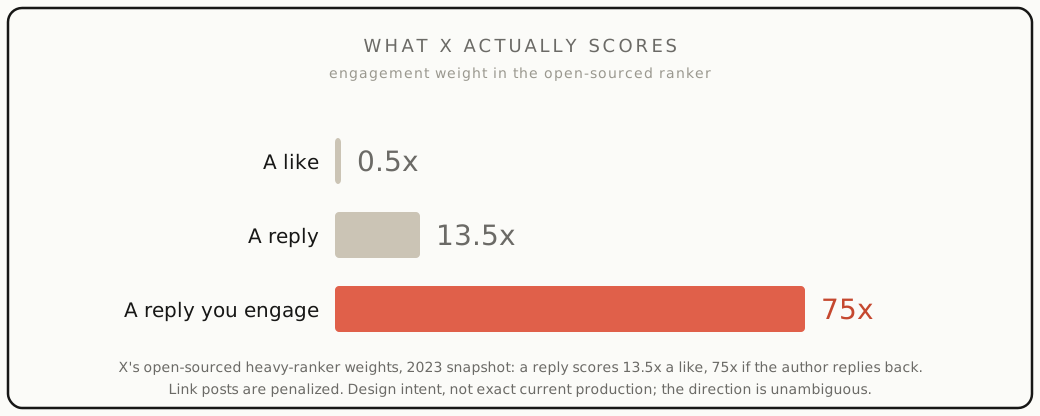
This is where I will point at our own work, at a scale small enough to be evidence about mechanics and nothing more. Okane Land runs a daily, human-approved reply loop on a sub-200-follower brand account. We lead every reply with a real number or a receipt and keep links out of the main post, on purpose, because those are exactly the mechanics above: the algorithm pays for the reply and the conversation, and it taxes the link. That is a first-hand look at the machine from inside; no revenue story attached. A small account is the right place to watch a mechanic work precisely because nothing else is inflating the result.
LinkedIn scores format too. Across 1.3 million posts, native documents pulled roughly 7 percent engagement against about 3.25 percent for plain link posts, and personal profiles out-reach company pages. The specific “personal gets you 561 percent more” number that circulates is a growth-vendor stat, so ignore the multiplier and keep the direction: native content from a person beats a link from a page.
And the launch-day folklore is stale. Product Hunt now features only around 9 to 10 percent of launches after its 2024 shift to hand-curation, per independent analyses of launch data, since the platform publishes no official figure. The old “win the day and the traffic follows” playbook mostly does not fire anymore. Owned channels are the default now. The launch feeds have a second problem: most of what launches quietly goes dark.
The skeptic’s cut: why the median is silence
Everything above still flatters the tactic, because the feed only shows you the survivors.
Prolific builders ship constantly and most of what they ship fails. Marc Lou has launched more than twenty products in a year, most going nowhere, and nobody live-tweets the ones that die. What you see as a stream of wins is the filtered top of a much larger pile of quiet failures, and the filtering is the point.
The base rate is low and getting lower. Goldman Sachs Research estimates that about 4 percent of the world’s roughly 50 million creators earn over $100,000 a year, down from around 10 percent in 2022. Building an audience is competing in a market where the professional tier is shrinking as a share.
An audience cannot rescue a product with no retention. Failory’s post-mortems are full of products that launched to real traffic and died anyway because nobody came back. The gate is retention, best proxied by the Sean Ellis test: if fewer than 40 percent of users would be very disappointed to lose your product, attention just pours more people into a leaking bucket. Distribution multiplies churn as readily as it multiplies revenue.
Two costs rarely get priced. The first is your own energy. A daily content treadmill is a second job stacked on the first, and founder capacity is finite: a 2025 Sifted survey of 138 founders found 54 percent reporting burnout and 83 percent reporting high stress over the prior year. The second is the pressure the public number creates. Once revenue is a public metric, there is a documented pull to inflate it, ARR being one of the most abused figures in the AI era. Cluely is just the confession that made it onto the record.
So it pays: a decision framework
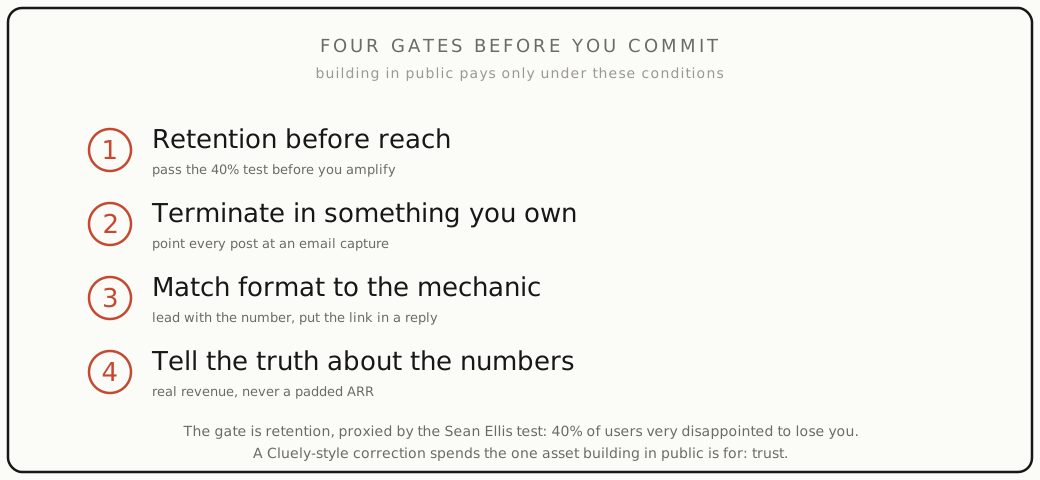
Building in public pays under specific conditions. Run it through four gates before you commit your hours.
Gate one: retention before reach. Do not amplify a product that fails the 40 percent test. Distribution multiplies whatever it points at, and pointing it at a leaking bucket just empties the bucket faster in front of an audience. Ship, hold early retention, then broadcast.
Gate two: terminate in something you own. Point every public post at an email capture rather than a bare follow. Roughly 5 percent of a good list can be brought to pay, against well under 1 percent of followers. Treat the follower count as the top of the funnel and the email list as its floor. The audience that never becomes a list is a vanity number.
Gate three: match the format to the mechanic. Lead with the number, put the link in a reply on X, use documents and native text over bare links on LinkedIn, and post from a personal profile. A company-page link post stacks two penalties at once. Play the scoring the platforms actually published.
Gate four: tell the truth about the numbers. Report real revenue, never a padded figure dressed up as ARR. A Cluely-style correction costs more reputation than any launch-day spike was ever worth, and the whole value of building in public is the trust, which is the one asset a fake number spends all at once.
The verdict is the thesis. Building in public is a multiplier. It amplifies a product that already retains, seeds a list you own, and rewards the founder who plays the platform straight and ships something people keep. Point it at anything less and it multiplies that too, in public, where everyone can watch. Base44 had a product doing the paying. The multiplier just made it faster.
One email, when there's something worth sending
Get the research in your inbox.
No fixed schedule, no filler. You get an email when we've tested something, run the numbers, or found a tool worth your time.
Free. Double opt-in, unsubscribe in one click.
Building in public, or just posting? Get the research →
Sources & how we researched this
- TechCrunch (2025), Solo-owned Base44 sells to Wix for $80M cash. techcrunch.com
- CTech / Calcalist (2026), Base44 hits $100M ARR nine months after the Wix acquisition. calcalistech.com
- TechCrunch (2026), Cluely CEO Roy Lee admits the revenue figure was false. techcrunch.com
- TechCrunch (2025), a16z's Bryan Kim on Cluely and momentum as the moat. techcrunch.com
- Fortune (2025) and Fast Company (2025), Friend.com and the subway ad campaign. fortune.com, fastcompany.com
- Indie Hackers (2025), Photo AI: 0 to $132K MRR deep-dive (conversion figures are author estimates). indiehackers.com
- IndieLaunches (2025), Indie Maker Analytics: 326 disclosed projects. indielaunches.com
- Goldman Sachs Research (2024), The creator economy could approach half a trillion dollars. goldmansachs.com
- Sifted (2025), Founders' mental health survey (138 founders). sifted.eu
- X / Twitter (2023), the-algorithm-ml open-sourced heavy-ranker weights. github.com/twitter/the-algorithm-ml
- Socialinsider (2024), LinkedIn benchmarks across 1.3M posts. socialinsider.io
- Tetriz.io (2024) and a 2025 analysis of ~5,000 launches, Product Hunt featured-rate change.
- Simon Owens (2024), realistic paid-newsletter conversion rates. simonowens.substack.com
- Marc Lou (2026), I made $1,032,000 in 2025 (self-reported founder figure). marclou.com
- The Successful Projects (2025), Senja.io reaches $1M ARR. thesuccessfulfounder
- Buffer (2026), public Transparent Metrics dashboard. buffer.com/transparency
- Fortune (2025), How startups inflate ARR with creative accounting.
- Failory, Startup failure post-mortems (market-fit failures). failory.com