The Study · Economics
The AI UGC ad math: $2 a video, and the bill nobody prices in

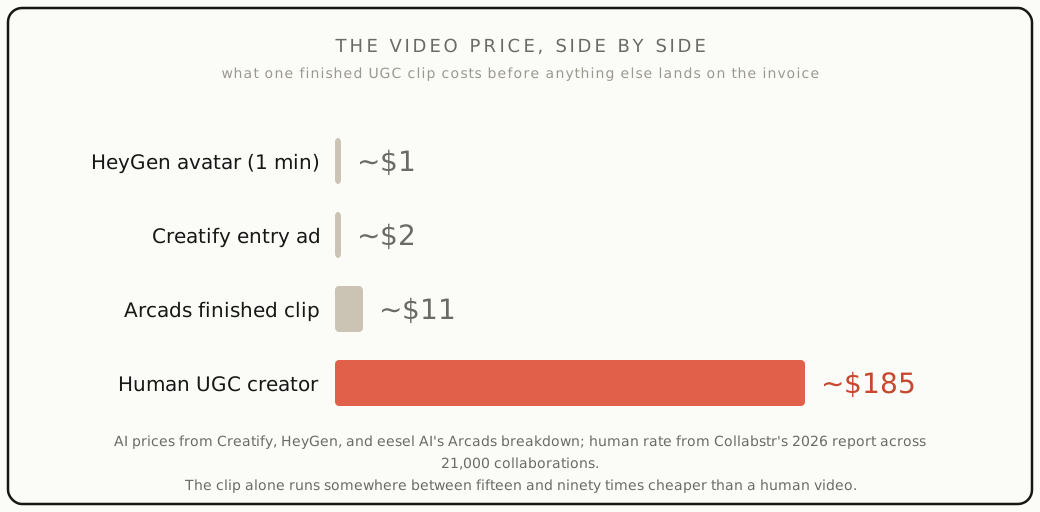
You can now buy a UGC ad, a real-looking person holding your product and reading your script into a phone camera, for about the price of a coffee. On Creatify’s own pricing, a short avatar ad works out to somewhere near $1 to $2 at the entry tiers, which lines up with our hands-on Creatify review after we bought the Pro plan and ran the tools. HeyGen bills its premium avatar video at 20 credits a minute, which lands a one-minute clip closer to a dollar. Arcads, the tool most of the AI UGC ad crowd actually names, runs about $11 a video.
Hold any of those next to a human UGC creator, who averaged about $185 a video in 2026 across Collabstr’s marketplace, and the clip alone is somewhere between fifteen and ninety times cheaper. The bargain is real, and it is narrower than the price makes it look.
That is a real cost collapse, and it has funded real revenue, and nobody gets to wave it off as a fad. It is also the only number the tools put on the slide.
The short version
If you are pointing a budget at this to make money:
- The cost gap is genuine. Roughly $1 to $11 per AI clip against about $185 for a human one, and much more once a human video is loaded with usage rights and coordination. For testing many hooks fast, nothing competes.
- Nobody has shown it converts as well. The one strong independent test, Ipsos with Syracuse, found AI ads underperformed human ones on predicted sales. Every “AI UGC beats human on click-through” stat traces back to a company selling AI UGC.
- Disclosure is the tax. Across 13 preregistered experiments, disclosing AI use lowered trust, and platforms increasingly disclose it for you.
- The label is not your choice. Meta auto-detects and labels third-party AI in ads. A synthetic testimonial can also be an FTC and EU violation.
- The play that works today: use AI UGC for cheap, high-volume hook testing where nobody expects a real person, and move the winners to human creators for anything that needs a real claim, real emotion, or will be labeled AI anyway.
The rest is the receipts, and the math the pricing pages skip.
The number that starts the argument
Start with how these tools meter, because the per-video price has to be derived; no tool prints it. Creatify sells credits: Starter at $39 for 100 credits, Pro at $99 for 300, and its free tier advertises “10 credits, up to 2 video ads,” which implies roughly 5 credits a video and puts a clean ad near $1.65 to $2 at the floor. The catch is in Creatify’s own fine print: a real ad burns anywhere from 2 to 20 credits once you count quality settings and re-renders, so $2 is a best case.
HeyGen meters the same way, $29 for 600 credits, $49 for 1,000, with its top avatar tier at 20 credits a minute, so the sticker of roughly a dollar a minute holds only until you regenerate. If you want the current floor across these tools, we keep what each tool actually costs tracked and dated.
Arcads sits at the premium end and is the clearest mirror of the category. Its Starter plan is $110 a month for 10 videos, its Creator plan $220 for 20, both about $11 a finished clip. On those tiers unused videos do not roll over, there is no free trial, and Arcads does not publish a pricing page at all: arcads.ai/pricing returns a 404, and the numbers only appear after you make an account. That is worth noticing before you build a budget on a screenshot. AI UGC stays cheap; the takeaway is that the “cents a video” framing is the marketing number, and the real per-usable-ad cost sits a notch above it once retries are counted.
The meters, derived to a per-clip price:
| Tool | The plan math | A clean clip | The catch |
|---|---|---|---|
| HeyGen | $29/600 credits, 20 credits per avatar minute | ~$1 a minute | Holds only until you regenerate |
| Creatify | $99/300 credits, ~5 credits a video | ~$1.65 to $2 | A real ad burns 2 to 20 credits with re-renders |
| Arcads | $110 for 10 videos, $220 for 20 | ~$11 | No rollover, no trial, no public pricing page |
| Human creator | Collabstr marketplace, 21,000+ collaborations | ~$185 | $500 to $2,000 all-in with rights and coordination |
What a human video actually costs
The comparison only means something with a real baseline, so here is the strongest one. Collabstr publishes rates from its own marketplace, and its 2026 report, drawn from more than 21,000 real collaborations, puts a UGC video at about $185. Treat that as a floor published by a company that sells these collaborations, with no audit behind it, but it is the most-cited real dataset in the category. One fair correction to the usual pitch: UGC is not the cheapest format going, plain X posts list for less. What UGC has is the smallest gap between what creators ask and what they get paid, which is its own signal that the market clears near the asking price.
The $185 buys the deliverable; the invoice is bigger. Industry rate guides put the all-in closer to $500 to $2,000 once you add usage rights, which run a 30 to 50 percent premium, rush turnaround, extra revision rounds, and the hours somebody on your side spends briefing and chasing. Those multipliers are consistent across guides, though the totals are estimates, so hold them as ranges. The structural point is what matters: the human cost is mostly coordination, and coordination does not fall with volume. Bundle discounts top out around a quarter off. So the human model is fine for a handful of hero videos and breaks the moment your media plan wants fifty.
The volume case, where the math actually holds
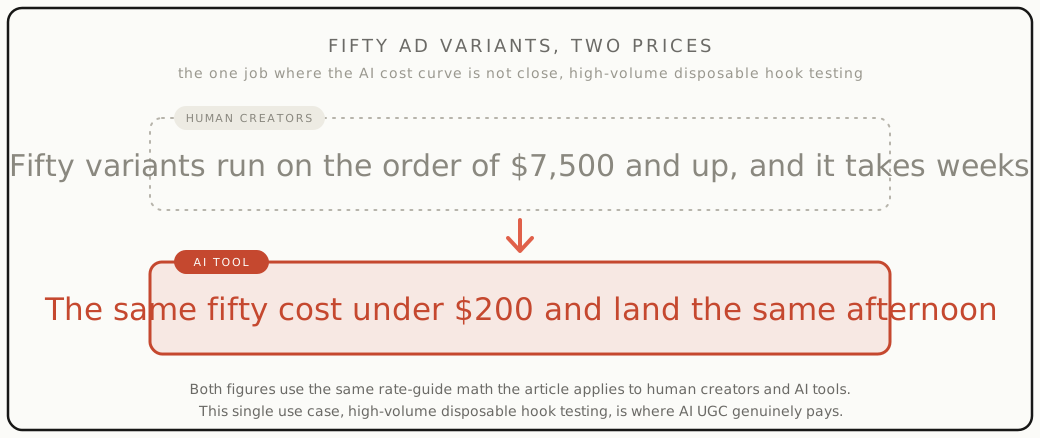
This is the strongest part of the AI case, and it is a real one. Testing creative is a numbers game, and the number is large. Commissioning fifty ad variants from human creators runs on the order of $7,500 and up, using the same rate-guide math, and it takes weeks. The same fifty from an AI tool cost under $200 and land the same afternoon. When the job is “find the one hook in fifty that works,” the cost curve is not close, and that single use case, high-volume disposable hook testing, is where AI UGC genuinely pays.
The market backs the volume thesis with revenue. HeyGen reached an estimated $95M in ARR by September 2025, up from $57.5M at the end of 2024, per the tracker Sacra rather than HeyGen itself. Creatify crossed $9M ARR on a $15.5M Series A, and Arcads raised a $16M seed in December 2025, said it was already profitable, and reported making roughly 100,000 assets a month for more than 6,000 clients. Somebody is buying a lot of AI video, and the pattern that buys it is volume.
Does it convert, and does AI match human?
Here the evidence forks, and the fork is the whole argument. That UGC-style creative beats polished studio ads is well supported and not really in dispute: Brainlabs, analyzing 46 Meta brand-lift studies, found lo-fi native creative lifted product purchase intent 6 percent against a 4 percent average, while high-production creative did its best work on awareness. Read that as a point for the UGC format, and note it is one agency’s read of its own client data.
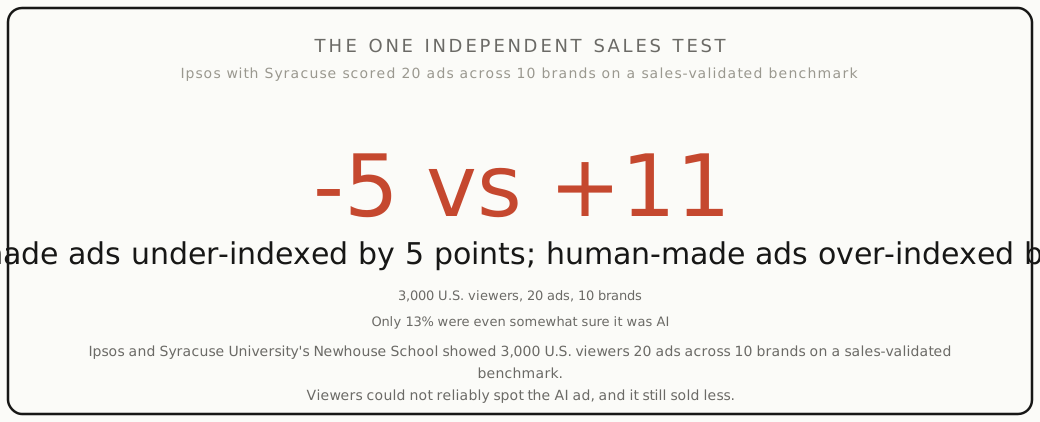
Whether an AI version of that format converts like the human one is a different question, and the strongest independent test points the wrong way for the vendors. Ipsos, working with Syracuse University’s Newhouse School, showed 3,000 U.S. viewers 20 ads across 10 brands and scored them on a sales-validated benchmark. Human-made ads over-indexed by 11 points; AI-made ads under-indexed by 5. The uncomfortable part for anyone hoping the audience simply cannot tell: only 13 percent of viewers who saw an AI ad were even somewhat sure it was AI. They could not reliably spot it, and it still sold less. AI held up on straightforward product creative and lost most ground where the ad needed a story or a feeling.
Set that against the win stats the tools advertise, the 4x click-through, the 350 percent engagement, the lower cost per acquisition. Every one of those traces to a company selling AI UGC, with no independent side-by-side benchmark behind it. There is, as of mid-2026, no independent study showing AI UGC converts as well as human UGC, and one credible study showing it does not. That is the sentence to keep.
The disclosure penalty is the real product risk
The reason the audience-cannot-tell defense does not save the model is that the penalty attaches to disclosure, and detection never enters into it. Schilke and Reimann ran 13 preregistered experiments with more than 5,000 participants, published in a peer-reviewed journal, and found the same thing every time: a person or brand that discloses using AI is trusted less than one that says nothing. Their thirteenth experiment adds the trap, because staying silent is not a safe harbor either. When a third party exposes the concealed AI use, trust falls further than if it had been disclosed up front. So the choices are a disclosure that costs you trust or a concealment that costs you more when it surfaces.
That is a hard place to build an ad strategy, and it explains why the “nobody will know” plan is fragile. The economics of AI UGC assume the audience reacts to the content. The evidence says a large slice of the value is set by the label, and the label is increasingly out of your hands.
The bill nobody prices in: platforms, FTC, EU
Which is the part the pricing pages skip entirely. Start with the platforms, because they now apply the label for you. As of its February 2025 announcement, Meta automatically detects ads made or edited with third-party AI tools “through industry-standard signals” and attaches an “AI info” label, and for an ad containing an AI-generated photorealistic human that label sits right next to “Sponsored.” You do not get to opt out of being marked, which means the disclosure penalty above is a default setting on the largest ad platform there is.
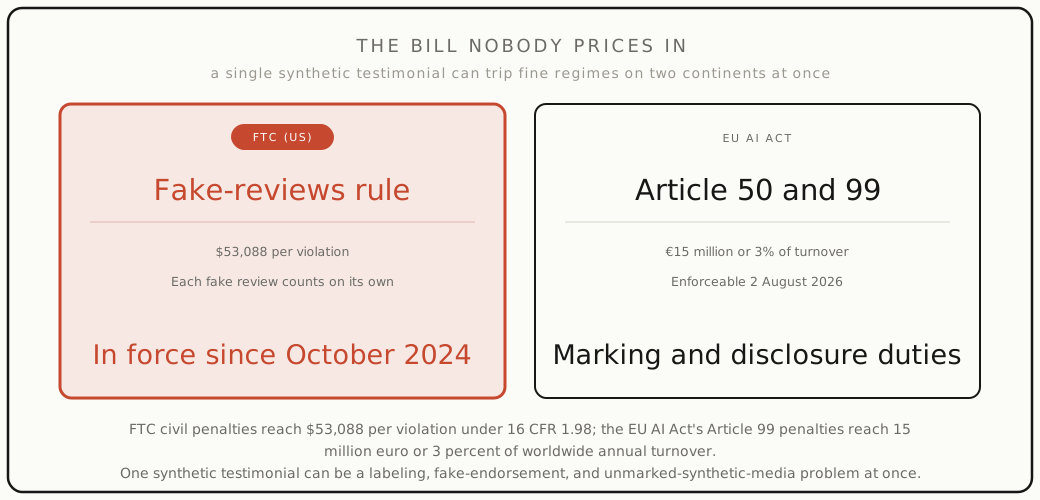
Then the law, where the exposure is money. The FTC’s fake-reviews rule, in force since October 2024, bans reviews and testimonials that misrepresent themselves as coming from “someone who does not exist, such as AI-generated fake reviews.” For knowing violations the FTC can seek civil penalties, each fake review counting as its own violation, up to a statutory maximum that inflation adjustments have now set at $53,088 per violation. A synthetic spokesperson vouching for a product is exactly the kind of nonexistent endorser the rule describes.
In the EU the clock is louder: the AI Act’s Article 50 transparency duties become enforceable on 2 August 2026, requiring AI output to be machine-marked and deepfakes to be disclosed even where there was no intent to deceive, with Article 99 penalties reaching €15 million or 3 percent of worldwide annual turnover. One synthetic testimonial can be a labeling problem, a fake-endorsement problem, and an unmarked-synthetic-media problem at the same time, in different jurisdictions, at once.
The verdict, and the cautionary tale
The clean version of this promise has already run once and broken. Icon launched as “the AI admaker,” pitched a hundred ads in ninety minutes, and paid $12 million for the Icon.com domain. By early 2026 its site had quietly gone dark, and it re-emerged selling six real, human-made UGC ads for $399 a month under the banner “the human admaker.” The company built to replace the agency became the agency. Around it, the backlash is now a repeatable brand risk rather than a one-off: Coca-Cola’s AI holiday ads were mocked in both 2024 and 2025, McDonald’s Netherlands pulled its AI Christmas ad within about four days in December 2025, and YouTube’s July 2025 monetization rules began demonetizing the mass-produced AI video the same tools make easy to churn out.
So price the whole production. AI UGC is a genuine bargain for one job: cheap, fast, disposable hook testing at a volume no human roster can match, in placements where nobody expected a real person anyway. It is a poor bet the moment the ad needs a real claim, a real feeling, or a testimonial a regulator could read as coming from a person who does not exist, because that is where the conversion gap, the disclosure penalty, and the fine all live. The video got 90 times cheaper. The rest of the invoice did not, and the rest of the invoice is where the money is.
One email, when there's something worth sending
Get the research in your inbox.
No fixed schedule, no filler. You get an email when we've tested something, run the numbers, or found a tool worth your time.
Free. Double opt-in, unsubscribe in one click.
Running AI UGC in your ads? Compare notes in the forum ↗
Sources & how we researched this
- Creatify (2026), official pricing page. creatify.ai/pricing
- HeyGen (2026), official pricing page. heygen.com/pricing
- eesel AI (2026), Arcads AI pricing breakdown. eesel.ai/blog/arcads-ai-pricing
- Collabstr (2026), Influencer Marketing Report: Trends and Statistics (21,000+ collaborations). collabstr.com/2026-influencer-marketing-report
- Ipsos and Syracuse University S.I. Newhouse School (2026), Newhouse Research Finds AI Ads Fall Short on Sales Impact. news.syr.edu/2026/05/18/newhouse-research-finds-ai-ads-fall-short-on-sales-impact
- Brainlabs (2025), 46 Meta Brand Lift Studies: Top Objectives and Creatives. brainlabsdigital.com/meta-brand-lift-studies-objectives-creatives-results
- Schilke, O. and Reimann, M. (2025), The transparency dilemma: How AI disclosure erodes trust. Organizational Behavior and Human Decision Processes 188, 104405. doi.org/10.1016/j.obhdp.2025.104405
- Meta (2025), Expanding GenAI transparency across Meta's ads products. about.fb.com/news/2025/02/gen-ai-transparency-metas-ads-products
- US Federal Trade Commission (2024), final rule banning fake reviews and testimonials (16 CFR Part 465). ftc.gov/news-events/news/press-releases/2024/08
- US Federal Trade Commission, civil penalty amounts, 16 CFR 1.98. ecfr.gov/current/title-16/chapter-I/subchapter-A/part-1/subpart-L/section-1.98
- European Union, Artificial Intelligence Act (Regulation (EU) 2024/1689), Articles 50 and 99. artificialintelligenceact.eu/article/50
- Sacra (2025), HeyGen revenue and ARR estimate. sacra.com/c/heygen
- Business Wire (2025), Creatify crosses $9M ARR, raises $15.5M Series A. businesswire.com
- PR Newswire (2025), Arcads.ai raises $16 million in seed funding. prnewswire.com
- Tech Startups (2026), Icon, the AI ad startup, goes dark after spending $12M on the Icon.com domain. techstartups.com/2026/03/05
- NBC News (2025), McDonald's pulls AI-generated Christmas advert after backlash. nbcnews.com/world/europe
- TechCrunch (2025), YouTube prepares crackdown on mass-produced and repetitive videos. techcrunch.com/2025/07/09