The Study · Economics
We pinged 522 vibe-coded launches. Here is how many answered
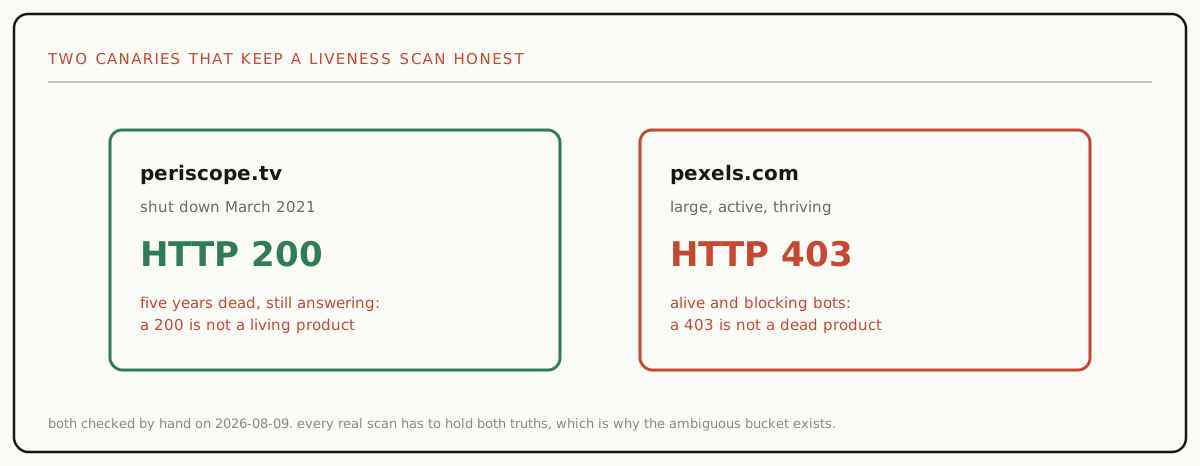
On 9 August 2026 we pointed an HTTP checker at periscope.tv, the live-streaming app that shut down in March 2021. It returned a 200 and a working page. Five years dead, still answering. One request, and the whole genre of confident claims about dead apps starts to wobble, because the web does not clean up after failure and a status code was never a business metric.
We kept the checker running. Over one afternoon it visited all 522 vibe-coded launches listed by the two showcase directories where every entry is provably built on a vibe-coding tool. This piece is what came back, with the full dataset attached.
The short version
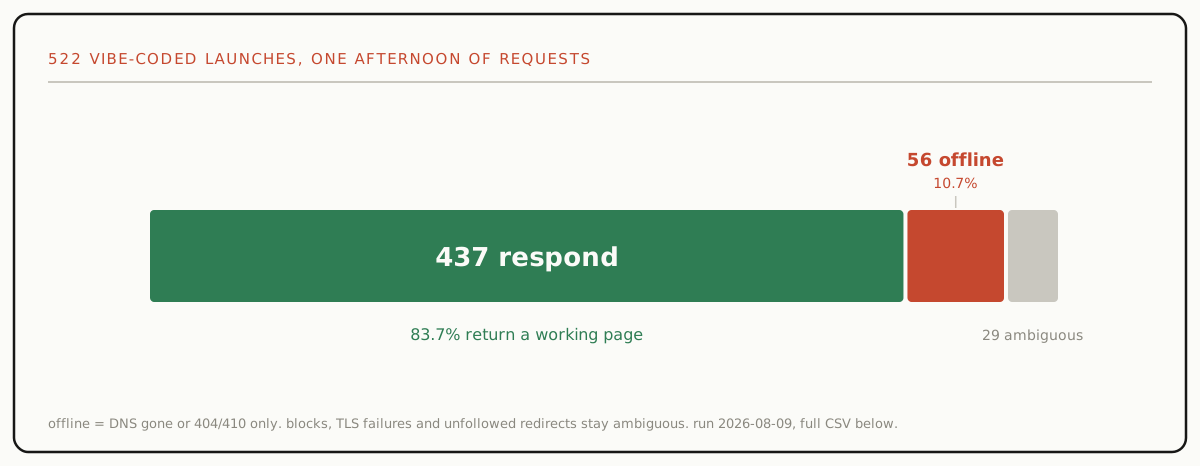
- We HTTP-checked 522 vibe-coded launches. At least 56 of them, 10.7%, are already fully offline. The domain no longer resolves, or the app returns a gone/404. That is better than one in nine, dark, from a directory of apps their own makers were proud enough to showcase.
- 437 of the 522, 83.7%, still return a working page. Another 29 (5.6%) are genuinely ambiguous: a bot-block, a broken TLS handshake, or a redirect our scanner would not follow. We put those in their own bucket rather than guess.
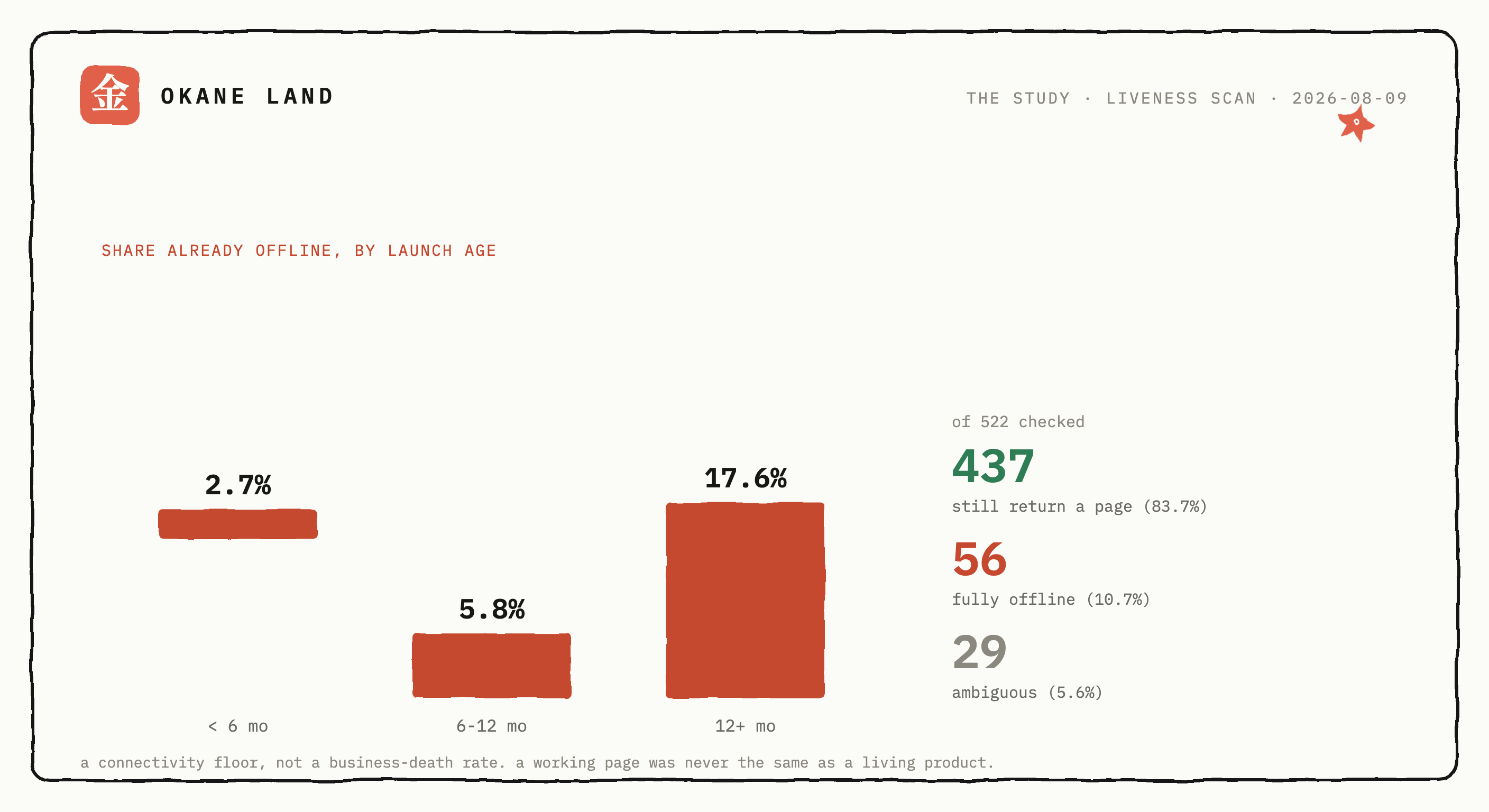
- The dead rate climbs sharply with age. Under six months old, 2.7% are offline. Past a year, 17.6% are. Time, not the tool, is what turns a showcased launch dark.
- This is a connectivity floor, not a business-death rate. A page that loads tells you the domain still points somewhere. It does not tell you the product has a single paying user. The viral “487 of 500 are dead” claim measures something entirely different, and we did not replicate it.
Every number here we generated ourselves on 9 August 2026, and the full CSV of all 522 URLs and their status is published at the end so you can re-run it.
What we actually checked, and what “alive” cannot mean
There is a lot of confident talk about vibe-coded apps dying and almost no actual measurement. The one viral number, from a Reddit post claiming 487 of 500 launches are dead, is a business-death metric that nobody can re-run. We wanted a number a reader could reproduce, so we narrowed the question until it was answerable: not “is the business alive,” which no HTTP request can tell you, but “does the URL still return a working page.”
The set matters as much as the method. Product Hunt listings and AI directories do not tell you a product was vibe-coded, so those cannot fairly carry the word. The only sets where every entry is provably built on a vibe-coding tool are the platform showcase galleries. We took both: madewithlovable.com (506 projects) and madewithbolt.com (29 projects), 535 in total. Of those, 522 exposed a live app URL we could check; 13 listed no external link. Each page also carries an “Added” date, which lets us plot decay against age.
Then we hit every URL with a real browser user-agent and sorted the responses into three buckets:
- Offline: the domain does not resolve (DNS gone) or the app returns 404/410. This is the only bucket we call dead.
- Responds: a 2xx working page.
- Ambiguous: a 401/403/429 block, a TLS handshake failure, or a 3xx redirect our scanner did not follow. Not counted either way.
The reason for that caution is two sites we checked by hand. periscope.tv returned HTTP 200, five years after Periscope shut down in 2021, so a working response cannot mean “alive.” And pexels.com returned 403 to our checker despite being a large, thriving site, so a block cannot mean “dead.” Every real liveness scan has to hold both of those truths at once, which is exactly why the ambiguous bucket exists instead of being forced into a verdict.
The number
Across the 522 checkable launches:
| Result | Count | Share |
|---|---|---|
| Responds (2xx working page) | 437 | 83.7% |
| Offline (DNS gone or 404) | 56 | 10.7% |
| Ambiguous (block, TLS fail, redirect) | 29 | 5.6% |
Of the 56 offline, 43 no longer resolve at all, their domains simply gone, and 13 resolve but serve a gone/404, several of them Lovable subdomains showing a literal “Build incomplete” page. We hand-checked a sample of each bucket by eye. The dead ones were dead: jeez.me and eden.pm would not connect at all. And the caution paid off in the other direction too: two of the three redirects we had parked as ambiguous turned out to be live products that had simply rebranded, which means our 83.7% “responds” figure is if anything a slight undercount. The 10.7% offline floor is not inflated. It is conservative.
The survival curve: age is the killer
Because each launch carries an “Added” date, we can watch the directory decay. Grouping the 494 dated launches by how long ago they were showcased:
| Launch age | Launches | Offline | Offline rate |
|---|---|---|---|
| Under 6 months | 146 | 4 | 2.7% |
| 6 to 12 months | 138 | 8 | 5.8% |
| Over 12 months | 210 | 37 | 17.6% |
The shape is the finding. A freshly showcased vibe-coded app is almost always up; nothing in the youngest cohort was offline by more than a rounding error. By a year out, better than one in six has gone dark. This is not a statement about whether AI can build a working app, because clearly it can, and most of these still load. It is a statement about what happens after launch day, when the domain renewal, the free-tier database that pauses after a week idle, and the maker’s attention all have to keep showing up. Most launches are a moment. The curve measures how many outlive it.
Split by platform, Lovable’s 494 launches ran 9.9% offline and Bolt’s 28 ran 25% offline, but Bolt’s sample is too small to lean on, so read that gap as a hint, not a result.
The viral claim, and why our number is lower
You have probably seen the number this piece will get compared to: a widely shared r/SaaS post claiming 487 of 500 Product Hunt launches are dead. We cite it as reported, because Reddit blocked our fetch tools and its author’s method cannot be verified, but the more important point is that it measures a completely different thing. That 487 is a business-death count: 97.4% under $1,000 in monthly revenue, 91.2% under a hundred active users, 84.6% never updated since launch. By that definition almost everything is “dead,” including plenty of apps that still load perfectly.
Our 10.7% is the narrow, hard, reproducible floor underneath that soft number. It says only this: at least one in nine of these launches has stopped returning a page at all. The gap between 10.7% and 97% is the gap between “the lights are off” and “nobody’s paying,” and conflating the two is how the vibe-coding-is-dead genre gets written. A great many of our 437 “responds” launches are almost certainly earning nothing. We just refuse to call them dead on evidence that only shows they are quiet. What the posted success stories hide is its own study.
What we could not establish, and the dataset
Three limits worth stating plainly. Showcase directories are survivorship-biased: these are apps whose makers submitted them to a gallery, so apps that were abandoned before they were ever showcased, or pulled after failing, are underrepresented. Our floor is a floor for that curated, optimistic population, and the true rate across all vibe-coded apps is higher. A 200 is not a living product, as periscope.tv proves; we can measure connectivity, not maintenance or revenue. And we cannot see intent: a domain that auto-renews on a lapsed card looks identical to one a founder is actively tending.
What we can offer is the raw material. The full CSV of every one of the 522 URLs, its launch date, its HTTP status, and its classification is here for you to re-run and argue with:
Download the dataset (522 rows, CSV)
That is the whole point of a receipt. The question “are vibe-coded apps dying?” has been answered mostly with vibes. Here is one narrow slice of it answered with a status code, dated, sampled by hand, and handed to you to check. If you want the wider frame, our study on whether vibe coding is dead weighs the sentiment against the usage data, and whether it is worth it does the same for the economics. This piece just establishes the floor they stand on: most launches still answer, the old ones increasingly do not, and a working page was never the same thing as a living product.
One email, when there's something worth sending
Get the research in your inbox.
No fixed schedule, no filler. You get an email when we've tested something, run the numbers, or found a tool worth your time.
Free. Double opt-in, unsubscribe in one click.
Is your launch still answering? Get the research →
Sources & how we researched this
- Okane Land liveness scan (run 2026-08-09): 522 app URLs pulled from madewithlovable.com/sitemap_projects.xml (506 entries) and madewithbolt.com/sitemap_projects.xml (29 entries), HTTP-checked with a browser user-agent, classified offline / responds / ambiguous, sample hand-verified. Full CSV published with this piece.
- madewithlovable.com projects sitemap (read 2026-08-09): 506 Lovable-built projects, each /projects/<slug> page exposing the live app URL and an "Added <date>" launch date. madewithlovable.com/sitemap_projects.xml
- madewithbolt.com projects sitemap (read 2026-08-09): 29 Bolt-built projects, same structure. madewithbolt.com/sitemap_projects.xml
- Canary A, a dead product that still answers: periscope.tv (Periscope shut down March 2021) returned HTTP 200 on 2026-08-09. Proof that a working response is not a living product.
- Canary B, a live product that refuses the check: pexels.com returned HTTP 403 to both a browser user-agent and a plain client on 2026-08-09, despite being a large active site. Proof that a 403 must be read as ambiguous, not dead.
- r/SaaS, "I analyzed 500 Product Hunt SaaS launches. 487 are dead." (posted ~Aug 2025, REPORTED): claims 487/500 dead by a business-death definition, 97.4% under $1k MRR, 91.2% under 100 active users, 84.6% not updated since launch. Reddit blocked our fetch tools; figures corroborated by two secondaries, methodology unverifiable. reddit.com/r/SaaS/comments/1mnc3nu/
- HuggingFace lumalik/Product-Hunt-Data (read 2026-08-09): 21,747 Product Hunt launches 2015-2019 with a resolved_url column and an undocumented "status" field. We used it only to understand prior-art limits; its status column is unreliable as a liveness signal (it marks periscope.tv Up and pexels.com Down), so we ran our own check instead. huggingface.co/datasets/lumalik/Product-Hunt-Data