The Study · Explainer
You may own less of your vibe-coded app than your AI tool's terms suggest
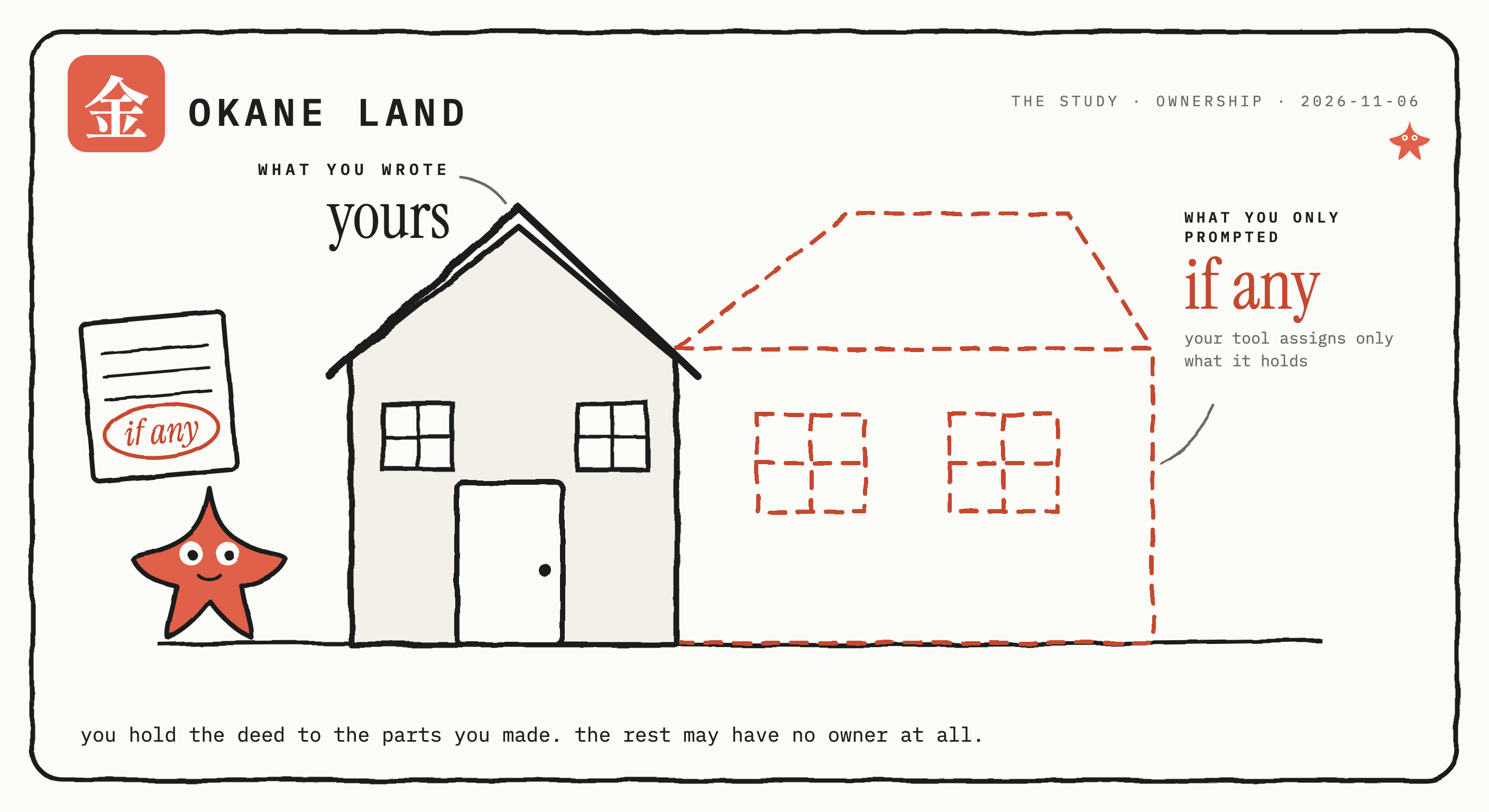
You describe an app, an agent writes it, and you start charging for it. The tool’s terms say the output is yours, and then OpenAI’s, like four others in the table below, hand over “all our right, title, and interest, if any.”
“If any” is the whole question. You own the business, the accounts and whatever you wrote or reworked by hand, while the code you only prompted may carry no copyright for anyone to hold.
We read the US rulings and Copyright Office reports, the terms of a dozen AI coding tools, the licensed-code studies and what buyers’ lawyers now ask for, then sorted what is settled from what is open. Nothing here is legal advice, and most of it is US law.
The short version
- Prompting alone probably earns no copyright. The Copyright Office’s position is that “prompts do not alone provide sufficient control,” and that revising them changes nothing. No US court has ruled on that yet, and we found no decision anywhere applying it to AI-written code.
- What you write or rework stays yours. Hand edits and creative arrangement can be protected, while the AI-written material underneath stays out. By May 2026 the Office had registered more than 7,000 claims with AI-generated material disclaimed.
- A contract cannot create a right the law withholds. Five of the eleven tools in our table assign their rights “if any” on individual plans. One law firm puts the same point to contractor deals: an assignment “conveys nothing where no copyright subsists.”
- Your login decides your legal cover. Claude Code on a Max plan carries no IP indemnity, and on an API key it does. Codex splits the same way. We found none in Lovable’s or Bolt’s terms or Replit’s Pro agreement, and v0’s terms disclaim one.
- Licensed-code copying looks low on strict tests, and courts have not ruled on it for code. Targeted tests of the strongest mid-2024 coding models found 0.88% to 2.01% of outputs strikingly similar to existing code. We found no ruling that AI-written code infringes and no suit over code against a tool’s user.
- Buyers have started asking. One acquirer calls “we don’t really know” the most expensive answer in diligence, and Wix warns its own investors about enforcing rights in AI output.
Everything below is the evidence, read on November 6, 2026, followed by what to do about it.
What copyright covers when an AI wrote the code
The settled part is narrow. In Thaler v. Perlmutter the D.C. Circuit held that the Copyright Act “requires all eligible work to be authored in the first instance by a human being,” and the Supreme Court declined the case in March 2026. The same opinion says the rule does not bar copyright in work made with AI’s help, and that disputes over how much AI contributed were not before the court. So a machine cannot be the author, and your own case stays open.
The working line comes from the Copyright Office’s January 2025 report. It is the agency’s view, tied to the technology available in early 2025, and a court could read the statute differently.
| What you did | What the Office says |
|---|---|
| Wrote a prompt, however detailed | Not enough: prompts work as instructions that convey ideas |
| Re-prompted many times | ”Repeatedly revising prompts does not change this analysis,” and the effort is irrelevant |
| Picked the best output | Choosing one output is not a creative act on its own |
| Arranged AI pieces into a whole | Creative selection and arrangement can protect the whole, and the AI pieces inside stay unprotected; two or three elements is generally too few |
| Edited the output by hand | Copyright reaches what you contributed, case by case |
| Steered a tool that edits selected parts in place | Can differ from prompts alone, case by case; a footnote names ChatGPT’s canvas for “a document or code” |
| Fed in your own work and it shows in the output | Your own work stays yours |
Three things make this harder for code.
The first is that we found no ruling on it. The report has no section on software, apart from that footnote and a few passing mentions, and we found no court or Review Board decision on AI-generated code.
The second is the closest official analogy, which is unfriendly. In Allen v. Perlmutter, a dispute over an image made with at least 624 Midjourney prompts, the government’s brief cites S.O.S. v. Payday, where a person “who described her company’s needs to computer programmers, but did not participate in the actual coding process, was not an author.” Swap the programmers for an agent and that reads like vibe coding, though that comparison is ours. The same brief says the case does not concern newer image models, released in early 2025, that can edit iteratively in plain English, and Allen’s side calls the Payday point a red herring. Whether a coding agent steered through many revisions looks more like those models is open. Briefing closed in February 2026, the last docket entry is from June, and no ruling has appeared.
The third is that copyright in code was always limited. Copyright excludes processes and methods, and the Office’s Compendium leaves out a program’s algorithm, functions, logic and system design. On October 30, 2026, in a case with no AI at issue, the Review Board refused 28 SQL queries because any manual writing of them showed no creativity. What your app does was never protected by copyright, whoever typed it.
Lawyers writing on this land in the same place. Baker McKenzie says that in pure vibe coding “no copyright typically arises.” Heuking, writing under German law, reaches a similar view and adds that the result may differ if the developer specifies the architecture, data structures and module layout. Under US law, whether that counts is untested.
None of this stops you running, charging for or selling the app. The gap shows up when someone copies you, or when a buyer asks what exactly they are buying.
What the terms hand you
Here is what each tool says about output on the plans a solo builder is likely to hold.
| Tool, individual plan | What the terms say about output |
|---|---|
| Claude, including Claude Code on Pro or Max | assigns Anthropic’s rights, “if any” |
| ChatGPT, including Codex | you “own the Output,” and OpenAI assigns its rights “if any” |
| GitHub Copilot Free to Max | ”GitHub does not claim ownership of your Input or Output” |
| Cursor | assigns its rights “if any” |
| Google Antigravity, under the Google Terms of Service | ”Google won’t claim ownership” |
| Cognition, Devin and Devin Desktop (formerly Windsurf) | “assigns to you all right, title, and interest in Output” |
| Replit Core and Pro | no sentence on output ownership found; Enterprise says “own the Output Content” |
| Lovable | ”you also own any AI Output,” subject to third-party rights |
| Bolt | assigns its rights “if any,” and warns output “may not be protectable by copyright” |
| v0 | assigns “Vercel’s rights, if any”; the Hobby plan is for personal or non-commercial use only |
| Kiro and Amazon Q Developer | ”The output… is Your Content” |
These sentences settle one thing: your vendor is not claiming your code. They bind nobody else, and they cannot produce a copyright the law withholds. Nearly all of them warn that other customers may receive the same or similar output: OpenAI, Cursor, Lovable, Bolt, v0, Amazon and Cognition in these terms, GitHub in its Copilot FAQ, and Google and Replit in their cloud or enterprise terms.
The clause with money attached is the IP indemnity, where the vendor defends you if someone claims the output infringes. That line runs through the plan, and one tool can sit on both sides of it.
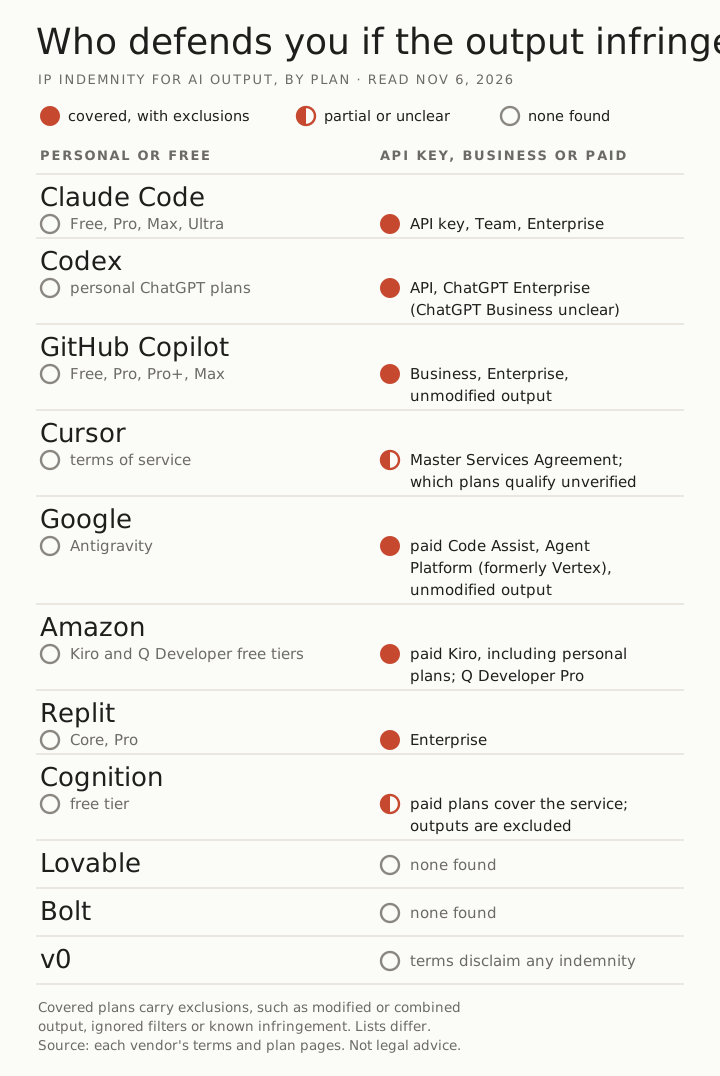
Claude Code’s docs put Free, Pro, Max and Ultra under the consumer terms, and Team, Enterprise and API users under the commercial ones. On the commercial terms Anthropic defends paid use and its outputs. On the consumer terms the indemnity runs the other way, and reaches products you build with the service. GitHub’s individual terms do the same for “claims arising from Output you incorporate into your products or services.” Paid Kiro is the exception among personal subscriptions: Amazon’s FAQ says paid subscribers get an output indemnity, with some models excluded.
The catch sits in the exclusions. Anthropic’s cover drops away to the extent a claim arises from your modifications or from combining output with anything it did not provide. OpenAI’s excludes output that was modified, transformed or combined. Copilot’s and Google’s cover speak of unmodified output. Cursor’s excludes modified or combined suggestions where the claim relates to that. Amazon’s section 50.10 names a modified service and has no express line on edited output, so read it before relying on that. Several also require you to leave filters on, and fall away if you knew or should have known about the problem.
A shipped app is edited and combined by nature. So, on our reading, the hand edit that earns you copyright can take that same code outside the vendor’s cover. We found no court that has read these clauses against a real app, so treat the indemnity as help with raw output and keep your expectations there.
The other risk: someone else’s code in yours
We found no measurement of how often today’s agents reproduce licensed code in everyday use. The evidence is targeted tests, mostly on older or open models. Rates per request are low on strict standards, and climb with more context or looser standards.
- LiCoEval gave 14 models in use in mid-2024 the file-level context, signature and docstring of 4,187 widely reused Python functions and asked for the body. The three strongest coders produced strikingly similar code 0.88% to 2.01% of the time, and the full range ran from 0% to 2.17%, on a standard the authors built to avoid false positives. Of the eight models that reproduced copyleft code, only Claude 3.5 Sonnet named any of those licenses correctly, in two of five cases.
- Colombo and colleagues ran GPT-4-turbo on Java methods from copyleft projects across more than 70,000 generations. In 1.48% of methods the average similarity passed 0.7, and in 3.35% the highest did. With the rest of the class as context, those figures rose to 9.73% and 19.5%.
- GitHub’s Copilot FAQ says matches occur in under 1% of cases, based on its own research.
- A 2026 preprint on four open models found 0.3% to 3.4% of filtered functions reproduced with the same behavior in restructured code that text similarity fails to detect. Of all the functions its execution tests flagged, over 90% were missed by text similarity. It is one preprint, and those restructured copies are the kind a scanner is likely to miss.
- A 2026 conference paper on four open-weight models reports unintended memorization in 13% to 14% of realistic completions, using a different method. We read only its abstract.
An agent writing a whole app makes many such requests, so a low rate per function says little about the app as a whole. We found no published figure for that.
US courts have not answered the core question either. On September 16, 2026, the Ninth Circuit affirmed dismissal of a DMCA claim in Doe v. GitHub, because on the plaintiffs’ own account Copilot creates new works, and on infringement it said “We express no view.” Contract claims continue against the vendors in the district court, and no user is a defendant. The nearest ruling we found is German: a Munich court held in November 2025 that ChatGPT’s reproduction of song lyrics infringed, and that judgment is under appeal.
An AI rewrite is also an unproven way to clean a license. In March 2026 the maintainer of chardet released an AI-assisted rewrite of the LGPL library under MIT, later moving it to 0BSD, and the original author objected. The maintainer’s own account concedes the library is in the model’s training data and that subagents read old source in three sessions, and reports very low similarity to the old code. We found no suit, so no court has tested it.
If a claim did come, open-source conditions are enforceable through copyright (Jacobsen v. Katzer). GPLv3 restores your rights if you fix a first violation within 30 days of notice, and GPLv2, the license in the Orange case, has no such cure clause. The largest award we found is €800,000 against Orange in France, after a suit begun in 2010. For a web app, the FSF’s view is that GPL code on your server does not require releasing source, GPL JavaScript sent to browsers does, and the AGPL reaches network users of modified versions. That is a license steward’s reading, and we did not find it tested in court.
The better-measured risk is your dependencies. Black Duck’s 2026 audit found license conflicts in 68% of 947 commercial codebases, up from 56% a year before. Black Duck sells these audits, and its sample is codebases submitted for audit, including 197 M&A deals, so it is no random cross-section. The report ties the rise to more components per application, Black Duck’s blog also blames AI assistants reproducing copyleft snippets, and neither gives an AI share. Each package an agent installs brings its own license.
Vendor filters help at the edge. Copilot lets individuals block suggestions that match public code, though GitHub says that filter does not apply to its coding agent. Amazon Q and Gemini Code Assist flag references, and Devin’s enterprise plan screens edits against public code. We found no equivalent setting in the Claude Code, Codex or Cursor docs, and that reflects our search of their docs only.
Where it bites: buyers, investors, insurers, contractors
Buyers. Buchalter lists what a buyer should ask about AI-written code, and says the answers can move price, earnout, indemnity and escrow. Bochner tells buyer’s counsel to examine development records and source-control history. In small deals, Acquire.com says AI help is no red flag in itself, and that a buyer should ask who wrote the code, how much was AI-assisted and who else understands it, or else price in a rebuild. FE International says buyers want a signed assignment from everyone who wrote code. These firms sell legal or deal services, so read them as what you will be asked. We found no public deal that disclosed an AI-code finding.
The largest disclosed sale we found cuts both ways. Wix paid about $80 million up front for Base44 in June 2025, plus earn-outs, and Lenny’s interview with founder Maor Shlomo, a programmer by trade, is billed as using AI to write 90% of the code. Wix’s latest annual report warns in general terms that it “may experience difficulties in enforcing the intellectual property rights in output,” and separately names the Base44 platform as a possible source of IP claims. The deal closed, and the risk now sits in Wix’s filings.
Investors. The NVCA’s model stock purchase agreement carries an optional promise that the company has not used generative AI tools on material proprietary IP in a way it believes would materially affect ownership. Its definition of those tools names source code. A founder raising on that form may need to disclose against it.
Insurers. Optional generative AI exclusions for general liability were introduced in late 2025 and became available to carriers in January 2026. Fenwick reports that some tech E&O carriers are declining AI-output liabilities while others test affirmative cover, and Beazley has added affirmative AI wording to its cyber and tech E&O policies, in an announcement that speaks of cyber attacks and does not mention AI-written code. We found no form that names AI-generated code, so ask your broker directly.
Contractors. Venable warns that a work-for-hire clause alone may be ineffective for AI-made deliverables, so add an assignment. If you are the freelancer, Clark Meyers advises against promising exclusivity you cannot deliver. For scope and contract basics, see scoping AI projects.
If someone copies your app
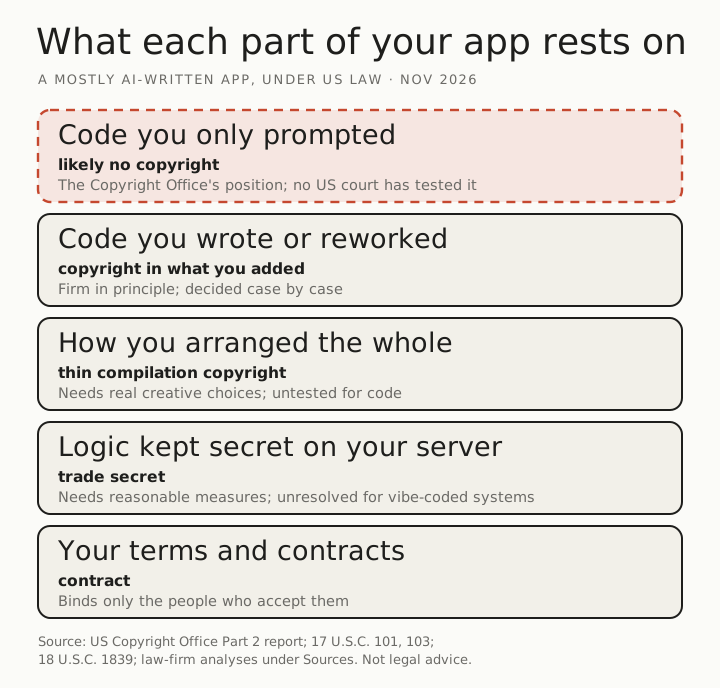
Copyright in your parts. Registering is realistic if you wrote or reworked real code and disclaim the rest. The Office’s guidance says AI-generated content that is more than de minimis should be excluded, and applicants who leave the record uncorrected risk losing the benefits of the registration. Our own search of the public catalog found 62 records with the phrase “source code generated by artificial intelligence,” 53 of them computer files, including ones from Adobe and Elastic. That is our own keyword count, those companies have human code to claim, and it does not show a purely prompted app would register. Circular 61 allows redacted deposits for code holding trade secrets.
Trade secret. The federal definition covers programs and codes with economic value that the owner keeps secret by reasonable measures, and we found no authorship test in it. It also says reverse engineering is not improper, and on our reading anything you ship to the browser is out in the open. Brownstein calls enforcement in vibe-coded systems likely possible and largely unresolved.
Your tool’s settings matter here. A federal court in California said a plaintiff who developed ideas in ChatGPT had “voluntarily disclosed the existence of her ideas to OpenAI,” though the plaintiff was self-represented, the ideas were not code and the order binds nobody else. Whether a no-training plan avoids that is open. Training is on by default on personal plans at OpenAI, GitHub, Lovable, Bolt, Replit Pro, paid Cognition and Kiro, and on v0’s Hobby plan. Most of those offer an opt-out, while Cognition’s free tier and Replit’s Core plan show none in what we read. Anthropic’s consumer plans train when the setting is on. Bolt can also license de-identified datasets to third parties unless you opt out.
Contract. Your terms of service bind people who accept them, so they help against customers and do little against a stranger who rebuilds your app from its screens.
Patent. AI cannot be an inventor, and the USPTO’s 2025 guidance treats AI as a tool and asks whether a human conceived the invention. Describing a goal to an agent is unlikely to meet that test.
Taken together, the law protects a mostly prompted codebase thinly. For most small apps the stronger defense sits outside the code, in distribution, brand and customers.
Outside the US
We found no ruling on AI-written code in any of these. The EU case concerns furniture, and the German and Chinese cases concern logos and images.
- UK: section 9(3) still protects computer-generated works, and the government’s March 2026 report proposes removing it. There is no bill yet.
- EU: in a furniture case, Mio/konektra, the Court of Justice set an originality test that German courts now apply to AI output, and Crowell reads it as saying originality is not presumed. Parliament’s non-binding March 2026 resolution says content fully generated by AI that fails the established criteria should stay ineligible.
- Germany: a Munich court refused protection to logos, including one from a 1,700-character prompt.
- China: courts have split, and the Beijing Internet Court asks for evidence of the creative process.
- Japan: the Agency for Cultural Affairs says autonomously generated material is not a work, and other cases turn on their facts.
What to do
- Start a provenance record today. Keep commits under your name, separate hand-written commits from agent ones where you can, save prompts or session logs for the parts that matter, and note which tool and plan you used. Buyers ask for this, a registration leans on it, and Amazon’s indemnity requires you to keep records.
- Put your hands on the core. Write or substantially rework the logic that makes the app worth having, make the structural decisions yourself and write them down. This is the only route to copyright, and it will not cover everything.
- Treat the rest as a secret. Use a private repo, keep valuable logic on the server, and turn off training or move to a plan that does not train on your code.
- Check which contract your login sits under. If a claim would hurt, move the work to a plan with cover, such as an API key or paid Kiro, and leave on the filters it requires. If you ship from v0, make sure you are off Hobby.
- Scan what you ship. Start with dependencies. Semgrep’s free edition includes Supply Chain, which its license checks run on, so confirm your plan shows them. GitHub’s dependency review covers public repos, and private ones only on an organization plan with Code Security. FOSSA’s free tier inventories dependencies, and its pricing page lists automated license scanning under the paid plan. ScanCode finds license text in files, and scanoss-py offers snippet matching against a free public knowledge base. We have not tested these for this piece, and restructured copies will likely get past them.
- Paper your people. Get a written assignment from anyone who touches the code, ask them to disclose AI use, and require real human work on what you need to own. If you freelance, promise to assign what rights exist and stop promising exclusive ownership of AI output.
- Register if you have real human code. Claim what you wrote, disclaim the AI-generated rest, and read the guidance first. The Office said it planned more disclaimer guidance in 2026, and we found none yet.
- Write the memo before you sell or raise. One page: tools, plans, how much was AI-assisted, what was reviewed by whom, and a scan report. A few hours of a lawyer’s time is well spent at this point, and “we don’t really know” is the answer to avoid.
- Watch Allen v. Perlmutter. A ruling could move the prompting line in either direction, and it is the first thing that would change this piece.
One email, when there's something worth sending
Get the research in your inbox.
No fixed schedule, no filler. You get an email when we've tested something, run the numbers, or found a tool worth your time.
Free. Double opt-in, unsubscribe in one click.
Got numbers of your own? Get the research →
Sources & how we researched this
- US Copyright Office, Copyright and Artificial Intelligence, Part 2: Copyrightability (January 29, 2025), read 2026-11-06: prompts, iterative prompting, selection, arrangement, modification and assistive use. The report has no software section. copyright.gov/ai
- US Copyright Office, registration guidance for works containing AI-generated material, 88 Fed. Reg. 16190 (March 2023), read 2026-11-06: excluding AI-generated content that is more than de minimis, and the risk of losing the benefits of a registration. copyright.gov/ai/ai_policy_guidance.pdf
- Register of Copyrights, testimony to the Senate Judiciary IP Subcommittee (May 12, 2026), read 2026-11-06: more than 7,000 registered claims with AI-generated material disclaimed; further disclaimer guidance planned later in 2026. copyright.gov/laws/hearings
- US Copyright Office, Compendium chapter 700 sec. 721.7 and Circular 61, read 2026-11-06: what a computer program registration excludes, and redacted deposits for code containing trade secrets. copyright.gov/comp3, copyright.gov/circs/circ61.pdf
- Copyright Review Board, refusal for Geriatric SQL (October 30, 2026), read 2026-11-06: 28 SQL queries refused for lack of creative authorship. Not an AI case. copyright.gov/rulings-filings/review-board
- US Copyright Office public catalog, our own keyword searches, read 2026-11-06: 62 records with the phrase "source code generated by artificial intelligence," 53 of them computer files, including Adobe Product Analytics 2024 (TX0009443009) and Elastic kibana ES9.2.0 (TX0009602489). Not an Office statistic. publicrecords.copyright.gov
- Thaler v. Perlmutter, D.C. Cir. No. 23-5233 (March 18, 2025), and Supreme Court docket 25-449 (certiorari denied March 2, 2026), read 2026-11-06. media.cadc.uscourts.gov, supremecourt.gov
- Allen v. Perlmutter, D. Colo. No. 1:24-cv-02665: docket as updated November 6, 2026, and the government brief, Doc. 58-1 (February 6, 2026), citing S.O.S. v. Payday, read 2026-11-06. courtlistener.com/docket/69198079, copyright.gov/ai/docs
- Doe v. GitHub, 9th Cir. No. 24-7700 (September 16, 2026), the district court order of June 24, 2024, and the N.D. Cal. docket, read 2026-11-06. cdn.ca9.uscourts.gov, courtlistener.com
- 17 U.S.C. 102 and 18 U.S.C. 1839, read 2026-11-06: what copyright excludes, the federal definition of a trade secret, and reverse engineering. law.cornell.edu
- Trinidad v. OpenAI, N.D. Cal. No. 4:25-cv-06328, order of January 5, 2026, read 2026-11-06. A self-represented plaintiff and ideas developed in ChatGPT, with no code at issue. cases.justia.com
- Thaler v. Vidal, Fed. Cir. (August 5, 2022), and USPTO inventorship guidance, 90 Fed. Reg. 54636 (November 28, 2025), read 2026-11-06. cafc.uscourts.gov, govinfo.gov
- Anthropic consumer terms (effective October 8, 2025), commercial terms (June 17, 2025), and Claude Code legal and data usage docs, read 2026-11-06. anthropic.com/legal, code.claude.com/docs
- OpenAI Terms of Use (effective January 1, 2026), Services Agreement (effective January 1, 2026) and Service Terms (October 16, 2026), read 2026-11-06. openai.com/policies
- GitHub Terms of Service (April 27, 2026), Terms for Additional Products (August 27, 2026), Copilot plans page and Copilot Trust Center FAQ, read 2026-11-06. docs.github.com, github.com/features/copilot/plans, copilot.github.trust.page/faq
- Cursor Terms of Service (September 3, 2026) and Master Services Agreement (October 12, 2026), read 2026-11-06. cursor.com
- Google Antigravity Additional Terms, Google Terms of Service (effective July 30, 2026), Google Cloud Service Specific Terms (October 30, 2026) and indemnified services list, read 2026-11-06. antigravity.google/terms, policies.google.com/terms, cloud.google.com/terms
- Cognition Platform Terms of Service (June 30, 2026), read 2026-11-06. cognition.com/legal
- Replit Terms of Service (August 3, 2026), Pro Agreement (undated) and Enterprise Agreement (September 9, 2026), read 2026-11-06. replit.com
- Lovable Terms (August 2026) and Privacy Policy (September 15, 2026), read 2026-11-06. lovable.dev
- StackBlitz Terms of Service for Bolt (effective October 7, 2026), read 2026-11-06. stackblitz.com/terms-of-service
- Vercel AI Product Terms (March 31, 2026) and Terms of Service (October 19, 2026) for v0, read 2026-11-06. vercel.com/legal
- AWS Service Terms section 50 (November 5, 2026), Kiro FAQ and Kiro model docs, read 2026-11-06. aws.amazon.com/service-terms, kiro.dev
- Xu et al., LiCoEval, ICSE 2025, read 2026-11-06: 14 models, 4,187 functions, 0.88% to 2.01% for the three strongest coders, 0% to 2.17% across all 14. arxiv.org/abs/2408.02487
- Colombo et al., ICPC 2025, read 2026-11-06: GPT-4-turbo, copyleft Java methods, more than 70,000 implementations, with rates rising given class context. arxiv.org/abs/2502.05023
- Cheng et al., AIware 2026, abstract only, read 2026-11-06: four open-weight models, 13 to 14 percent unintentional memorization in realistic code completion. doi.org/10.1145/3805760.3814902
- Functional memorization preprint, read 2026-11-06: four open models, 0.3 to 3.4 percent of filtered functions reproduced in restructured form, over 90 percent of those missed by text similarity. arxiv.org/abs/2606.12764
- Black Duck, 2026 Open Source Security and Risk Analysis and launch blog post, read 2026-11-06: 947 audited commercial codebases including 197 M&A deals, license conflicts in 68 percent, up from 56. Black Duck sells audits. assets.blackduck.com/image/upload/rep-ossra.pdf, blackduck.com/blog
- GitHub, Amazon Q, Gemini Code Assist and Devin documentation on code referencing, citations and attribution filtering, and our search of the Claude Code, Codex and Cursor docs, read 2026-11-06. docs.github.com, docs.aws.amazon.com, cloud.google.com, docs.devin.ai
- Chardet issue 327, the release list, and Dan Blanchard's account of the rewrite (March 2026), read 2026-11-06. github.com/chardet/chardet/issues/327, dan-blanchard.github.io
- Jacobsen v. Katzer, 535 F.3d 1373 (Fed. Cir. 2008); GNU GPLv3 and the GNU GPL FAQ; Entr'Ouvert v. Orange, Paris Court of Appeal (February 14, 2024), and Heather Meeker's note on it, read 2026-11-06. gnu.org/licenses, interoperable-europe.ec.europa.eu, heathermeeker.com
- GitHub dependency review, FOSSA pricing, Semgrep pricing and license docs, ScanCode docs and the scanoss-py readme, read 2026-11-06. We did not run these tools for this piece. docs.github.com, fossa.com/pricing, semgrep.dev, scancode-toolkit.readthedocs.io, github.com/scanoss/scanoss.py
- Buchalter, AI issues for transactional practice (March 18, 2026); Bochner PLLC, AI due diligence in M&A (October 14, 2026), read 2026-11-06. buchalter.com, bochner.law
- Acquire.com, SaaS due diligence red flags (updated August 2026); saas.group, what an acquirer will ask (August 10, 2026); FE International, sell-side due diligence checklist, read 2026-11-06. These firms sell deal services or buy companies. blog.acquire.com, saas.group, feinternational.com
- Wix FY2025 Form 20-F and press release on acquiring Base44 (June 18, 2025); Lenny's Newsletter interview with Maor Shlomo (July 6, 2025); Calcalist on Base44, read 2026-11-06. sec.gov, wix.com, lennysnewsletter.com, calcalistech.com
- NVCA Model Stock Purchase Agreement (file dated October 28, 2025), read 2026-11-06: optional generative AI representation. nvca.org/model-legal-documents
- Pillsbury, AI exclusions in insurance policies (April 13, 2026); Insurance Business on ISO's exclusion; Fenwick on AI exclusions (June 15, 2026); Reinsurance News on Beazley (September 17, 2026), read 2026-11-06. policyholderpulse.com, insurancebusinessmag.com, fenwick.com, reinsurancene.ws
- Venable, development contract considerations for AI (July 14, 2025); KJK, Who owns AI-generated work (August 21, 2026); Clark Meyers, Who owns AI-generated work product (October 16, 2026), read 2026-11-06. venable.com, kjk.com, clarkmeyers.com
- Baker McKenzie, Vibe coding legal pitfalls (April 16, 2026); Heuking, Vibe coding legal issues (October 12, 2026); Brownstein, trade secrets in vibe-coded systems (June 8, 2026), read 2026-11-06. connectontech.bakermckenzie.com, heuking.de, bhfs.com
- UK government report on copyright and AI (March 18, 2026) and CDPA s.9(3); European Parliament resolution of March 10, 2026; Crowell on Mio/konektra (C-580/23); Bird & Bird on the Munich, Frankfurt and Dusseldorf rulings; Morgan Lewis on GEMA v. OpenAI (Munich Regional Court, November 11, 2025; appeal pending); Quinn Emanuel and National Law Review on China; Japan Agency for Cultural Affairs general understanding (March 2024), read 2026-11-06. gov.uk, legislation.gov.uk, crowell.com, twobirds.com, morganlewis.com, quinnemanuel.com, natlawreview.com, bunka.go.jp