The Study · Comparison
The AI coding agent field guide (2026)
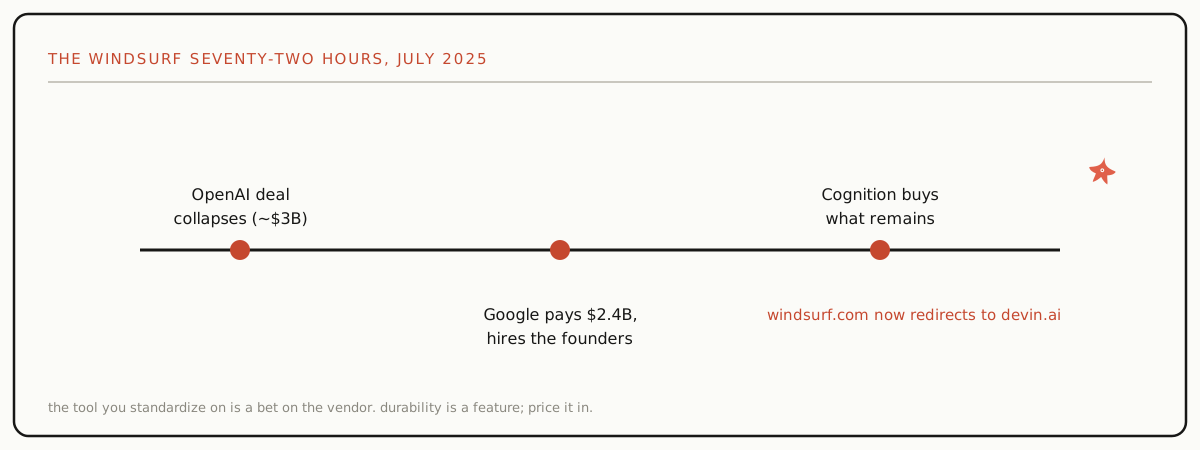
In July 2025, one of the most popular AI coding editors was taken apart in about seventy-two hours. OpenAI’s roughly $3 billion deal to buy Windsurf collapsed, Google paid $2.4 billion to license its technology and hire its founders, and Cognition bought what remained. Type windsurf.com into a browser today and you land on devin.ai. Everyone who had standardized on the tool now owns a different one.
The rest of the field is healthier, and this guide maps it: the seven agents worth knowing in 2026, what each one is for, and, labelled throughout, which claims we tested ourselves and which we only read.
The short version
The 2026 field splits into two camps, and a solo builder should choose between them on shape before looking at any leaderboard.
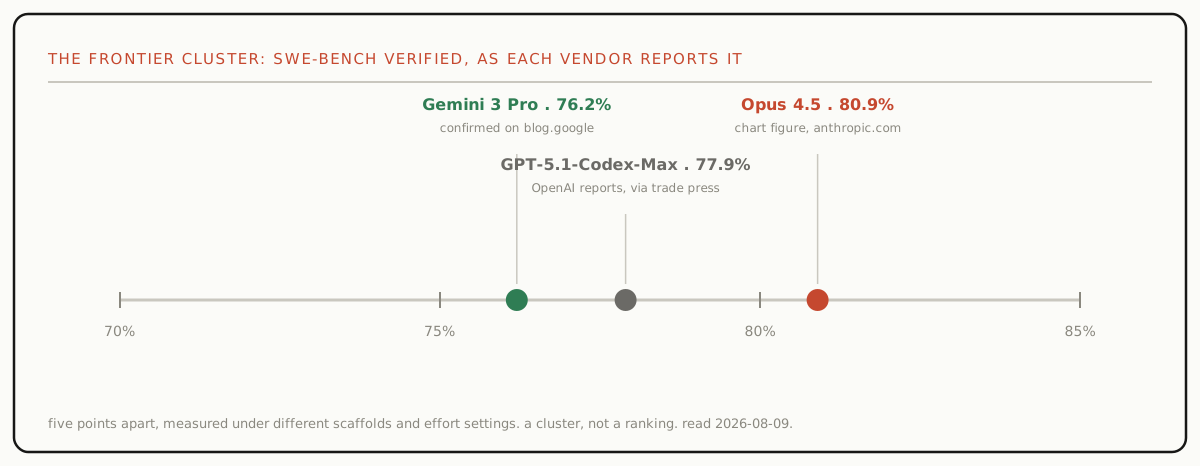
Model-owned agents come from the three frontier labs and run that lab’s own model: Claude Code (Anthropic), Codex (OpenAI), and Antigravity (Google). Their reported SWE-bench Verified numbers now cluster together in the high seventies to low eighties, close enough that the number is not the deciding factor.
Model-agnostic tools route to whichever model you point them at, and increasingly ship a house model tuned for speed: Cursor, Zed, and OpenCode, plus the Windsurf editor, which was dismembered in 2025 and is now Cognition’s Devin Desktop.
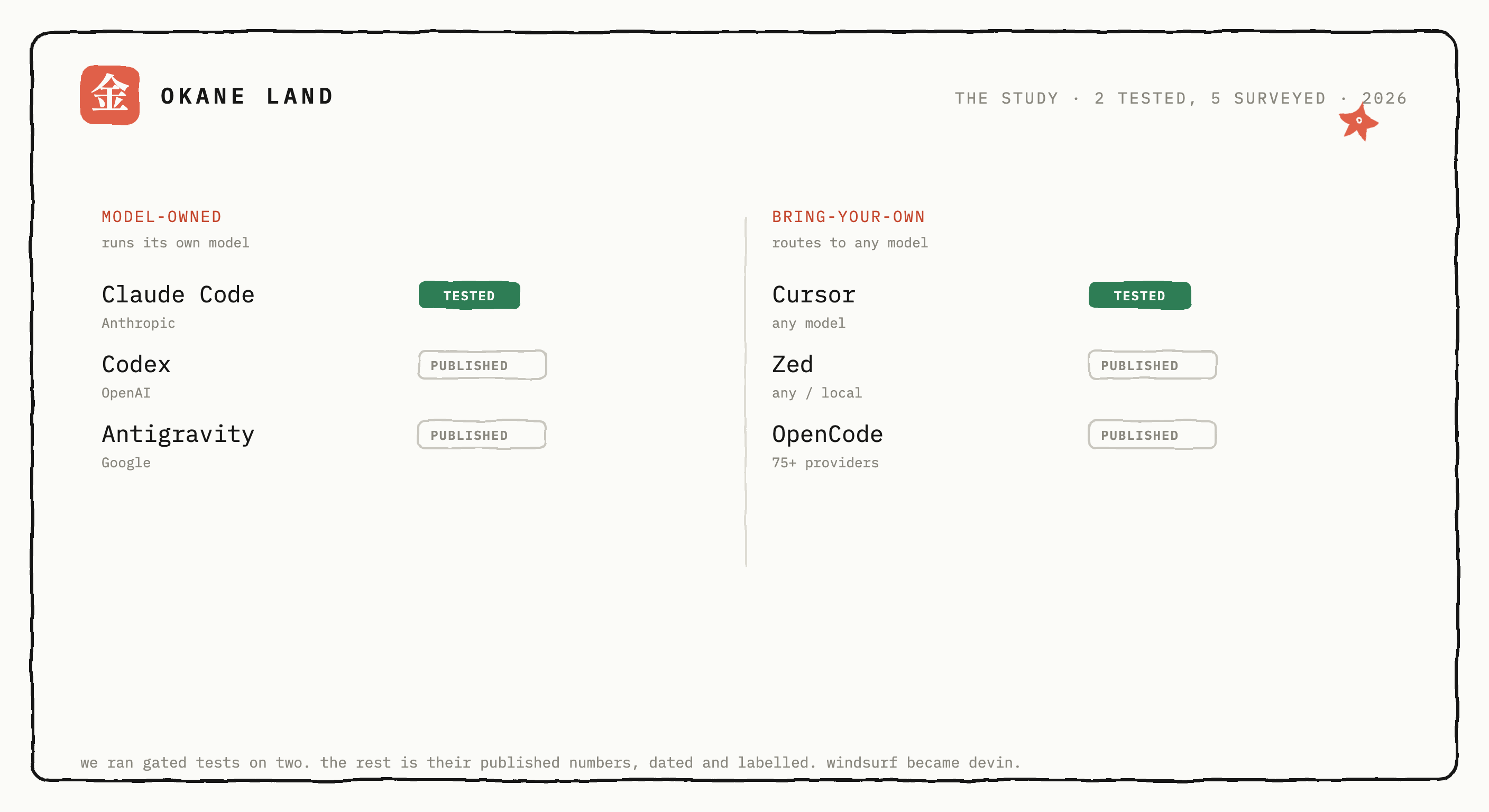
One thing to hold onto as you read: we have hands-on tested exactly three of these: Cursor and Claude Code across two builds and 24 frozen gates, where they tied, and Codex on the free ChatGPT tier on the first of those builds, where it passed all twelve. For the other four we have opened pricing pages and vendor posts and run nothing, and we label every tool below so you can see the seam.
| Agent | Camp | Surface | Entry price | Our evidence |
|---|---|---|---|---|
| Claude Code | Model-owned (Anthropic) | terminal, IDE, web | $20/mo | Tested |
| Cursor | Bring-your-own | IDE | $20/mo | Tested |
| Codex | Model-owned (OpenAI) | in ChatGPT, CLI, IDE | $0 (Free), Astra from $20 | Tested (12/12 at $0) |
| Antigravity | Model-owned (Google) | agent-manager IDE | free preview | Published evidence only |
| Zed | Bring-your-own | editor | free / $10 | Published evidence only |
| OpenCode | Bring-your-own | terminal, IDE | free | Published evidence only |
| Devin Desktop (ex-Windsurf) | Bring-your-own | IDE | $20/mo | Published evidence only |
How to read a coding-agent benchmark without getting played
SWE-bench Verified is the number every lab quotes. It is 500 real GitHub issues from open-source projects, where the agent has to produce a patch that passes the project’s own tests. It is a genuinely useful signal, and it is not apples to apples across vendors.
Three reasons the same-looking numbers are not directly comparable: labs run at different reasoning effort, they wrap the model in different agent scaffolding, and they sometimes report on subsets rather than the full 500. So our rule for this piece is simple. We quote the vendor’s own number, we date it, and we did not re-run any of them. Where a number lives on a chart image rather than in a page’s text, or where the vendor’s page would not load and we had to rely on trade coverage, we say that too.
Read the numbers as a cluster, not a ranking. When three flagship models land within a few points of each other, the benchmark has told you they are all capable, and the choice moves to everything else.
The model-owned agents: Claude Code, Codex, Antigravity
Claude Code (Anthropic). Runs Claude, works from the terminal, an IDE, Slack, and the web. Anthropic’s Opus 4.5 announcement from November 24, 2025 calls it state-of-the-art on real-world software engineering, and the widely cited ~80.9% SWE-bench Verified figure sits on that page’s chart. Plans run $20 for Pro and $100 or $200 for Max. It is the one we know best: in our head-to-head it exited cleanly, reported its token use exactly, and built with no dependencies, and its meter is legible. If you live in a terminal and want auditable cost, this is the default.
Codex (OpenAI). Runs GPT-5.1-Codex-family models, and lives inside ChatGPT (Plus, Pro, Business) plus a CLI and IDE extension. OpenAI reports 77.9% on SWE-bench Verified at extra-high reasoning for GPT-5.1-Codex-Max, up from 73.7% for the prior Codex model, as relayed by trade coverage; OpenAI’s own announcement page returned an access error when we tried to read it, so treat that figure as reported rather than confirmed. Codex billing moved to token-based in April 2026. We have since run the free tier through our booking-app fixture: twelve of twelve gates on GPT-5.6 Terra, 37 percent of a single 30-day meter for one build, and no Astra on that plan. It is the natural pick if your work already lives in ChatGPT.
Antigravity (Google). Google’s agentic development platform, an IDE built around an agent manager, running Gemini 3 Pro. Google’s own launch post puts Gemini 3 Pro at 76.2% on SWE-bench Verified, the one frontier number here we confirmed directly from the primary. It is free for individual developers during preview, which makes it the cheapest way to try a frontier lab’s agent right now, with the usual caveat that preview pricing is not a promise.
The model-agnostic tools: Cursor, Zed, OpenCode
Cursor. The IDE most people mean when they say AI coding. Hobby is free, Pro is $20, and a $200 Ultra tier is reported by aggregators though it was not shown on the pricing page we read. Cursor’s own model, Composer, is benchmarked on Cursor’s internal bench and sold on speed, roughly four times faster than similar models, rather than on SWE-bench. In our testing Cursor was the fastest to a running build and kept everything inside the $20 plan, with the caveat that its usage ledger logs the model as “auto”, so you cannot audit which model did the work. If you already live in an IDE and value speed, this is the pick.
Zed. An open-source editor, fast and lightweight, whose agentic editing runs Claude, Codex, or OpenCode through the open ACP protocol, or a local model via Ollama. Personal is free with a capped number of edit predictions, Pro is $10 a month, Business is $30 a seat. It fits a builder who wants an open-source spine and the freedom to route to any model, including a local one.
OpenCode. A free, open-source agent for the terminal, IDE, or desktop, supporting more than 75 providers including local models. It is the most portable option and the one with no vendor lock-in at all, in exchange for you assembling more of the setup yourself.
The Windsurf footnote: durability is a feature
One product on this list is a cautionary tale worth a paragraph, because it teaches a lesson a solo builder should price in.
In July 2025 the Windsurf editor was taken apart in about seventy-two hours. OpenAI’s roughly $3B deal to buy it collapsed, Google paid $2.4B to license its technology and hire its founders into DeepMind, and Cognition bought what remained. You can reproduce the receipt in one click: windsurf.com now redirects to devin.ai, and Devin Desktop states it “is the new name for Windsurf,” running a house model called SWE-1.6 Fast. The tool still works and has a real free tier. The lesson is that the tool you standardize on is a bet on the vendor still being there and pointed the same direction next year, and that is worth weighing alongside today’s feature list.
Pricing at a glance
| Agent | Free tier | Entry paid | Ceiling |
|---|---|---|---|
| Claude Code | limited (Free plan) | $20 Pro | $200 Max |
| Cursor | Hobby free | $20 Pro | $200 Ultra (reported) |
| Codex | in ChatGPT Free/Go | in Plus | in Pro |
| Antigravity | free preview | n/a | n/a |
| Zed | Personal free | $10 Pro | $30 Business |
| OpenCode | free | n/a | n/a |
| Devin Desktop | Free | $20 Pro | $200 Max |
Watch one thing across all of them: the “usage allowance” plans (Cursor, Codex, Devin) refresh on windows and can meter you past the sticker price, which is exactly the dynamic our Claude Code limits study and cost study map in detail. The entry price is the floor, not the number you will actually pay in a heavy month.
How to choose, and what we cannot tell you
A short flow, given the benchmark cluster means capability is not the tiebreaker:
- Terminal-first and you want exact accounting: Claude Code.
- Already in an IDE and you want speed: Cursor.
- You want open source, or a local model, or no lock-in: Zed or OpenCode.
- You are all-in on one lab’s model already: that lab’s own agent (Codex for OpenAI, Antigravity for Gemini), and Antigravity is currently free to try.
The limit we owe you: we ran real, gated tests on only two of these seven, Cursor and Claude Code, and everything we say about the other five rests on their published pages and numbers, dated and labeled above. The benchmark cluster is real, the pricing is current as of early August 2026, and the durability lesson from Windsurf is the one most people skip. When we put the three-way test into the field, Codex is first in line, and the community is already telling us what to make it prove.
One email, when there's something worth sending
Get the research in your inbox.
No fixed schedule, no filler. You get an email when we've tested something, run the numbers, or found a tool worth your time.
Free. Double opt-in, unsubscribe in one click.
Which agent did you standardize on? Get the research →
Sources & how we researched this
- Okane Land, "Cursor vs Claude Code" head-to-head: the only two agents here we have hands-on tested, across two builds and 24 frozen gates. okaneland.com/proof/cursor-vs-claude-code/
- Google, Gemini 3 launch post (Nov 18, 2025): Gemini 3 Pro scores 76.2% on SWE-bench Verified; it is the model powering Google Antigravity. blog.google
- Anthropic, Claude Opus 4.5 announcement (Nov 24, 2025): called state-of-the-art on real-world software engineering; the widely cited ~80.9% SWE-bench Verified figure appears on the page's chart rather than in its text. anthropic.com/news/claude-opus-4-5
- OpenAI, GPT-5.1-Codex-Max: OpenAI reports 77.9% on SWE-bench Verified at extra-high reasoning (n=500), up from GPT-5.1-Codex's 73.7%, as relayed by trade coverage; OpenAI's own page returned an access error at read time. Codex is included in ChatGPT Plus, Pro, and Business.
- Cursor pricing (read 2026-08-09): Hobby free, Pro $20/mo, Teams $40/user; a $200 Ultra tier is reported by aggregators but was not shown on the pricing page we read. Cursor's house model Composer is benchmarked on Cursor's own bench and positioned on speed, about four times faster than similar models, not on SWE-bench. cursor.com/pricing and cursor.com/blog/composer
- Zed (read 2026-08-09): open-source editor; Personal free, Pro $10/mo, Business $30/seat; routes to Claude, Codex, or OpenCode via the open ACP protocol, or a local model via Ollama. zed.dev/pricing and zed.dev/agentic
- OpenCode (read 2026-08-09): free, open source, terminal/IDE/desktop, 75+ providers via Models.dev including local models. opencode.ai
- Devin Desktop, "the new name for Windsurf" (devin.ai/desktop), and CNBC (Jul 14, 2025): Google paid $2.4B to license Windsurf tech and hire its founders to DeepMind, and Cognition bought the rest; windsurf.com now redirects to devin.ai. Devin pricing: Free, Pro $20/mo, Max $200/mo. devin.ai/pricing