The Primer · Tools & Stacks
How to use v0: generate the UI, get real code
Vendor-neutral
v0 is Vercel's AI builder: describe a UI or an app, and it writes real React and Next.js code you can preview, own, and deploy. Two things trip people up before they start, and both are here. It moved from v0.dev to v0.app, and it bills in credits metered on tokens, with a free tier capped at seven messages a day. This is the whole thing, first prompt to shipped, and what the credits actually buy.
v0 is Vercel’s AI builder, and its trick is a narrow one done well: you describe a screen or an app, and it writes real React and Next.js code you can preview live, edit, own, and deploy. It is the tool that made prompt-to-UI mainstream, and it stayed close to the stack a lot of the web already runs on. Before you start, two facts save you confusion. It lives at v0.app now, not the v0.dev you may have bookmarked, and it bills in credits metered on tokens, with a free tier that stops at seven messages a day.
Here is the whole shape. Sign in at v0.app, type what you want, and v0 generates a working, previewed component or app that you refine by prompting. When it is ready you export the code, sync it to GitHub, or deploy it to Vercel in one click. The meter is credits, and the skill is describing tightly so each message spends less. Everything below is the how.
What v0 is, and the v0.dev move
v0 is described in its own docs as an AI agent that creates real code and full-stack apps, made by Vercel and deployed on Vercel’s infrastructure. The one piece of housekeeping: the product moved domains. The v0.dev address now redirects to v0.app (the old URL answers with a 307 to the new root and a 308 on doc pages), so old links and tutorials still land in the right place, but the current home is v0.app. If a guide you are following says v0.dev, it is the same tool.
What v0 builds: the output stack
v0 emits real code on the modern React stack, not throwaway mockups. Its docs say it works with Next.js, Tailwind, and shadcn/ui, and in practice you get React components, Next.js on the App Router, TypeScript, Tailwind CSS, and shadcn/ui primitives. There is no hard framework lock stated in the docs; Next.js App Router is the default full-stack target, it also generates standalone React components, and it references Python and SQL for Snowflake data apps. If your world is already Next.js and shadcn, v0 outputs the exact thing you would have hand-written, which is the reason it fits so cleanly into a Vercel workflow.
How to use v0: prompt, preview, iterate
The loop is a chat. You describe your idea, v0 generates the code with a real-time preview, and you keep prompting to ship features, refine the design, and update copy. Two things make the loop forgiving: the live preview shows the result as it builds, and v0 does automatic error fixing, running intelligent diagnostics and repairing its own mistakes rather than handing you a broken render. Start narrow (one screen, one component) and add on, because a tight first prompt both looks better and, as the pricing section explains, spends fewer credits.
Getting your code out: export, GitHub, deploy
v0 is not a walled garden, and this is the part worth knowing before you commit. You can export the code to work locally or edit it directly in v0. The GitHub integration is genuinely Git-native: connecting a chat creates a dedicated branch for it (something like v0/username-abc123), every message that changes code becomes a commit, and the Publish button opens a pull request from that working branch into its base so you review and merge like any other PR. And to ship, the Share button’s Publish tab takes the app live on Vercel with one click, on Vercel’s own scalable infrastructure. Export to own it, GitHub to review it, Vercel to ship it, and you can do all three from the same chat. The from-scratch primer makes the case that owning the repo is what gets you past the demo, and v0 hands it to you.
v0 pricing and credits
This is the most-searched thing about v0, and the part with the sharpest edges. v0 bills in credits, and since May 2025 those credits are metered on input and output tokens rather than a fixed message count, so a longer prompt and a larger generated file both cost more. Prices read from v0.app/pricing on 23 August 2026:
- Free: $0 a month, with $5 of included monthly credits and a hard 7 messages a day limit. Enough to try it, tight for real work.
- Plus: $30 per user a month, with $30 of included monthly credits plus $2 of free daily credits on login. This is the plan marked Popular.
- Business: $100 per user a month, with the same $30 of monthly credits as Plus plus the same $2 daily. The extra $70 buys privacy and security for teams, not more usage.
- Enterprise: custom. And a legacy Premium at $20 is being sunsetted, closed to new users.
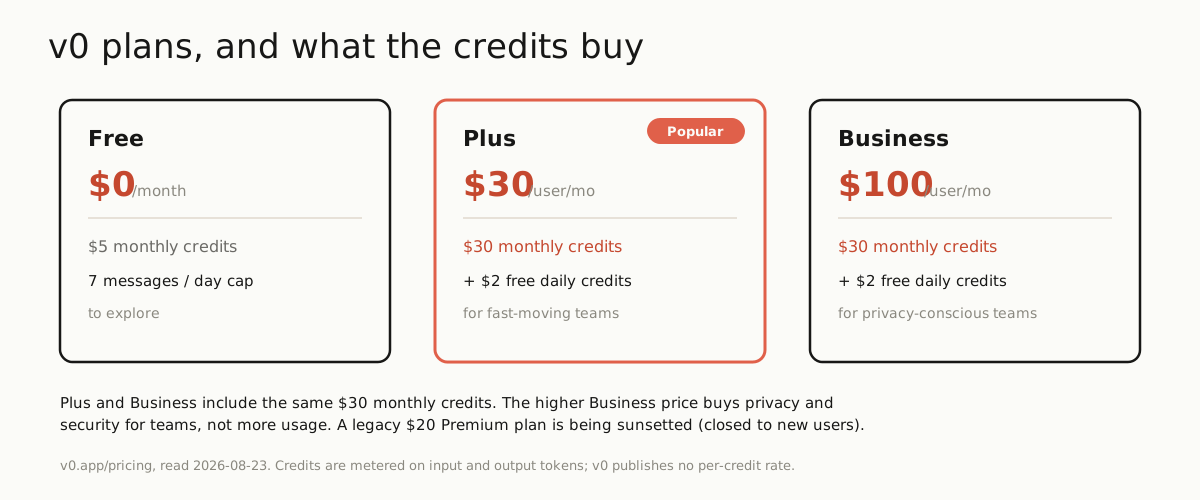
Read the Business row twice, because the price jump is the confusing part: it carries the same credit allowance as Plus, so paying more than three times as much buys a privacy and security posture for the team, not a bigger tank. On the meter itself, one caution: v0 publishes no token-to-credit or dollar-per-credit conversion on any of its pages, so anyone quoting “X credits per prompt” is estimating. Plan by the qualitative rule instead, shorter prompts and smaller scoped changes cost less, and watch the same usage-billing trap our cost study maps for model tokens: the danger is a meter with no ceiling, so scope every message.
Integrations and the v0 API
Around the core loop, v0 connects to the parts a real project needs. It can clone a page from a screenshot or a Figma file, which is the fastest way to turn an existing design into code. There is a Platform API for programmatic access to v0’s generation, chat, and deploy, so you can wire v0 into your own tools or a CI pipeline. And under the hood v0 runs on Vercel’s composite v0 models, which pair a language model’s reasoning with retrieval and a dedicated error-fixing step; the current generation, v0-1.5-md at 128K context and v0-1.5-lg at 512K, is what does the heavy lifting when you prompt.
v0 vs Bolt vs Lovable
The three-way everyone searches, and the answer is about stack and meter, so here it is as plain fact. All three turn a prompt into real code you can sync to GitHub; they differ in what they build on and what they charge by.
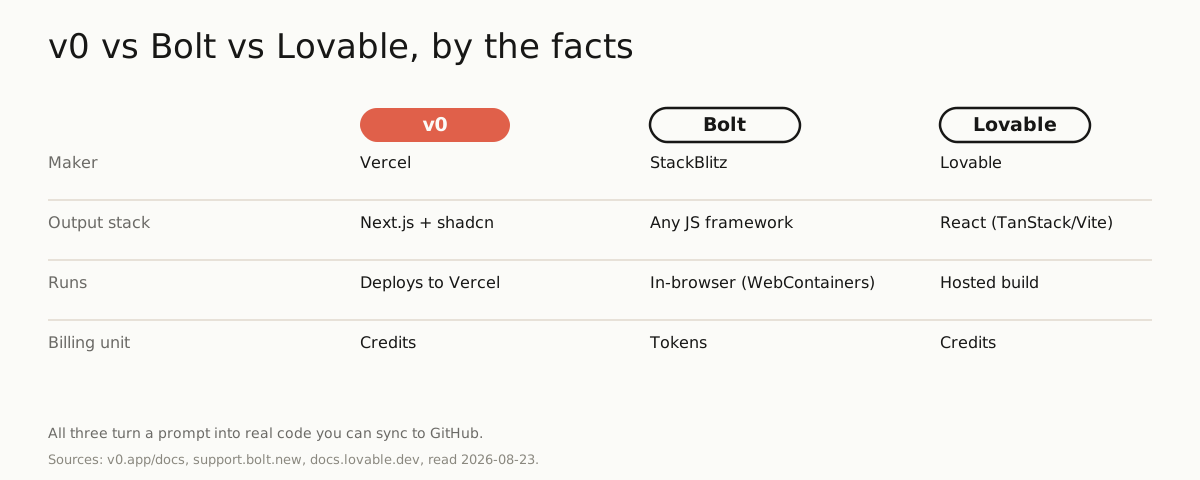
v0 is the Vercel-native choice: it writes Next.js App Router, React, Tailwind, and shadcn/ui, deploys to Vercel, and bills in credits. Bolt is by StackBlitz and runs a whole development environment in your browser through WebContainers, builds across JavaScript frameworks plus Expo for mobile, and bills in tokens. Lovable builds a React app (new projects on TanStack Start with server-side rendering, older ones on React and Vite) with an optional Supabase backend, and bills in credits. A useful pattern falls out of that: two of the three meter in credits and one in tokens, and v0 is the one that assumes you are living in the Next.js and shadcn world already. Pick v0 if that is your stack, start on the free seven-a-day to learn the meter, and read the cost study before you scale, because a credit-billed builder rewards knowing what each prompt spends.
One email, when there's something worth sending
Get the research in your inbox.
No fixed schedule, no filler. You get an email when we've tested something, run the numbers, or found a tool worth your time.
Free. Double opt-in, unsubscribe in one click.
What did v0 cost you to build? Get the research →
Sources
| Source | Link |
|---|---|
| v0 introduction and docs (v0.app/docs and /docs/introduction, read 2026-08-23): v0 is an AI agent by Vercel that creates real code and full-stack apps, working with Next.js, Tailwind, and shadcn/ui, with a real-time preview and automatic error fixing. The domain moved from v0.dev to v0.app: v0.dev/ returns a 307 redirect to v0.app/ and v0.dev/docs/introduction a 308 to v0.app. | v0.app ↗ |
| v0 code ownership: export, GitHub, deploy (v0.app/docs/faqs and /docs/github, read 2026-08-23): you can export the code to work locally or edit in v0; the GitHub integration creates a dedicated per-chat branch (for example v0/username-abc123), commits on every code-changing message, and the Publish button opens a pull request from the working branch to its base; Share then Publish takes the app live on Vercel. | v0.app ↗ |
| v0 pricing (v0.app/pricing and /docs/pricing, read 2026-08-23): Free is $0/month with $5 of included monthly credits and a 7 message/day limit; Plus is $30/user/month with $30 of included monthly credits plus $2 of free daily credits on login; Business is $100/user/month with the same $30 of included monthly credits plus $2 daily, for privacy conscious teams; Enterprise is custom; a legacy Premium plan at $20/month is being sunsetted and is no longer available to new users. | v0.app ↗ |
| v0 billing unit and credit rollover (vercel.com/blog/updated-v0-pricing dated 2025-05-13 and v0.app/docs/pricing, read 2026-08-23): usage is metered on input and output tokens which convert to credits, so longer prompts and larger outputs cost more; no token-to-credit or dollar-per-credit rate is published on any primary page. Unused monthly credits roll over and expire after 65 days; purchased credits require an active paid plan and expire one year after purchase. | vercel.com ↗ |
| v0 integrations, Platform API, and composite models (v0.app/docs/introduction, /docs/api/platform, vercel.com/changelog/models-api-v0-1.5-beta dated 2025-06-09, vercel.com/blog/v0-composite-model-family dated 2025-06-01, read 2026-08-23): v0 can clone pages from screenshots or Figma files; the Platform API gives programmatic access to code generation, chat, and deploy; and v0-1.5-md (128K context) and v0-1.5-lg (512K) entered beta, powered by a composite model that combines retrieval, LLM reasoning, and a streaming error-fixing step. | v0.app ↗ |
| Comparison primaries, all read 2026-08-23: Bolt (support.bolt.new/get-started/intro-bolt) is by StackBlitz, runs on WebContainers (Node.js in the browser, no local setup), builds full-stack JavaScript-framework apps plus Expo for mobile, and prices on tokens; Lovable (docs.lovable.dev/introduction/faq) is priced by credits not seats, and new apps from May 13 2026 use TanStack Start with SSR while older apps use React and Vite, with Tailwind and an optional Supabase backend. | support.bolt.new ↗ |