The Signal · Issue 2
The vibe coding split is a pricing event
The short version
- The vocabulary split, and the searches followed. The queries breaking out this month are “the new SDLC with vibe coding,” “harness engineering,” and “from vibe coding to agentic engineering.” People stopped asking what vibe coding is. They started asking what separates the casual version from the professional one.
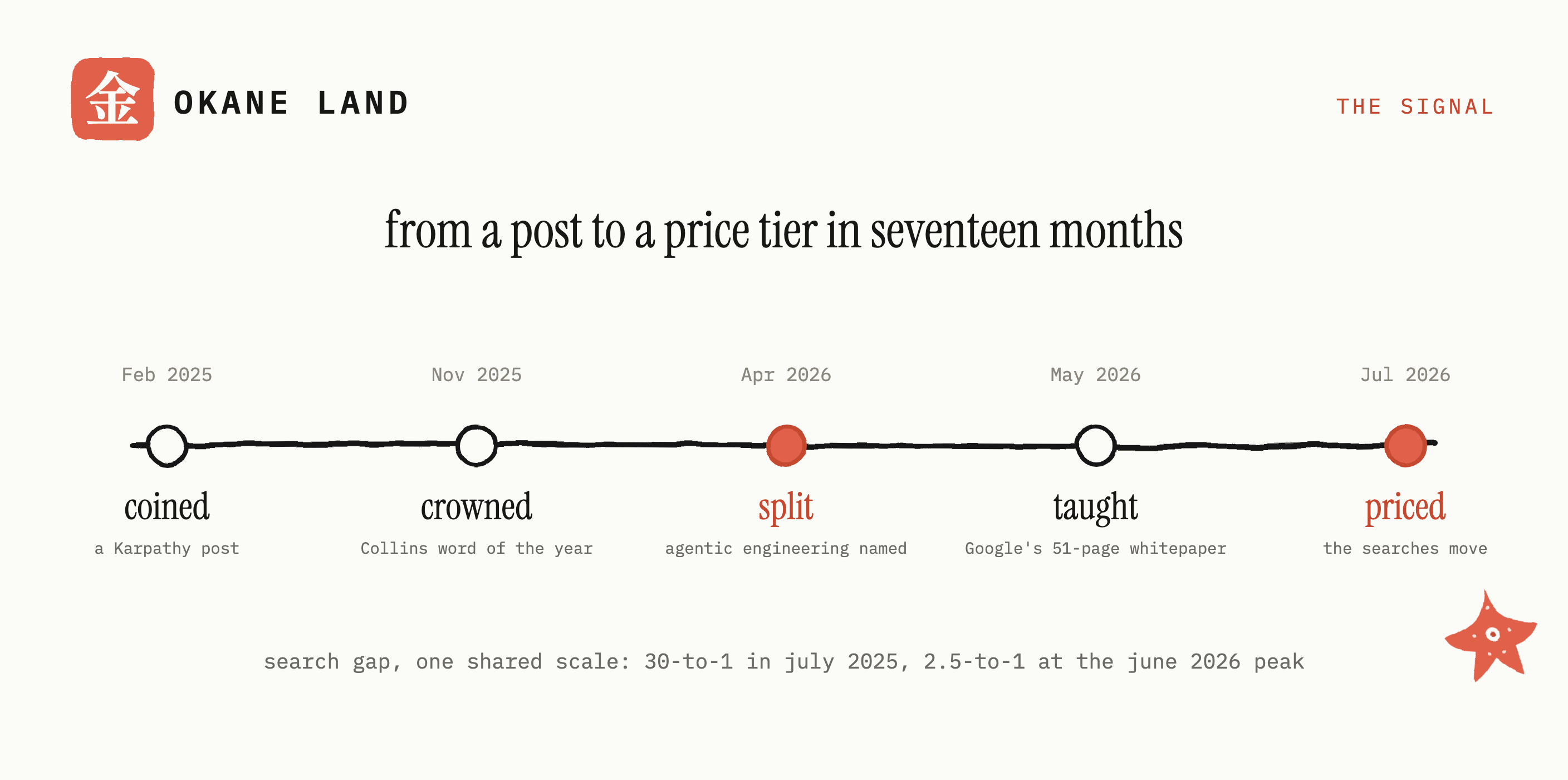
- The timeline is seventeen months long. Karpathy coined the word in February 2025, Collins crowned it in November, Karpathy himself named the disciplined end “agentic engineering” in April 2026, Google institutionalized the split with a 51-page whitepaper and a five-day course, and Addy Osmani’s July 15 condensation sent the long-tail searches moving.
- Our own data pull says split, and no obituary. One shared scale, US web search, twelve months: a 30-to-1 gap in July 2025, roughly 2.5-to-1 at the June 2026 peak, about 7-to-1 in the July lull, with “vibe coding” interest near half its March high.
- The builders’ rooms already run at two rates. In r/vibecoding this month, a stamp app vibecoded from scratch sold for $8,000 six weeks after its first commit. The same month in r/ExperiencedDevs, 1,490 upvotes relitigated where the hard part of software actually lives, and the FT asked who cleans up after the party.
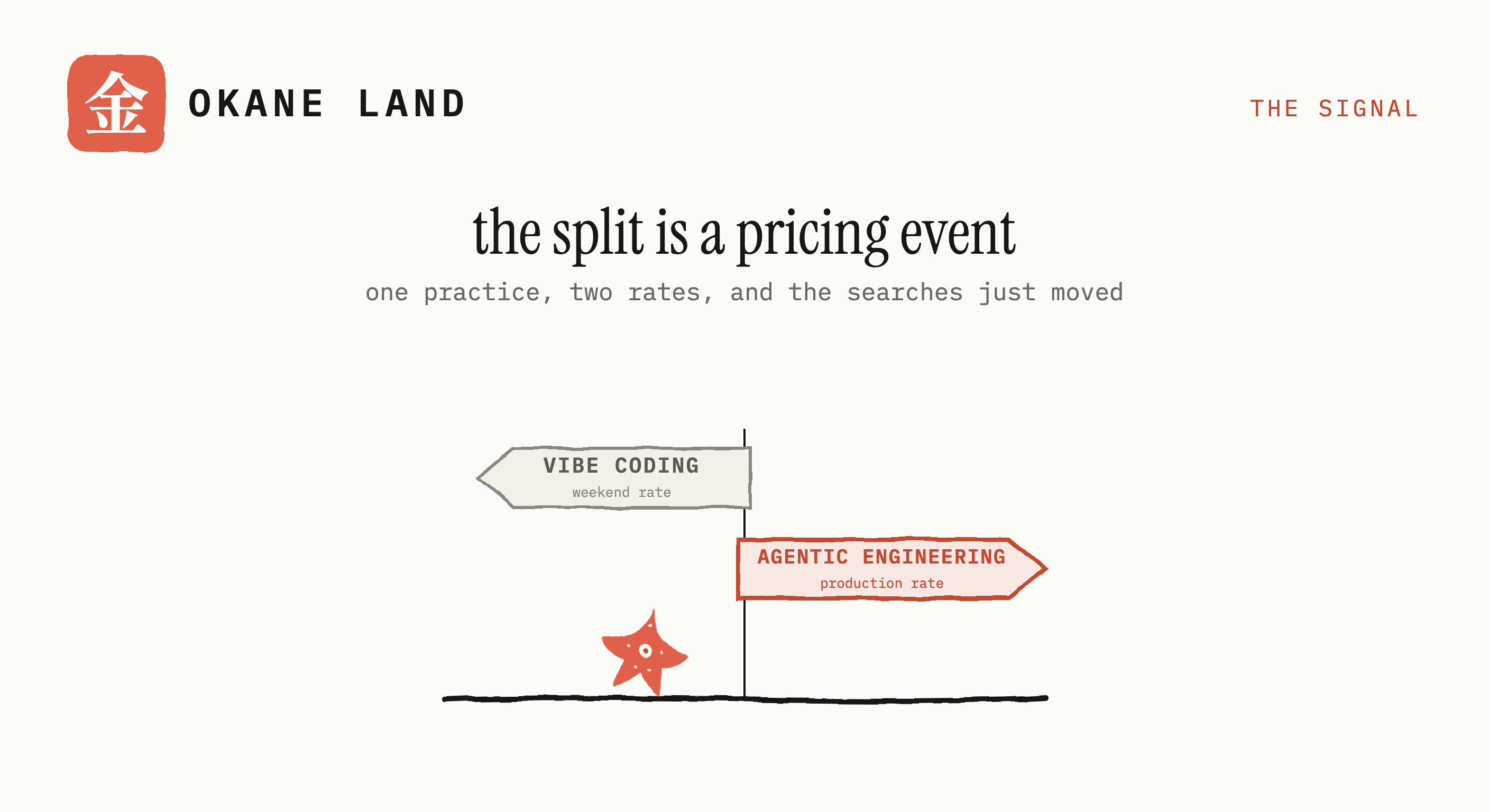
- The argument: this is a pricing event. A market invents vocabulary when it needs to price a difference it can finally see. Two words end one price: vibe coding becomes the weekend rate, agentic engineering the production rate, and verification is the dividing line. Put the vocabulary on your quote before your clients learn it elsewhere.
Everything below is the receipts, the search data, and what the builders’ rooms sound like this month.
The receipts, in order
Andrej Karpathy coined vibe coding in a February 2025 post. Collins made it Word of the Year that November, the surest sign a technical term had escaped into the culture. By April 2026, at Sequoia’s AI Ascent, Karpathy himself drew the line the term had been missing, introducing “agentic engineering” for the disciplined end and framing vibe coding as the mode that raises the floor of who gets to make software. The ceiling got its own word. Google then did the institutional part, a 51-page whitepaper dated May 2026 and a free five-day course in June whose previous run reached 1.5 million learners, both teaching the two modes as one spectrum with verification as the dividing line. Addy Osmani, the whitepaper’s lead author, condensed it for O’Reilly on July 15, and the searches have followed him into the long tail since.
What the search data shows
We pulled the two terms head to head from Google Trends ourselves, both on one shared scale, US web search, twelve months. In July 2025 the gap was 30 to 1. At the June 2026 peak it was roughly 2.5 to 1. “Vibe coding” search interest has fallen by about half from its March high, and in the current July lull the old term still leads about 7 to 1, so nobody should write the obituary. The full chart, with the flags on, is in the study linked below.
What the builders are saying this month
The split is not a pundit construction. Spend an evening in the rooms where builders actually talk and you can watch the two rates trading separately.
The floor is real, and it is glorious. The top post in r/vibecoding this month, 4,400 upvotes, is a builder who started learning to vibecode in March, shipped a stamp-cutting app, marketed it to virality, and sold it for $8,000 inside six weeks. That is the weekend rate working exactly as advertised: fast, cheap, and paid.
The identity fight has moved from whether to how. In the 1,700-upvote “You used AI? That’s not real programming” thread, the top reply reports that every professional programmer the commenter knows “uses AI, uses it extensively and uses it well,” and the next one draws the line this column is about: “a big difference in how we use it as opposed to true vibe coders.” The distinction the searches are groping for is already folk law in the replies.
The professionals are arguing about where the hard part lives, which is the pricing question wearing a different shirt. The month’s big r/ExperiencedDevs thread, 1,490 upvotes and 387 comments, pushes back on executives who wave away code as “never the hard part.” Its top reply, 930 upvotes, concedes the slogan only within the guild: “For us, programmers, code isn’t the hard part.” The hard part is everything around it, the specs, the context, the judgment. That is a room full of people discovering that the harness is the product.
And the money press noticed the bill. The FT’s July 11 piece asked “Who cleans up after the vibe-coding party?” and the HN thread on it went straight to unit economics, with one reply noting of the new $100-to-$200 tool bills that “those prices are still subsidized.” Two weeks later, under “How do we stop vibe coding?”, the top economic take conceded the direction entirely: “working bespoke on coding will simply not be profitable anymore.” Bespoke code is repricing toward zero. What is left to charge for is the discipline around it.
The argument: this is a pricing event
A market invents vocabulary when it needs to price a difference it can finally see. For seventeen months every AI-built deliverable lived under one word, which meant a weekend prototype and a production system read the same on an invoice, and buyers quietly discounted both. Two words end that. “Vibe coding” is becoming the weekend rate: fast, disposable, gloriously cheap, the mode that raises the floor, the mode that sells a stamp app in six weeks. “Agentic engineering” is the production rate: specs, tests, review, gates, the harness around the model, the everything-around-the-code that a room of experienced developers just spent 387 comments defending. Google’s whitepaper says the quiet part in ten words: “Generation is solved. Verification, judgment, and direction are the new craft.” Craft is the thing clients pay rates for.
What a solo builder does with this
Put the vocabulary on your quote before your clients learn it from someone else. Scope the prototype phase as vibe coding and price it for speed. Scope the production phase as the discipline, name the verification you are selling, and charge for the harness you bring, because the harness is yours and it compounds across projects. The searchers arriving this month are your future clients learning the difference between the two line items. Be the builder who taught it to them.
One email, when there's something worth sending
Get the research in your inbox.
No fixed schedule, no filler. You get an email when we've tested something, run the numbers, or found a tool worth your time.
Free. Double opt-in, unsubscribe in one click.
Got a signal we missed? Send it in
Sources & how we researched this
- Andrej Karpathy, the post that coined vibe coding (Feb 2, 2025)
- Collins Dictionary, Word of the Year 2025: vibe coding (Nov 6, 2025)
- Andrej Karpathy, Sequoia AI Ascent summary, introducing agentic engineering (Apr 30, 2026)
- Google, The New SDLC With Vibe Coding, the 51-page whitepaper (May 2026)
- Google, 5-Day AI Agents intensive course announcement (June 2026)
- Addy Osmani, The New Software Lifecycle (O'Reilly Radar, Jul 15, 2026)
- Google Trends compare pull: vibe coding vs agentic engineering, US web search, 12 months, one shared scale (pulled Jul 24, 2026; our own measurement)
- Financial Times, 'Who cleans up after the vibe-coding party?' (Jul 11, 2026), and the Hacker News discussion of it.
- r/ExperiencedDevs, 'Code was never the hard part' (Jul 15, 2026): 1,490 upvotes, 387 comments.
- r/vibecoding, 'How I vibecode a stamp cut app and got acquired 6 weeks later' (Jul 10, 2026): 4,400 upvotes.
- r/vibecoding, 'You used AI? That's not real programming' (Jul 20, 2026): 1,700 upvotes.
- Hacker News, 'How do we stop vibe coding?' (Jul 24, 2026): 61 points, 76 comments.
The Signal is Okane Land's weekly read on the AI news that changes a decision you make as a solo builder, verified to primary sources.