The Signal · Issue 7
Your users can pay your AI bill with ChatGPT. OpenAI keeps the meter.
The short version
- On September 29, spending your ChatGPT plan in other apps became an official program. At DevDay, OpenAI let Plus and Pro subscribers route AI requests in 15 partner apps to their plan, with Lovable to follow, and each user can set a weekly limit per app. Coding tools make up most of the list, from Devin and Warp to the open-source OpenCode.
- The pitch lands hardest on small AI products. Sam Altman told developers the change means “now you don’t have to cover their token costs to get them going.” If you read our study of why flat-priced AI wrappers lose money, that is the heavy user’s bill moving to the heavy user.
- Open source gets it now, and paid apps get a waitlist. OpenAI’s developer docs open plan usage to all open-source partners and to private clients OpenAI selects. A paid or remotely hosted app has to apply and wait for a place in a limited trial.
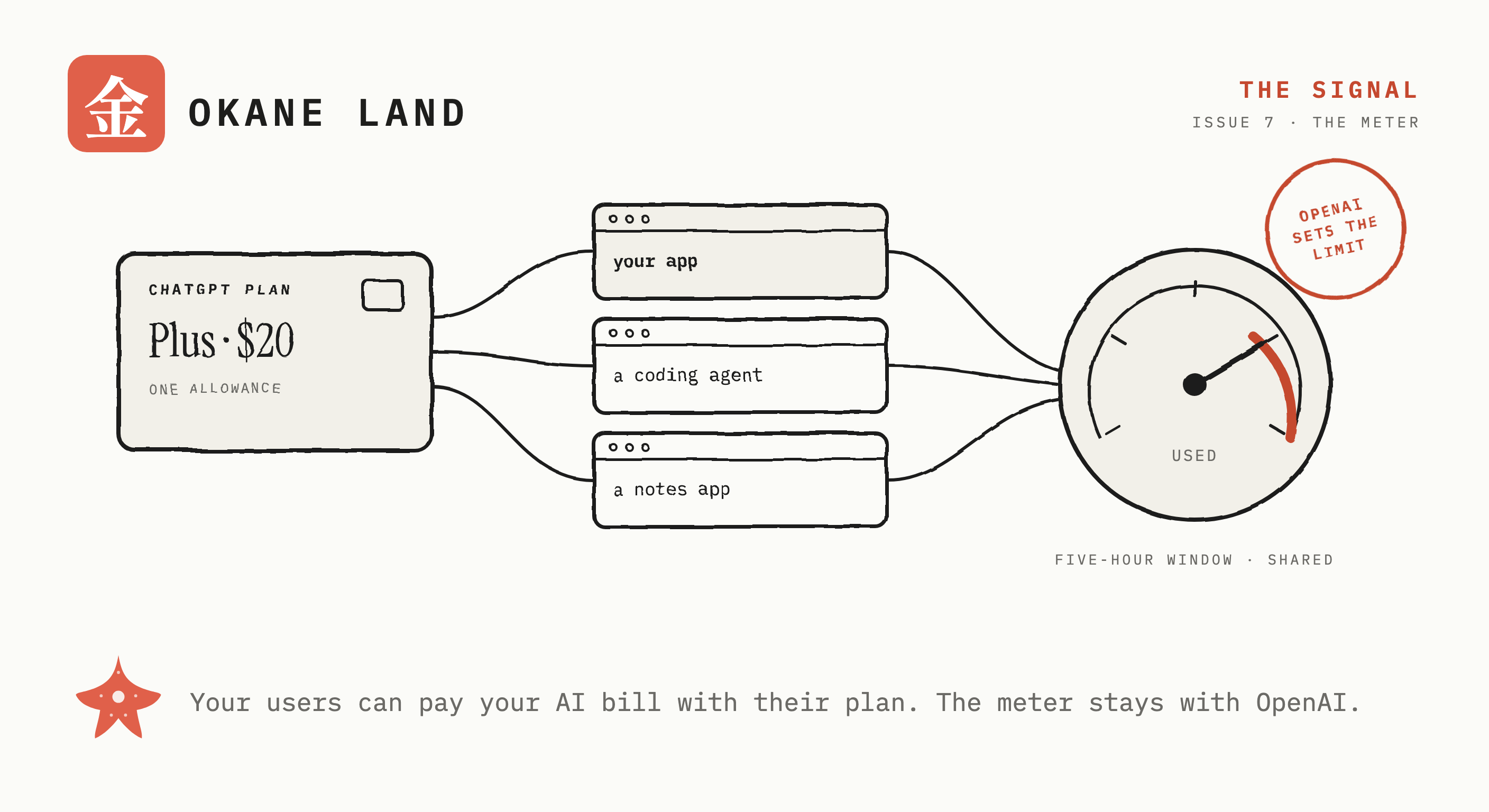
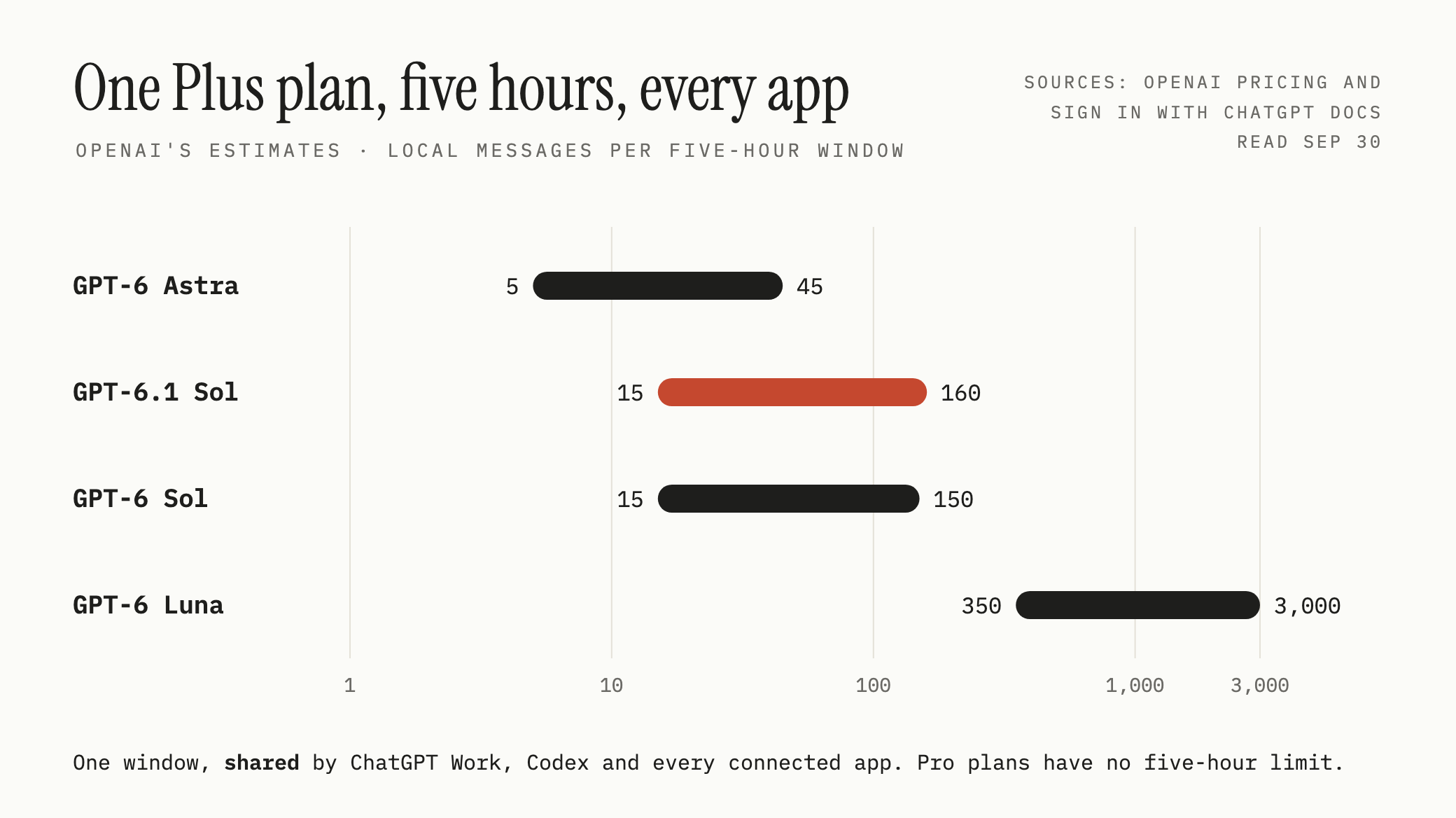
- It is one allowance, and everything draws on it. Connected apps spend the same ChatGPT Work and Codex usage the subscriber spends directly. On Plus, the five-hour limit covers all of them, and “no app receives a separate allowance.” OpenAI estimates that window at 15 to 160 local messages on GPT-6.1 Sol, with cloud tasks using more.
- The same day, OpenAI changed what a plan buys. Pro 200 now includes less usage for new sign-ups, and current subscribers switch after October 29. The Next Web reports Codex and Work usage falling from 20 to 10 times the Plus allowance, next to a new $500 tier.
- Agent storefronts opened the same month, built for discovery more than payment. Meta, Anthropic and OpenAI all widened their directories for outside developers. Anthropic’s and OpenAI’s new purchase paths serve enterprise budgets, OpenAI announced no app-store-style billing or revenue share, and Meta points developers to Stripe.
- The argument: letting users pay with their ChatGPT plan can take inference off a solo builder’s books, but it prices your product’s capacity in an allowance OpenAI sets and can shrink. Offer it as one way to pay, with your own checkout and API key still behind it.
What shipped on September 29
Sign in with ChatGPT is older than DevDay. OpenAI released it as a beta in July with partners including Airtable, GitLab, HubSpot, Notion, Supabase and Vercel, and at that point it was mostly a login button. What changed at DevDay is the second permission. When a Plus or Pro user signs in to a participating app, they can now choose to let that app’s AI requests count against the usage included in their ChatGPT plan.
The user sees a consent screen, then a line in ChatGPT’s settings for each connected app, where they can cap it at a percentage of their weekly usage. No API key changes hands. Signing in shares the user’s name, email address and profile picture, and using the plan does not by itself give the app their conversations or memories. If the plan runs out, the app can draw on the user’s ChatGPT credits only if the user has turned that on. And OpenAI’s help page is careful on one point: “The app may charge separately for its subscription, infrastructure, services, or premium features.”
The launch list says who this is for. OpenAI’s directory lists twelve apps for plan usage: eleven live at launch (Amp Code, Conductor, Dactyl, Devin, Hermes Agent, Hyperagent, Kilo Code, Notion, Vercel, Vorflux and Warp) and Lovable, marked coming soon. Most of them are coding tools. Four open-source clients round out the sixteen: OpenCode, OpenClaw, Pi and T3.
Some of this was already happening. Dactyl, a vibe-coding platform for native mobile apps, was showing the option in late August, and OpenClaw announced in May that users could power agent turns with a ChatGPT subscription through Codex login. DevDay folded those routes into one program the user manages from ChatGPT, and OpenAI told The New Stack it will add partners quickly.
Kilo’s launch post shows what it looks like from the inside. The plan works across its editor extensions, command line, cloud agents, code reviews and mobile app, and in Kilo’s words “the ‘key’ is the ChatGPT subscription you already pay for.”
Why this matters to a small AI product
The hardest line on a solo builder’s AI product is the one nobody controls: what the heaviest user costs. Price at $20 a month and the person running your agent around the clock can cost you more than they pay. Our wrapper study found the big AI products answering that with meters and caps.
Plan usage answers it differently. The heavy user’s requests come out of the heavy user’s own ChatGPT allowance, and when that runs out, OpenAI’s limit is the one they hit. Free trials get cheaper to offer, because a new user who brings a plan costs you almost nothing in inference. That is the part of Altman’s pitch that holds up.
It also makes your product’s capacity someone else’s number, and agentic work eats an allowance fast. When we ran OpenAI’s Codex on the Free plan for our Proof, one app build used 37 percent of that plan’s 30-day meter. Free has its own meter and cannot be shared with other apps, but the build shows the appetite. A Plus subscriber who connects your tool and two other coding agents, and also codes in Codex, is splitting a single five-hour window four ways.
What OpenAI still controls
Five things stay on OpenAI’s side of the table, and each one reaches into your product.
- Who gets in. Open-source clients can register themselves today from the developer docs, and closed-source clients are chosen by OpenAI. A paid or hosted app can fill in an interest form, which puts it on a waitlist, and the terms for commercial token sharing are not published.
- The meter. The user sets your app’s weekly share, from 10 to 100 percent in OpenAI’s example. On Plus, every connected app shares one five-hour window with the subscriber’s own Codex and ChatGPT Work sessions. Pro plans currently have no five-hour limit.
- The stop. When the user hits a limit, their plan’s or the weekly cap they set for your app, and has not allowed credits, the request fails with a usage-limit error. OpenAI does not silently switch it to another billing path, so unless you offer a paid option of your own, your product stops for that user until their limit resets.
- The feature list. During the preview, plan mode does not support image generation, file search, Code Interpreter, native computer use or hosted connectors. A feature built on any of them needs another billing path behind it, such as your own API key or the user’s.
- The front door. OpenAI’s docs ask for a Continue with ChatGPT button, placed with your other sign-in options at comparable visual prominence and in approved OpenAI branding. A website may also use an approved Sign in with ChatGPT format. The customer’s identity arrives from OpenAI.
The $200 plan got lighter the same day
While OpenAI was inviting developers to build on its plans, it changed what one of them buys. New Pro 200 subscriptions come with a lower allowance, set, OpenAI says, “to reflect our increasingly efficient models.” Existing subscribers keep the old allowance through October 29, and the price stays $200. The Next Web reports that from October 30 Pro 200’s Work and Codex usage falls from 20 to 10 times the Plus allowance. Tibo, who works on Codex and ChatGPT at OpenAI, previewed the change in dollars the night before: the new plan “will net out at half the dollar in API spend compared to the old Pro $200 plan.” He argued subscribers will still get more work done than on Pro 200 a month earlier, pointing to OpenAI halving the price of GPT-6 Sol and GPT-6 Luna that week. Existing subscribers also get a one-time $2,500 usage-credit grant that expires at year end, The Next Web reports. For the heaviest users, OpenAI added Pro 500, at 25 times Plus.
The change was announced for Pro 200 alone. It still shows who sets the exchange rate. OpenAI decides both what a plan includes and what the API charges, and a product that tells its users their ChatGPT plan covers the AI inherits whatever OpenAI decides a plan is worth.
The storefronts are open. Bring your own checkout.
September also opened three storefronts for agents. Meta opened its Muse agent to outside connectors; its platform page promises each one a review “for functional, security, and legal requirements” plus end-to-end testing, and editors choose which to feature. Alexandr Wang, Meta’s chief AI officer, said on stage at Connect that more than 1,500 applications arrived in under a week.
Anthropic launched the Claude Marketplace on September 23 with more than 2,000 connectors and plugins. Two days later it opened a plugin submission portal to developers on paid Claude plans. Submissions get a safety scan, and live plugins get analytics on installs and the searches that find them. At DevDay, OpenAI said ChatGPT will start suggesting apps in the middle of a conversation when one fits the task, and that developers will be able to track a plug-in’s review and request a human reviewer.
Payment is thinner. The buying routes Anthropic and OpenAI built serve enterprise budgets: teams can put part of their committed Anthropic spend toward listed products, and OpenAI’s new marketplace lets eligible enterprise customers apply part of their OpenAI commitment to software from its first 32 partners. TechCrunch noted that OpenAI announced no billing or revenue-sharing system comparable to an app store’s. Meta has gone furthest, with a Stripe partnership for accepting payments through Link, and Mark Zuckerberg said Muse is free for a huge number of tokens “with the expectation that over time we will profit by taking a small fee from transactions.”
So the storefronts supply reach, and Sign in with ChatGPT supplies inference. Collecting your own price is still your job.
What to do this week
- If you ship a free, open-source tool that runs on the user’s machine, add plan usage now. The developer docs cover registration, and removing the API-key step is a real gain for new users. Keep bring-your-own-key as a second path.
- If you run a paid or hosted app, join the waitlist and keep your billing. Plan usage is one way users can choose to pay. Keep your own checkout working for everyone else.
- Build for the stop. Catch the usage-limit error and tell the user they have hit a ChatGPT usage limit, either their plan’s or the cap they set for your app. Make a Manage usage link to their ChatGPT settings the main action, and offer your own paid route second.
- Say what you cannot promise. If your AI runs on the user’s plan, your speed and volume depend on their plan and their other apps. Put that in your onboarding in plain words.
- If you are the buyer, set caps. Connect your plan to the coding tools that support it, cap each one’s weekly share, and check which of them still charge their own subscription on top.
One email, when there's something worth sending
Get the research in your inbox.
No fixed schedule, no filler. You get an email when we've tested something, run the numbers, or found a tool worth your time.
Free. Double opt-in, unsubscribe in one click.
Got a signal we missed? Send it in
Sources & how we researched this
- OpenAI, "DevDay 2026 Recap" (Sep 29, 2026). Primary. Sign in with ChatGPT plan usage across 16 partners with per-app controls, plugin extensions, the OpenAI Marketplace for enterprise commitments with its first 32 partners, and the Pro 500 plan at 25 times the Plus allowance.
- OpenAI Help Center, "Using your ChatGPT plan in other apps and sites" (read Sep 30, 2026). Primary for how plan usage works for the user: requests counted against ChatGPT Work and Codex usage, per-app weekly limits, credits only after an explicit opt-in, no API key, the basic account info an app receives, that apps may charge separately, and the interest form for commercial partners.
- OpenAI developer docs, Sign in with ChatGPT Quickstart (read Sep 30, 2026). Primary for plan usage being open to all open-source partners and selected private clients, commercial sign-in through a limited trial, open-source self-registration, and the Continue with ChatGPT label, placement and branding.
- OpenAI developer docs, ChatGPT plan usage overview (read Sep 30, 2026). Primary for docs that cover open-source and locally hosted apps, and the interest form for paid or remotely hosted ones.
- OpenAI developer docs, Accounts and sessions (read Sep 30, 2026). Primary for the Plus five-hour limit shared across every app using the plan, with no separate allowance, the 10 to 100 percent weekly limit in OpenAI's example, and no five-hour limit on Pro.
- OpenAI developer docs, Errors and recovery (read Sep 30, 2026). Primary for plan-usage errors stopping inference with no silent switch to another billing path, and the warning not to read a usage-limit error as an empty plan.
- OpenAI developer docs, Preview limitations (read Sep 30, 2026). Primary for the tools unavailable in plan mode during the preview, including image generation, file search, Code Interpreter, native computer use and hosted connectors.
- OpenAI developer docs, UI/UX guidelines (read Sep 30, 2026). Primary for making Manage usage the main action at a usage limit, with an app's own credits offered second.
- OpenAI developer docs, On your website (read Sep 30, 2026). Primary for the four approved button formats: Continue with ChatGPT or Sign in with ChatGPT, on black or white.
- ChatGPT docs, Sign in with ChatGPT partner directory (read Sep 30, 2026). Primary for the 12 apps listed for plan usage (11 live, Lovable coming soon), the 4 open-source integrations, and the 5 apps that offer sign-in only.
- ChatGPT docs, Work and Codex pricing (read Sep 30, 2026). Primary for ChatGPT Work and Codex sharing usage, OpenAI's estimates of local messages per five-hour window on Plus (including 15 to 160 on GPT-6.1 Sol), cloud tasks using more, and Pro plans currently having no five-hour limit.
- OpenAI Help Center, "About ChatGPT Pro tiers" (read Sep 30, 2026). Primary for the lower allowance on new Pro 200 subscriptions, grandfathering through Oct 29, 2026, the unchanged $200 price, and Pro 500.
- The New Stack, "OpenAI makes Sign in with ChatGPT a way to use your subscription in third-party developer tools" (Sep 29, 2026). Secondary; carries Sam Altman's remarks on stage, OpenAI's statement that it will add partners, the July beta, which was mainly about identity, OpenClaw's May subscription login through Codex, and Dactyl's early integration.
- Kilo, "Introducing Sign in with ChatGPT in Kilo" (Sep 29, 2026). Primary from a launch partner: the plan works across Kilo's editor extensions, CLI, cloud agents, code reviews and mobile app in place of per-token API billing.
- The Next Web, "OpenAI halves Pro 200 usage and launches a $500 ChatGPT plan at DevDay" (Sep 29, 2026). Secondary; reports Pro 200's Work and Codex usage falling from 20 to 10 times the Plus allowance from Oct 30, and a one-time $2,500 usage-credit grant for existing subscribers that expires at year end.
- Tibo (@thsottiaux) on X (06:41 UTC, Sep 29, 2026, the night before DevDay in San Francisco). Primary for the Pro 200 usage recalculation netting out at half the old plan's value in API spend, his case that subscribers still get more done than a month earlier, and GPT-6 Sol and GPT-6 Luna at half their previous price.
- Meta, Muse connector platform page (read Sep 30, 2026). Primary for connector review against functional, security and legal requirements with end-to-end testing, editor-chosen featured placement, and payments through Stripe's Link.
- TechCrunch, "Everything new coming to Meta's AI agent Muse" (Sep 23, 2026). Secondary; carries Alexandr Wang's keynote figure of more than 1,500 connector applications in under a week and Mark Zuckerberg's remark on taking a small fee from transactions.
- Anthropic, "Claude Marketplace: one place to discover plugins, agents, and services from our partners" (Sep 23, 2026). Primary for the 2,000-plus connectors and plugins and for purchases made with a portion of a team's committed Anthropic spend.
- Anthropic, "Build plugins for Claude" (Sep 25, 2026). Primary for the directory submission portal, open to developers on paid Claude plans, with a safety scan on each submission and, once live, analytics on installs, listing views and searches.
- TechCrunch, "OpenAI's latest features take direct aim at the app store model" (Sep 29, 2026). Secondary; reports in-conversation app suggestions, the plug-in review changes, and that OpenAI announced no billing or revenue-sharing system comparable to an app store's.
- Okane Land, "Codex on the ChatGPT Free plan" (Sep 15, 2026). Our own measurement: one four-phase app build used 37 percent of the Free plan's 30-day meter.
The Signal is Okane Land's weekly read on the AI news that changes a decision you make as a solo builder, verified to primary sources.