The Signal · Issue 1
AI made code free. Accountability is the scarce part now.
The short version
- Godot closed the door on June 30, and said why. Autonomous AI agents that open pull requests now trigger an automatic ban, substantial AI-written code is refused, and any AI assistance must be disclosed. The stated reason is the sentence that matters: “AI cannot take responsibility.”
- The pattern is two years old and still growing. cURL paused its bug bounty under a wave of AI slop reports and reopened it in March. Ghostty put drive-by AI pull requests off-limits. A public tracker lists NetBSD, Gentoo, and Zig; Ladybird stopped taking public pull requests in June, and Flathub restricted AI submissions the same season.
- The same week, the payroll version. Amazon CTO Werner Vogels told Fortune the engineer’s value is moving to judgment: deciding whether the output ships, and owning it after. You cannot tell a regulator the model made the mistake.
- The rooms full of builders agreed on the diagnosis, loudly. The Hacker News thread ran to 403 comments and the r/godot announcement past 900 upvotes, and the most-upvoted replies in both rooms converged on the same two points: the demoralizing review work, and who is on the hook.
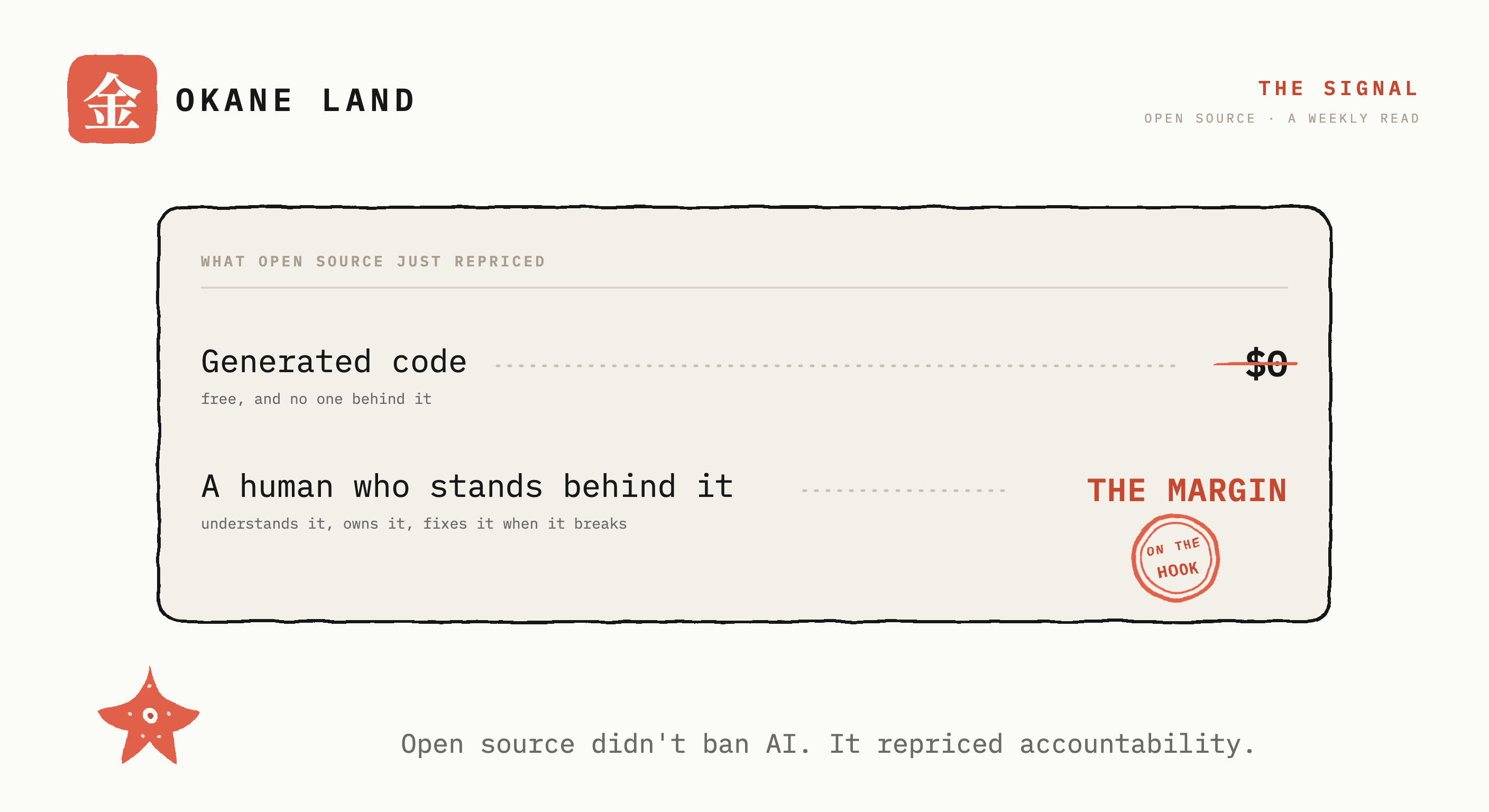
- The argument: this is a repricing. Open source never ran on code; it ran on a human attached to the code. AI severed that attachment, so the commons is marking generated code down to zero and marking up the person who stands behind it. That second line is where a solo builder earns.
Everything below is the record, with what the maintainers and their communities actually said.
What Godot actually changed
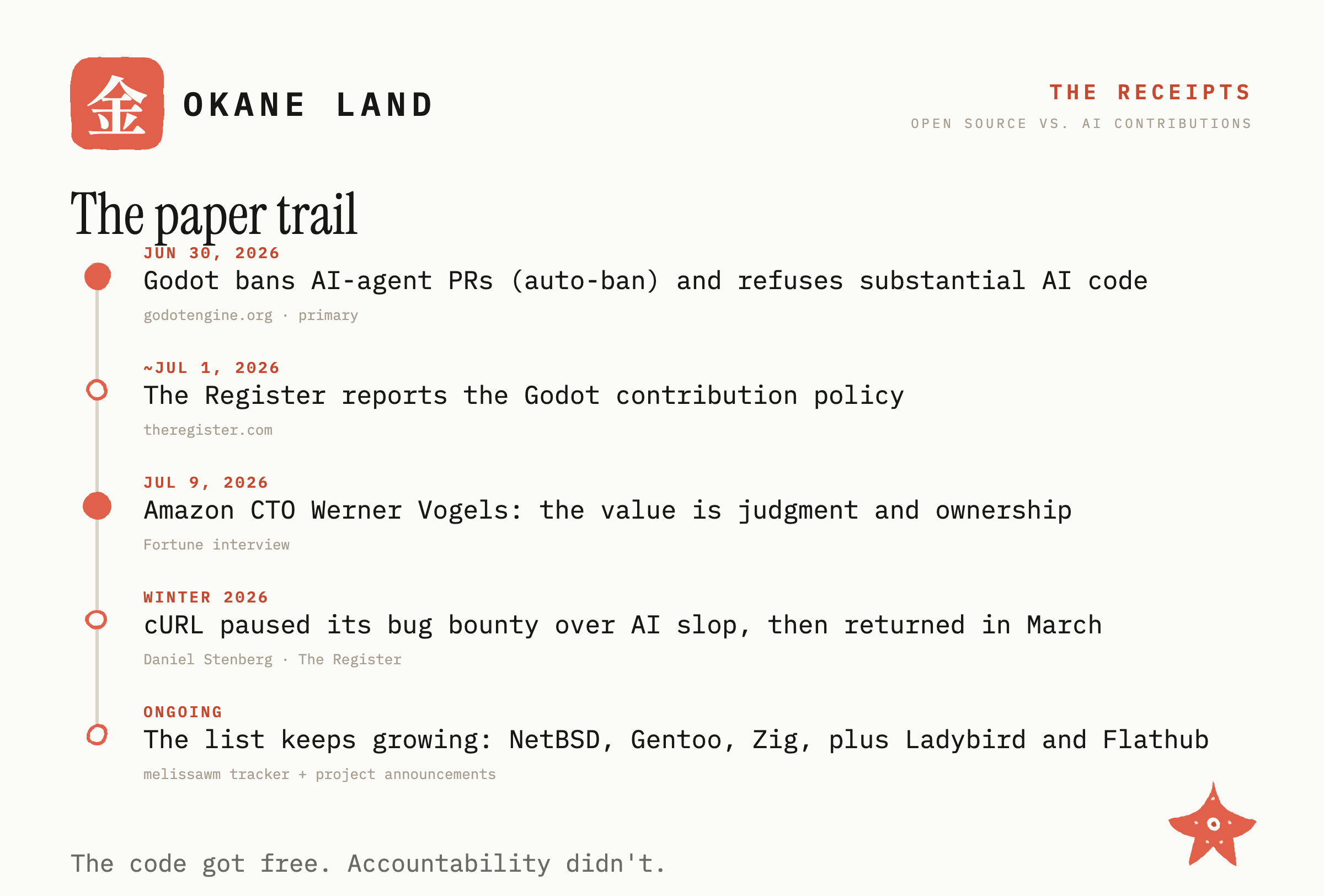
On June 30, the Godot game engine, one of the largest open-source projects on GitHub, published a contribution policy that reads like a door closing. Autonomous AI agents that open pull requests now trigger an automatic ban. Substantial AI-written code is refused, with the tool allowed only for menial help like completion, regex, and find-and-replace. If AI assisted, you disclose it. When you talk to a maintainer, a human writes the message.
The line that matters is the reason. Godot’s maintainers did not say the output was low quality. They said “AI cannot take responsibility,” and that they cannot trust heavy AI users to understand their own submissions well enough to fix them later. Read that twice, because the objection is not about the code. It points at who is on the hook.
The two-year paper trail
This is where the story stops being about Godot. Over the winter, cURL’s maintainer paused the project’s bug bounty after a wave of AI-generated vulnerability reports, most of them false, overwhelmed his reviewers, then reopened it in March once the volume eased. Earlier in the year, Mitchell Hashimoto put drive-by AI pull requests off-limits on Ghostty. A public tracker now lists open-source projects with AI-contribution rules, NetBSD, Gentoo, and Zig among them, and others have moved on their own: Ladybird stopped taking public pull requests this June, and Flathub restricted AI-generated submissions around the same time. Godot is not the start of something. It is the moment the pattern got big enough to argue about.
The same week, Amazon’s CTO Werner Vogels made a parallel case in a Fortune interview. As AI writes more of the code, he argued, the work that matters moves to judgment: deciding whether the output should ship, and owning it once it does. He framed ownership in regulatory terms, that you cannot tell a regulator the model made the mistake, because a person still has to answer for the result. Godot was ruling on volunteer patches and Vogels was talking about payroll, and both arrived at the same standard: someone has to be accountable for the code.
What the builders’ rooms said
The policy did huge numbers in both of the rooms where maintainers actually live, and the reaction is its own dataset.
On Hacker News, 561 points and 403 comments, the top of the thread was an argument about enforcement that kept resolving to authorship. Asked why the tool should matter more than the quality of past contributions, one reply put the whole policy in eleven words: “In the case of AI generated code, the tool is the author.” A maintainer’s-eye reply explained why review can’t price the risk anymore: with first-time contributors on AI tools, “maybe their PR is amazing, maybe it is trash.” You never know until a human has done the unpaid work of finding out. The most-quoted line in the thread called reviewing AI walls of text “a denial-of-service attack on the human mind.” And further down, quieter and sadder: one engineer mentioned building a tool just to get through AI-generated pull requests, “pretty sad that it’s got to this point.” A Godot contributor also confirmed in-thread that allowing AI for trusted contributors was discussed and turned down.
On r/godot, where the announcement passed 900 upvotes, the top comment, with more than 400 of its own, singled out one passage of the policy as the most important thing anyone has said about AI contributions: the part where Godot calls the review work demoralizing, because feedback on an AI patch never mentors a future maintainer, it just gets absorbed by a machine. The second-most-upvoted reply was blunter: “Godot continues to gain my respect at the same rate other engines lose it.”
Notice what is missing from both rooms: almost nobody defended the orphaned patch. The fight was over enforcement mechanics, never over the principle.
The repricing
Here is the argument. Open source never actually ran on code. Code was always the cheap part, freely copyable and freely forkable. What made a contribution worth a maintainer’s time was the human attached to it: someone who understood the change and would come back to fix it when it broke. That attachment is what review is for, and it is what a pull request was really carrying.
AI severed the human from the code. A model can now produce a patch that compiles and passes a first glance, with no one behind it who could tell you why line 40 is there. The code got free. The accountability went to zero. Maintainers are not banning AI because the output is bad. They are banning it because the output arrives orphaned, and reviewing orphaned code is unpaid work with nobody to hand the maintenance to.
So the bans are a repricing. The commons is marking free code down to what it is now worth, close to nothing, and marking up the scarce thing, a human who understands the change and will stand behind it.
What this means if you build alone
You are on both sides of this line, and the second side is the one that pays.
As a contributor, the free ride is ending. Shipping an AI patch you cannot explain into a project with a policy like Godot’s is now a fast way to get your account banned. If you want open-source standing, contribute where you understand the code well enough to defend it in review. That is a shorter list of pull requests and a far stronger one.
As a builder, this is the clearest signal yet about where your margin is. The market is doing to your work exactly what Godot did to contributions: pricing generated output at zero and paying for the human who can vouch for it. Nobody will pay you to run a prompt they could run themselves. They will pay you to be the one who caught what the model got wrong and signed off on the result. On everything you ship, keep the receipts that prove a human was in the loop, because that is the part with a price on it.
We made this case in The $5,000 tell, about vendors quietly selling human review as the premium layer over their own AI. This month a volunteer game engine, a trillion-dollar cloud, and two rooms full of working maintainers said it in the same breath. The code is free now. Being accountable for it is not.
One email, when there's something worth sending
Get the research in your inbox.
No fixed schedule, no filler. You get an email when we've tested something, run the numbers, or found a tool worth your time.
Free. Double opt-in, unsubscribe in one click.
Got a signal we missed? Send it in
Sources & how we researched this
- Godot contribution policy, June 30, 2026 (primary). Autonomous AI pull requests auto-banned, substantial AI code refused, disclosure required.
- PC Gamer on the policy, July 1, 2026: 'we can't trust heavy users of AI to understand their code enough to fix it.'
- Hacker News discussion of the Godot policy, July 1, 2026: 561 points, 403 comments. Comment permalinks are linked inline where quoted.
- r/godot, 'Changes to our Contribution Policies,' the announcement thread, June 30, 2026: 900+ upvotes, 121 comments.
- Werner Vogels on judgment and ownership as the engineer's value, Fortune, July 9, 2026.
- cURL paused its bug bounty over AI slop and returned in March: Daniel Stenberg and The Register (winter 2026, context).
- Ghostty on drive-by AI pull requests, Mitchell Hashimoto (early 2026, context).
- The tracker of open-source AI-contribution policies (NetBSD, Gentoo, Zig and more). Ladybird ended public PRs in June 2026; Flathub restricted AI-generated submissions separately.
The Signal is Okane Land's weekly read on the AI news that changes a decision you make as a solo builder, verified to primary sources.